The Secret To Loving The Business You Built, with Charlie Bassett
November 04, 2026

Hosted By
 Dan Sullivan
Does growing your business have to mean working longer hours? Charlie Bassett grew up watching his family work hard for slim grocery margins. In this episode, he shares how Strategic Coach® helped him rethink his role, build strong teams across four stores, and find more enjoyment in a business he once thought about leaving.
Here’s some of what you’ll learn in this episode:
- Why Charlie’s been hearing about grocery prices since kindergarten.
- How COVID brought both tough challenges and record success to Charlie’s business.
- What helped Charlie realize it was time to step back from day-to-day operations.
- Why Charlie credits Strategic Coach with keeping him in the grocery business.
Show Notes:
There are no bad industries; you can still build a great business in an industry where others are struggling.
In the Strategic Coach community, there are about 100 industries represented, and clients come from about 75 different countries.
Focusing on what makes your business different is more useful than watching every move your competitors make.
It’s easy to change when everyone’s changing. Everyone else is so busy with their own adjustments that they’re not paying attention to yours.
Working in your Unique Ability® lets you bring more of what you do best to your business.
The work you don’t enjoy may be exactly what someone else on your team loves doing.
Part of your job as a leader is to help your team stay confident when things get tough.
When you’re under pressure, stop and take a breath before your thinking runs straight to the worst-case scenario.
Making a little progress each day can help you get through even the toughest stretches.
It’s easier to think clearly when you’re not physically, mentally, and emotionally worn out.
Building a business that manages itself takes practice, but small changes can add up and start to build on one another.
Resources:
The Gap And The Gain by Dan Sullivan with Dr. Benjamin Hardy
What Free Days™ Are And How To Know When You Need Them
Your Life As A Strategy Circle by Dan Sullivan
What Is A Self-Managing Company®?
In our last episode, you'll discover how a different approach to creating value can open up possibilities you might not see when you focus only on what customers ask for. Tap here to listen to The Difference Between Most Entrepreneurs And Great Entrepreneurs
Episode Transcript
Dan Sullivan: Hi, this is Dan Sullivan. I'd like to welcome you to the Multiplier Mindset podcast. On today's episode, we have Charlie Bassett. I met Charlie probably nine years ago when he first joined Strategic Coach. Ohio people can really spot Ohio people. And probably if I think about where he grew up as a child, it's probably about maybe 30 miles from where I grew up. As a matter of fact, he was looking to purchase. He didn't do it, but he was looking to purchase a new store in the town where I grew up. And one of the things I want to say about that is there are no bad businesses and there are no bad industries. So in Strategic Coach, we have probably 100 different industries represented. If we take our worldwide, Strategic entrepreneurs come from probably 70 or 80 different countries. And the thing that we focus with everybody is don't pay too much attention to the competition in your industry, because you're going to do it differently right from the beginning. You're probably joining Strategic Coach because you're already different. And where that starts, long before we ever meet the entrepreneurs, is that they have a unique take on whatever business that they're in.
And Charlie's is retail, and he mentions Dan Katz, Noah Katz, and Dan Katz, longtime clients, but they're just the opposite. They're from New York City, they're from Brooklyn, they're from the Bronx. Really tough competition, and they're just geniuses in how they've gone about doing retail, and retail's retail. And I went to one of their stores in Brooklyn—it wasn't in a wealthy part of the city at all, but the store was spectacular. I mean, everything about the store was just spectacular and a lot of it anybody could do, but they just had this sense of presentation. They had this sense of how you organize things, what the traffic flow is, how you greet the customers, which customers should you greet more than others and everything. They just had a genius approach to what they do.
And I didn't know that Charlie, who was influenced by Daniel, is a genius, just a total genius. But the big thing about this is that he's not the person he was 10 years ago, and his business is not what it was 10 years ago. And I think COVID was really a good test. It's kind of funny; I didn't really want to say this out in the open, during the years of COVID, but actually a lot of our clients went through their greatest growth during COVID because it's easy to change when everything else is changing. Nobody's paying any attention to the changes you're making because they're so busy with their own adjustments to go through it. And some of those adjustments weren't good adjustments and some people just thrived. And Charlie seems to me to be one of the people who really, really thrived for it. We just profited enormously not having person-to-person, you know, because throughout our whole history, it was in-person workshops, and it just got taken away from us. So we had to go to virtual. Zoom had been around. We're a three-country business, so we've always used Zoom for back stage, but you could never do it front stage because there was no one at the other end.
But what I love about the story that Charlie tells is that you have to realize that the business is good if you're good. In other words, that the business is unique if you as the owner, you as the person that everybody looks to, is going into their areas of Unique Ability. So more and more you're arranging things so that the things that you don't do well, things that you don't like in the business, you don't do those anymore. You find other great people who love doing what you hate, who are great at what you're mediocre at. And I can just see, as he tells his story, that more and more every quarter when he comes to Coach, he's more and more just in the area. And then you begin enjoying the business enormously because you're enjoying every day what you're doing.
And that's the formula for Strategic Coach. We don't care what your business is, we don't make judgments that this is a good business to be in, this is a bad business. We have people who are growing great businesses in industries where everybody else is failing. And the reason is, I mean, with retail, people have to eat, they have to buy groceries, they have to have tools. He's got an equipment company. So my sense is it doesn't really matter what other people think is happening. If you're in your Unique Ability and you have Unique Ability Teamwork around you, and you're great at serving the wants and the needs of your customer base, it's going to be a great business. It doesn't matter what else is happening.
The big thing the leader has to do in a company is you have to keep everybody else's confidence up. And I can tell he may be, you know, by his own estimation, he's an introvert, but I bet he has a very, very powerful effect day to day in a very positive way to all the people that he works with. So we're so delighted and so grateful that Charlie shared his entrepreneurial experience and showed what his multiplier mindset is.
Charlie Bassett: Hi, my name is Charlie Bassett. I'm from Port Clinton, Ohio, and I'm in the grocery business. I've been in Coach for nine years now. I grew up in a little farming town called Oak Harbor, Ohio. That's where my great-grandparents landed. They were immigrants from Syria. My great-grandfather started out of a horse and buggy, going house to house, selling dry goods. And then they eventually settled on a one-room store that they lived above, and everybody worked below. By the time I was born, our family business had been around for 98 years, I believe. So I grew up in the grocery business, watched my father work very long hours for small profits. So it wasn't a really motivating experience. And I can remember sitting at the lunch table in kindergarten, and kids would tell me that their parents don't shop at our store because of our prices.
So I've been hearing price impact pretty much all my life, and I definitely saw what hard work is like. My biggest influence as a child to become an entrepreneur was definitely my father, because I watched him work really hard. He always pushed me. I had a lawn mowing business when I was 12 years old. He got me into my first stock trade when I was 13 years old. And I always enjoyed taking risks and trying something new with business. And we obviously had this business there that I could kind of test things or work in different departments and see how I liked it. But I think it's definitely in my blood, and it was definitely in our home growing up. I think I was 4 or 5 years old, and I had made some paper bracelets, and then I went door-to-door in my neighborhood and sold them for about a penny or 2 cents apiece. And I was a really good salesman, and then growing up in sports, they would give us a big box of these kind of low-quality candy bars and we had to go house to house and sell those to people. And they were like two or three dollars a piece at the time. And I would always sell out the very first night.
So I definitely had that sales drive, whether I knew it or not. I've always liked money as long as I can remember. So our business now, we've got four locations. In two of our stores, it's very seasonally affected by tourism. So our team count goes from about 250 up to about 350, depending on the time of the year. We've got stores of all different sizes. Our main store is about 60,000 square foot with 17,000 square feet of hardware attached to it. It's a huge store, big operation, and we have people that have worked there for 35 to 40 years still, so we've got an incredible team. But then we have a store in the same market. It's about 17,000 square foot, but again, it's half hardware, half grocery. And then within about an hour's drive, we have two other stores, which are a little bit more conventional. But we've got incredible team members that really love the day-to-day, which is something that I don't really love that much.
So it's great to have these people that take on the challenge with a smile, and they're really people-oriented. So now at this point, I'm able to look at our brand and look for the future and grow, but not too fast, too quick as well. I mean, the way I grew up, the grocery business was kind of always hard. We were in an always hard season because the margins are so slim. I think a lot of independent grocers were kind of permanently in The Gap. You know, sales were always declining, margins were always declining, overheads were always going up. So I was kind of born into that, and that's why I never really had a huge interest to get into the business.
But then once COVID hit, you know, talk about a disruption. I mean, everything changed overnight. We went from zero to a hundred. I can remember saying to my father, just imagine if this lasts for two or three weeks, how much money we'll make. And you know, three years later, we're like, wow, that was an experience. But that came into, you know, we had to learn to react very quickly, because things were changing as far as laws, suppliers, supply was changing, we had to think on our feet. But the hardest part was definitely the people, you know, customers. And there were mask mandates, and so we had to request them to wear a mask, and that could get political and almost physical at times. So that was definitely the most challenging I can remember, but also at the same time, it was our most successful and rewarding part of our business in our whole 128-year history.
I had a couple kind of red flag events that really pushed me out of the day-to-day because I did lose my patience with customers during that time. We did have one instance where we did get physical and so it kind of opened my eyes to maybe this isn't what I should be doing day-to-day, you know, leave this to people that are better suited for it with maybe just a little bit more patience for tough people. But, you know, it really reinforced it. It definitely energized me, re-energized me into retail that grocery stores aren't going anywhere. You know, even with online delivery, and Amazon does an amazing job, but they're not going to be able to deliver you a filet mignon that was cut at nine o'clock in the morning by a meat cutter. So it definitely reinforced how important our business is and critical it is to people's day-to-day lives.
Strategic Coach taught us how to take time off and Free Days. But that was a period where we worked every day, almost all day. And so we really were dealing with burnout. Even when we wanted to take and we knew we needed to take time off, we just had to keep going. And so resilience definitely came up. Keeping the team motivated at times was definitely challenging, especially when customers had poor attitudes coming into the store. Trying to keep people motivated, happy, and kind of sane at the same time was challenging. I think we all grew together during that time. And then after COVID went down, our business became pretty easy.
Within the grocery business, the activities that fuel me and make me happy, I love the finance portion on the back end because there's a lot of moving parts and cash is very important to our business. And it fluctuates big time from summertime to wintertime, more than 10 times in July's business versus February's business. So I love watching our share price. We're an ESOP, so we get evaluation every year, so I like to see the impact of what we do on a day-to-day basis on our share price. I love our relationships with our bankers, because they're small-town bankers, so we can be really open and honest with them, and they're always accommodating to us. And I love looking at growth in the future, opportunities to scale.
And because I have one of my Unique Abilities, especially in retails, I can walk into a grocery store and within about three to four minutes, I can get a good idea of the vibe of the store, how well it's managed, the cleanliness, and approximately how much sales they're doing per week based on how many people are in the store and who's coming through the front end. And if you think about when you walk into a grocery store, there's an olfactory smell, you know, and you can tell a lot by that smell. Like if you smell seafood when you first walk into a grocery store, that's not a good sign. If you smell fresh baked goods, that's something good is happening there. So I think it's just in my DNA, you know, my senses arouse when I come into a retail shop.
Advice I would give to an entrepreneur under pressure would be to just stop and take a breath. Your mind can get ahead of you sometimes, and you can get to doom and gloom real easily. But if you just make a little bit of progress every day, no matter how bad it is, I think that can get you through some tough times. You know, I can remember my feet hurt, my head hurt. You know, we were running out of product and just things coming at you and you just do the best you can at the time and then look back the next day and see where you're at and try and get ahead a little bit from there. I think it's important for an entrepreneur to step back from what's bringing them joy as soon as possible, because you know it, you can feel it on the inside, but your body language, you know, people can usually tell just by looking at you and how you're interacting with them if you're happy doing what you're doing or not. So the sooner the better, I would say.
My advice to an entrepreneur that's doing something that does not bring them joy anymore would be to get out of that situation as quickly as you can. I can give you a little bit of an example. I don't love the day-to-day of the grocery business, but I love the challenges on the back stage. And so I've gravitated to that, and that does bring me joy. It's been important for me to invest in Strategic Coach because I'm naturally an introverted person and Coach helps me become more extroverted, talking on breakouts, meeting new people. But I don't think I would be in the grocery business anymore if it wasn't for Coach because I was brought up on work hard, work long, and that's how you get the results. And so I've had to really shift our kind of generational attitude toward work, and the grocery business is a lot more fun when you're not working 90 hours a week. And you can just think a lot smarter when you're not physically, mentally, and spiritually tired all the time.
The impact that Coach has had on me for the past nine years to be around other ambitious entrepreneurs is definitely to look at the positive. You know, The Positive Focus is so important. And then I think we all get to a point where The Strategy Circle kind of just becomes brain tattooed on us. So we can look at a problem and within seconds we're already figuring out what the strategies could be to solve that problem or at least come up with, you know, what's working against us. And then we can just flip that around and and make it into a positive working solution.
There's two ways that I could explain what significant changes I've seen in my business since joining Coach. And the gentleman that was responsible for getting me in, his name is Dan Katz. I met him at a Robin Sharma seminar. And being the introvert I was, I didn't really feel like talking to anybody. But Robin Sharma called out and said, oh, this guy is a grocer, and he has 30 stores. And I thought, you know what? I should probably go say hi to this gentleman. And so I did. I went up, introduced myself. And about six seconds later, he said, “What are you doing to compete with Kroger and Dunn-Humby on your digital marketing?” I said, “I don't know.” And he said, “Get AppCard, get ProLogic.” So he gave me the first piece of advice in about 15 seconds. And then he said, “How are you competing with the big stores with online grocery?” And I said, “I'm not.” And he said, “Get fresh out.” And so we're about 40 seconds into it. And he said, “How are you managing your time, you know, working in the grocery business so that you get time off?” And I said, “I'm not.” And he said, “Join Strategic Coach.”
So the advice that this gentleman gave me in less than a minute was all game changing because I just kind of followed him blindly. So I joined Strategic Coach, which was amazing. We did get online grocery and thank goodness we had that before COVID. And then we've been running the ProLogic system ever since, and it's helped us become more digital in a historically non-digital format. So yeah, that's one example. If I could say anything to Dan about Strategic Coach, I would thank him for representing Ohio so well, because he's from Ohio. But just his attitude toward life and business, it's inspiring to me, which rubs off on our team and lots of people close to me. So just keep doing what you're doing, and thank you for everything you're doing.
One thing I would say is that when I first heard about the Self-Managing Company, I thought it would work for every business except for mine. And I found out that that's not true. And so the things that you learn and Coach sounds amazing here. It's not always transferable tomorrow, but if you keep persistently using the tools, using the attitude, staying positive and working toward it, the results do come. And then once they start to come, they start to compound. If somebody's thinking about joining Strategic Coach or doing it on-site, I would suggest just to do it, because your upside versus your downside is much higher, and so the risk is small and the reward could be 100 times. So just do it.
Related Content

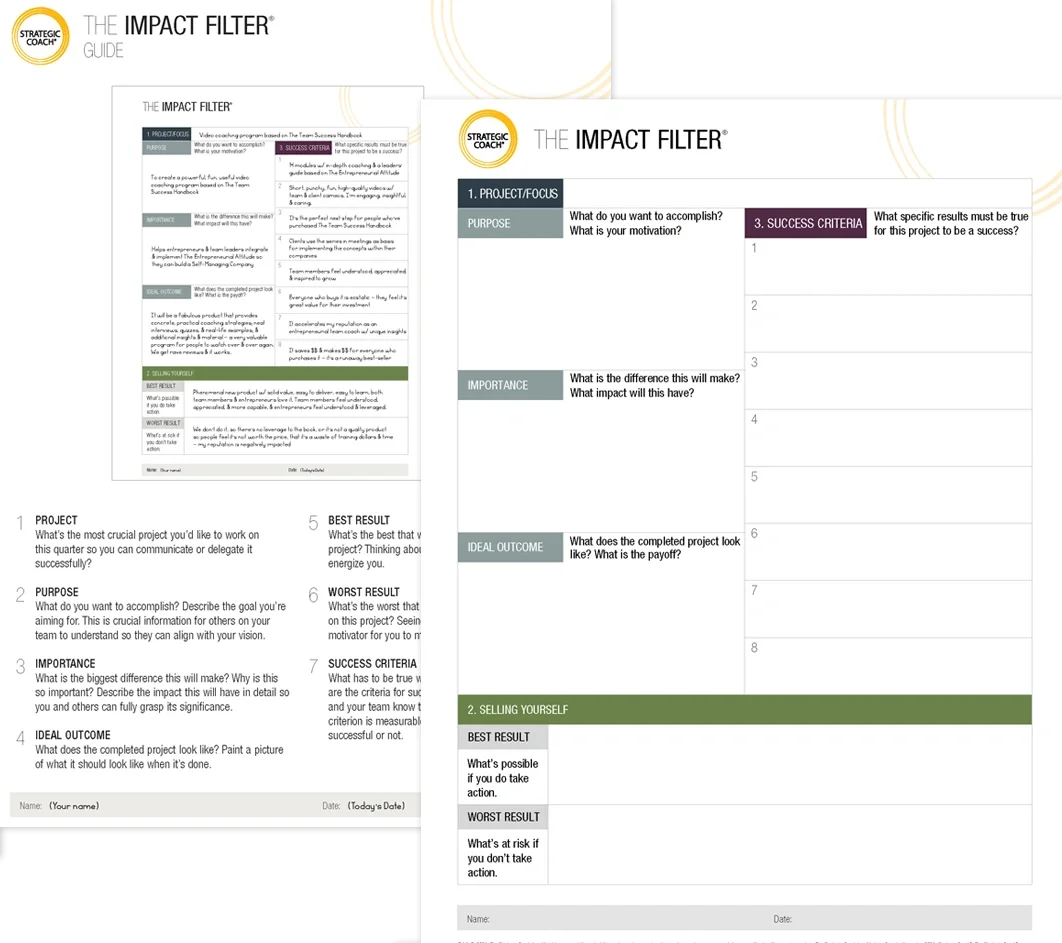
The Impact Filter®
Dan Sullivan’s #1 Thinking Tool
Are you tired of feeling overwhelmed by your goals? The Impact Filter is a powerful planning tool that can help you find clarity and focus. It’s a thinking process that filters out everything except the impact you want to have, and it’s the same tool that Dan Sullivan uses in every meeting.