The Difference Between Most Entrepreneurs And Great Entrepreneurs
October 14, 2026

Hosted By
 Dan Sullivan
What separates a successful entrepreneur from one who changes the way people live and work? In this episode, Dan Sullivan explores the shift in thinking that sets great entrepreneurs apart, using Steve Jobs as an example. Discover how a different approach to creating value can open up possibilities you might not see when you focus only on what customers ask for.
Here’s some of what you’ll learn in this episode:
- The two ways entrepreneurs think differently from most people.
- What most entrepreneurs focus on in the marketplace.
- What great entrepreneurs focus on instead.
- How Steve Jobs created capabilities for himself and millions of others.
Show notes:
Entrepreneurs take responsibility for their own financial success and security rather than expecting an employer, government, or institution to do it for them.
Entrepreneurs don’t get paid first; they get paid after they create value that someone else is willing to buy.
It doesn’t matter how useful you think your work is; it only matters if someone else sees enough value in it to write you a check.
When you focus only on solving existing problems, your clients can end up defining the work you do.
Great entrepreneurs are more interested in creating new capabilities than solving known problems.
Start with a capability you wish existed for your own life, then ask whether other people would want it too.
Steve Jobs wanted computers to be easier to use, music to be purchased one song at a time, and phones to do far more than make calls.
Great entrepreneurs build a formula around their capabilities that stays true even as technology, markets, and the world change.
Apple’s enduring formula is to create beautiful technology that people love using.
A clear formula lets you keep creating new value without having to reinvent who you are every time the world changes.
Episode Transcript
Dan Sullivan: Hi, this is Dan Sullivan. I'd like to welcome you to the Multiplier Mindset podcast. Probably 95 percent of all entrepreneurs are trying to solve an existing problem. But the really great entrepreneurs really aren't interested in solving a problem. They're very fascinated and motivated to create a new capability. So I'm often asked the question, how in the 21st century do successful entrepreneurs think? My first answer is that, well, first of all, entrepreneurs, period, think differently than other people for two reasons. Number one is that they take total responsibility for their own financial success and security in the world, where a lot of people are looking for an employer to actually do that for them to take responsibility, or the government or some other institution who's going to actually be responsible for their financial welfare. So that's the first way that entrepreneurs are different.
And the second way that entrepreneurs are different is that they understand that they don't get paid until they first of all create value. So they don't get paid if they don't create value and they don't get paid first if they don't create value. So there's this sense that they always have to be useful in the eyes of a consumer. And it doesn't matter how important or how valuable or how useful what you do is in your own mind, you know, that you think that what you do is really superb and really wonderful. But unless there's someone who wants to write a check for that, it's not really worth anything at all. And that's a hard thing for a lot of people to succeed at. So that's the general difference between entrepreneurs and non-entrepreneurs. And that's not to say that there aren't lots of people who aren't entrepreneurs who don't take responsibility for themselves and don't realize they have to create value. But they're the exceptions in their world, where just to be an entrepreneur and to survive as an entrepreneur, you have to have this.
Now, the second question is, what's the difference between entrepreneurs, period, and really successful entrepreneurs? Because I think that's what every entrepreneur wants to know. And that is that instead of trying to solve problems in the marketplace, known problems in the marketplace, the really great entrepreneurs are only interested in creating new capabilities. So if I were to use a percentage, I would say that probably 95 percent of all entrepreneurs are trying to solve an existing problem; so it's clients and customers need something solved. But in many ways, it's the client or customers who are defining the activity of the entrepreneur. But the really great entrepreneurs really aren't interested in solving a problem. They're very fascinated and motivated to create a new capability.
And one of my real role models here, and he may be one of the greatest role models in the history of entrepreneurship, is Steve Jobs at Apple. Because Steve Jobs, during the entire time, never did focus groups. He would never bring in customers and clients and ask them what they needed. What were their problems? What did they want to solve? But instead, he said, if there was a really great new capability I wanted for myself in the world, what would it be? One of the answers was, I would like to be able to operate a computer without knowing code. And a lot of people don't know this, but Steve Jobs wasn't a great technology guy. So he said, you know, it'd just be a lot easier for me if I could just click.
So he didn't invent this, but he was the one who made it famous. It was called the graphic user interface, where instead of learning code and punching in code, all you did with the mouse is that you clicked and you got the thing. So everybody in the computer world now uses graphic user interface. But the reason why Apple was the first to use graphic user interface faster than anyone else is because Steve Jobs wanted this capability for himself. And another capability he wanted, much later, was he said, why when I want to buy one song of an artist or a band do I have to buy 12? In other words, why do I have to buy the entire album to get one song? He said, you know, I'd just like to be able to buy one song, you know, with cell phones, which had been around for many years before Steve Jobs was there.
And he said, I would like to have a capability where this could connect to the internet. I could have all sorts of different functions on the internet, where if there was any kind of new electronic capability, I would just be able to download it to my phone. And that created the Apple Store, and you had iTunes where you could download things, and you had the iPhone. So, what his rule was, that I want a particular new capability for myself, and if it really works for me, probably a lot of other people will want to have it. And I don't have to worry about what their needs are. I don't have to worry about their problems. I'm just going to take things that I need personally for my life. And then he wrapped a formula around this. And this is the second part.
So first of all, the great entrepreneurs develop new capabilities for themselves. And the second part of it is the great entrepreneurs build a formula around their capabilities that are always the same. So for Apple, the formula is we make beautiful technology that people love using. And this is a formula, when you think about it, that could last for a hundred years. So, I saw an article once and they said that Apple is most likely, of the great technology companies today, to be still in operation a hundred years from now. And the reason is they have a formula, so it doesn't really matter what kind of technology is being made, so they can adjust to any kind of technology. But the one thing is that it has to be beautiful technology. The experience of using it has to be sort of a beautiful experience. And the individuals, the customers and clients who are using the technology love the experience.
So I would say, going back to the question, what is the difference between entrepreneurs in general, and great entrepreneurs, is that great entrepreneurs don't try to solve problems. They try to create capabilities that they themselves want to have, and then they have a formula so that no matter how technology changes, how the world changes, how the marketplace, the economy changes, they have a single strategy that they can stay with forever. I found that when you give these two differentiating points to most entrepreneurs, they can make very, very rapid progress in identifying the capabilities that don't exist now that they would like to have for themselves, and also that they can create a formula that they can stay with forever. And all of a sudden, what might have been just sort of a reasonably successful entrepreneur, they immediately make the shift to being a truly great entrepreneur.
Related Content

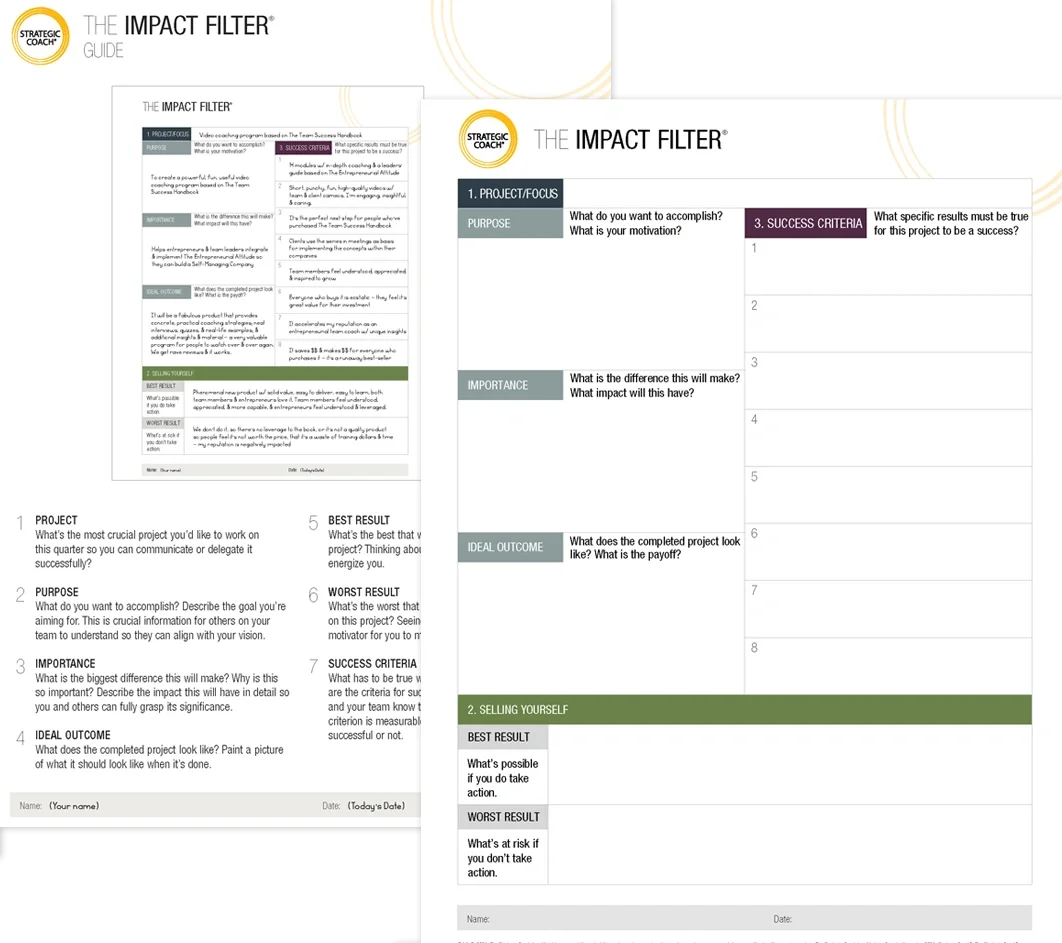
The Impact Filter®
Dan Sullivan’s #1 Thinking Tool
Are you tired of feeling overwhelmed by your goals? The Impact Filter is a powerful planning tool that can help you find clarity and focus. It’s a thinking process that filters out everything except the impact you want to have, and it’s the same tool that Dan Sullivan uses in every meeting.