Find Your Fellow Gritty, Courageous Entrepreneurs, with Eric Hansen
May 20, 2026

Hosted By
 Dan Sullivan
Eric Hansen built his business the hard way—decades of grit, risk, and going it alone. But he hit a ceiling he couldn’t break through by himself. In this episode, Eric shares how joining The Strategic Coach® Program helped him multiply his business, reclaim his time, and design a more balanced, purposeful entrepreneurial life.
Here’s some of what you’ll learn in this episode:
- Why entrepreneurs talk about completely different things with one another than anyone else in their lives.
- The two crucial stages that signal you’re ready to join The Strategic Coach Program.
- Why Eric said no to Coach for years—and what finally changed his mind.
- The kind of wireless telecommunications company Eric has been growing for nearly three decades.
- How Eric has actually gained more free time and freedom as his company has scaled.
Show Notes:
When corporate executives meet, they share wins. When professionals meet, they discuss problems. When entrepreneurs meet, they trade stories about their biggest failures and comebacks.
Entrepreneurs routinely put themselves into situations where they have to grow as people in order to create the solutions they need.
Great entrepreneurs are always acquiring new capabilities, and that continual growth is what builds their confidence.
The most successful entrepreneurs can go through almost any kind of trouble and still find a way to come out stronger on the other side.
In the Strategic Coach® community, you never have to explain yourself because everyone has lived through their own version of the challenges you’re describing.
It’s a powerful advantage for a new entrepreneur to admit they don’t know everything and be open to learning.
Companies, like people, move through distinct phases of growth, and each phase demands a different kind of leadership.
When you’re staring down potential business ruin, you quickly discover who you are and what you’re really made of.
Grit is a crucial entrepreneurial capability that never shows up neatly on a resume and is almost impossible to judge on the surface.
Most small businesses don’t survive beyond their first few years, which makes staying power and resilience a serious competitive advantage.
The willingness to be vulnerable, especially after major setbacks, can become one of an entrepreneur’s greatest superpowers.
Resources:
The 4 C’s Formula by Dan Sullivan
Grit by Angela Duckworth
The 4 Freedoms That Motivate Successful Entrepreneurs
The Self-Managing Company by Dan Sullivan
From Strength to Strength: Finding Success, Happiness, and Deep Purpose in the Second Half of Life by Arthur C. Brook
Episode Transcript
Dan Sullivan: Hi, this is Dan Sullivan. I'd like to welcome you to the Multiplier Mindset podcast. Hi, everybody. Today's episode of Multiplier Mindset, it's just a great story. This is Eric Hansen, and he's from Lynchburg, Virginia. And as is the case with many of our entrepreneurs at Strategic Coach, they start young. And he was talking about his 12-year-old experience and his 15-year-old experience and his 18-year-old experience already in the marketplace, already striving to create an independent lifestyle through entrepreneurism, and he's been at it now since he started his company for 29 years. Eric tells a very, very interesting story, and I'd just like to bring some research in to support some of the points that Eric made.
There's a business researcher from New York City that I met about 20 years ago, and he takes a look at all aspects of the business market. So he talks to big corporations, people who are CEOs, C-level in a big corporation. He talks to professionals, lawyers, accountants, engineers, doctors, architects. And he talks to founders of entrepreneurial companies. And he said, you know, it's really interesting when these people get together and they're just having conversations among themselves. Corporate executives talk about their wins. They just talk about their successes. And part of the reason is that the way that large corporations work is that C-level executives don't spend their whole lifetime at the corporation. They might go six years and then they jump to another corporation, another six years. So they're always talking about the wins that are going to be the bridge to their next assignment. They're looking for a bigger paycheck, they're looking for stock options and everything else.
But he says it's very interesting when they're by themselves, they just talk about their wins. Professionals—accountants, doctors, lawyers, engineers—only talk about the problems that they're solving. They've come up with a neat solution to this problem. You know, it might be a legal solution. It might be a financial accounting solution. It might be a medical solution. But what they talk about is their problems that they're solving. But he says it's very interesting when you get founders of entrepreneurial companies. He says what they most enjoy talking about is their disasters. They enjoy talking about the huge, almost completely wipe-out failures. And then they tell the story of how they recovered, how they came back from a bad experience. And entrepreneurs just absolutely love this. So when I'm watching Eric's story, you know, you get into the deals that you get into, and then you find out maybe it wasn't such a great deal.
And what you have to do is you have to go through an experience where you literally have to change yourself as a person to come up with a solution. And what I loved about what Eric is talking about in his interview with Suvi is that he wasn't going to quit, so he's very committed. We're going to come out of this. We're going to hang in there together. We're going to get our company back so that we're 100% in charge of our own company. And we're going to get much more freedom, and we're going to grow from it. I draw a lot of insight from what Eric's talking about. We've just created a new book. We have a new book which is called Who We're Looking For. And what we describe is an individual who has an enormous amount of commitment, enormous amount of courage, is constantly acquiring new capabilities. And that's how their confidence goes up. And then they take on bigger commitments and they go through the cycle again.
But Eric came to a stopping point in his career. And the reason why he came to a stopping point, he had done as much as he could on his own. He said, I'm always alone with this. And what we're looking for is entrepreneurs exactly like Eric, that this is the person we're looking for, who have already shown that they can go through any kind of trouble and they can come out the other side. But they also come to a decision, now I've got to join a group. I can't be out there alone. I can't be isolated. I've done as much as I can myself as a lone entrepreneur, and now I'd like to join a group where everything I talk about, they get, because they've been through the same experiences. And this is what we call stage two.
So stage one is proving that you can make it on your own out in the marketplace and not only survive, but you're now thriving. You've learned all the lessons you need to learn, but now you've got to jump to stage two. And that's where you're in a totally supportive community. They totally get you. Anything you can talk about as an entrepreneur, they've been through it, they understand it, and they love hearing about your experiences because it gives them a chance to share their experiences. So this was just a real gift to us hearing Eric talking about it. And, you know, when I check out the experiences of our greatest entrepreneurs and Strategic Coach, they were out there at 10 years old, 12 years old, 14 years old. They had already started. And now it's 30 years later, 40 years later, and they've done everything they can on their own. And now they're ready for stage two. Stage two is where you're in a totally supportive community of people who've had your experiences. And that's what we provide at Strategic Coach.
Eric Hansen: I founded my business 29 years ago, 1997. I'm an engineer. We make wireless telecommunication equipment for mission critical markets and heavy industry markets. I joined Coach. I had a real good friend that suggested it for years and I always kind of said I was too busy. I was too busy growing a business, running a business. I joined Coach probably four years ago. I think my personality, I mean, going back to a kid in high school, I had a landscaping business, a snow shoveling business. I started selling Kool-Aid outside an Ingersoll Rand plant when I was a 12-year Kool-Aid stan. So I've always kind of had this itch to do things. I was adopted at birth. And my parents always kind of didn't know what to do with me, but with this kind of energy, super ADHD, always wanted to try new things. I had a DJ and a music band in high school that we'd go do dances and so very kind of creative, very probably more of an innovator, visionary personality, and a bit of a black sheep, but also understood, fortunately, in my parents' conservative Midwestern values, kept me in the guardrails of focusing my ADHD enough to be successful in the world.
So I went to engineering school. My father was an engineer, got a good job at Motorola, transferred to GE and then Ericsson. So I always wanted and strove to kind of have my own business. But I also was maybe lucky or humble or fortunate enough to realize I didn't know everything. And it would be great to work at a large Fortune 500 firm and learn a lot more about how business works, which I really didn't know. You know, it was the eighties, so you can imagine that. So even today, my workouts, I'm always doing eighties workout music. So, you know, everything from Prince, Journey, ACDC, Def Leppard. So I grew up on that and I haven't grew out of it. And all my kids are wearing like ACDC t-shirts. My undergraduate program had a one-year co-op requirement, so I had to co-op somewhere for a full year before I could actually graduate.
So I co-oped at many different companies my junior and senior years. We were on a quarterly basis, so I'd be at school for a quarter and then go to co-op for a quarter. So I learned a lot about kind of what I wanted to do during that exploratory phase. I joined Motorola right out of college. I actually had one more quarter of co-op I had to finish, so I started as a co-op. That led to a full-time job and that's really the market I've stayed in is wireless from the very get-go of my career. I will say the group I worked in, Motorola, was called Special Applications, and it was a very small entrepreneurial group, kind of outside the normal Motorola engineering group. So we had a spice of life, kind of. We'd do really interesting projects for the White House, for three, four-letter agencies, a little bit, you know, DEA, FBI. It was a place that you could kind of work on a lot of diverse things. I was there for about five or six years, and then GE, which was one of their big competitors, recruited me to come to Lynchburg, Virginia, which is where I live today. And we still had family in a little town in upstate New York.
Corning Glass makes Gorilla Glass on your iPhones. My dad had worked for Corning. But we wanted to get closer to family. So I went to GE, and there was just a lot of turmoil in that business because Jack Welch had decided they were a small number two, wanted to sell that business, sold it to a Swedish firm, Ericsson, who didn't really, at the time, understand the business, but needed a U.S. presence. So I was at GE, and then it became Ericsson over the course of years, and it was a great company to work for, but I finally found myself in a career point where I really wanted to try something on my own. And I was in a place I really loved in this area, the Blue Ridge Mountains, and there's Smithmount Lake really close. And things at the time were not going well for that group. They ended up selling all those groups. Erickson ended up selling all those groups.
So I wrote a business plan with another engineer and said, if this gets really bad, we're gonna go out. So it got worse because people were leaving so quickly. I was working 80 hours a week and my wife pulled me aside and said, we're gonna have kids. You've talked about this your entire life. If you're gonna do this, now's your window. So fortunately, she has been a wonderful blessing for 30 some odd years, very supportive. She's a physical therapist. So I had a soft landing where I had benefits and everything that could absorb so we could leverage her good work. But we lived on macaroni and cheese for probably a decade. I think a company goes in phases just like a person in their personal growth and their life goes in phases. So the early phases were, you know, we'll work for food. And certainly those were scary, but I was working, you know, 70, 80 hours a week and just trying to survive.
And fortunately, in the early days, my old employer hired me to do my old job because I guess I did a good job when I was there. So we had a little bit of a soft landing that was not anticipated when I turned my resignation, but they gave us a couple of years to continue to support them in a different type of capacity. So that helped. Probably the biggest challenge in the 29 years of being in business was we were just starting to take off as a business, and we run fairly conservatively, and we had all these great products that were serving the industry, but we were selling them through a large Fortune 100 company. It was our technology, but they were putting their name on it and selling it to the industry. And the industry just did not like working with this company. It was really hard-handed. And many of the customers would come to us frequently and say, can we just buy from you? And for about two years, we said, no, we've got a partnership. We were respecting the partnership, even though we didn't have anything contractually.
Well, it got to a head. And we notified the company that we were going to have to go out on our own, and they sued us for $480 million. So we were, at the time, probably about a $5 million revenue company. The sheriff shows up, files papers to me, sued six people, myself, and the company for all these things that were not true. We were very close to being out of business that year many, many times. Now, without going through all the details, you learn really quick what you're made of when that happens. And you also, we felt like this was a violation of trust and integrity that they accused us of a bunch of things we didn't do. But it didn't matter because they really only wanted to break us with a lawsuit that they hoped they could bleed us dry of any funds so that they could pick us up on 10 cents of the dollar. They had tried to acquire us. They kind of insulted us with the acquisition value they came up with and how they did it.
So when that stopped, when that conversation stopped, they sued us. And they saw this as a quicker, cheaper way to get what they wanted, which was all of our tech. And so for ten months, we ran a lawsuit instead of a business, and it went all the way up to the Arlington Fourth District Court, which is considered the rocket docket of the eastern United States. And our judge was Judge Brinkema, who put Zachariah Massari, the 9-11 terrorist, away for life. But we held our ground, we pulled together as a team, we scraped by. I had some really good partners that helped me get through it. And what happened through that is we were two weeks away from, we counter sued them for $30 million for IP infringement and theft. And that had some teeth in it. Theirs was mostly just shotgun, we'll try to do everything, but they had tried to reverse engineer our design as well, as kind of a backup plan. All this came out in discovery. They were pretty well exposed. They now were looking at a countersuit for $30 million. We were two weeks away and they cried uncle and wanted to arbitrate.
So we had asked them at the very beginning of the lawsuit if they'd just sell us the business since we were 90% of it. And they said, sure, for $40 million. And we said, no, we're not going to pay you that because you don't have anything we really want. We just want clear freedom to operate. We ended up buying about $10 or $11 million of our equipment back from them, taking over the entire business, and we settled at $3 million for that equipment. So scary times. We were months away from not making payroll. We had to have a small ref of employees. Everyone on the team had to take a pay cut. The management team took the biggest pay cut. We managed really transparently, and I said, this is the situation we're in. Everyone in the executive suite took a 25 percent pay cut and then we gradiated that out to a lower number when it got down to the lower people in the organization as we were just fighting to survive.
And so fast forward from that moment, we pick up all this equipment, we had to take out a loan, we had to meet our loan commitments, we had debt covenants. Fast forward a year later, we've now got a business that's twice the size with a much broader reach to the customers, with freedom to operate and create a brand and a customer experience that we really wanted to. And talk about, you know, David versus Goliath and seizing defeat and turning it into victory. That was a huge moment in our business. So that's probably the scariest time. In fact, the financials were so bad. Over 29 years in business, my CFO refuses to show that year. It's like the 13th floor in an elevator. Some buildings don't have 13 floors for a reason. We don't have financials from 2013.
There's a great book and I'm gonna maybe duck worth on grit and how important grit is to people's success. I truly believe it's one of the most fundamental skills that's hard to measure on a resume and hard to judge. I think people have to go through adversity. You know, there's a saying that the hardest deal is made in the hottest fire. And I think when you go through those moments, and Dan talks a lot about it, is that courage to go through that and then the commitment to see it through. We just felt like in that moment, we were completely aligned as a team. There were people on my team that were, you know, accused of things that they didn't do and they knew they didn't do. So we stuck together and we just gridded it out because we thought that was the right thing to do, and we held our ground. And every entrepreneur I know goes through these moments, and it's what separates, I think, the folks that get through it and are stronger are the ones that just never give up.
I had a really good friend I worked with at Motorola who had his own company, and sadly, about three years ago, I guess it wasn't doing well, he committed suicide. And I shared this actually in my Coach class, that Chad just saw something was wrong with me that day. And I just said, well, you know, remember people, what we're trying to do is really, really hard. That's why 90 percent of small businesses don't last past five years. But what's great about the Coach community is whether it's this company or this company or this problem or this problem, sharing the problems, you find a community of gritty people that have done and been through things worse than you've been through. And you're like, I'm not alone. An entrepreneur's life is often very alone because I felt for years and years, I could never share my concerns with my team for fear their head would explode and they'd be on Monster or whatever, Indeed, looking for a job. Because if they saw the world as I saw it, they'd be so scared. So many times, that grittiness and that courage and the shoulders to carry it on, it goes down to the founder. And the thing I've really enjoyed about the Coach experience is a network of gritty people and courageous people that have been through it. We can talk about these things. People talk about their divorces and their horrible legal experiences and lawsuits and partners, bankruptcies even. It's not easy what we're doing. So when I interview people, I look for grit as one of the most important factors of whether someone can go through adversity and come out stronger. I think the ability to be vulnerable can be a superpower. But I found myself, and even in my decision to not go to Coach for years, a decade, I had to really look at that a little bit and go, I have a superpower that I'm gritty. The opposite of grit is vulnerability, really, in a lot of ways in that dimension. Even going through this experience of this massive lawsuit that almost broke us and we were down to pennies in our bank account, almost literally, you create this image of yourself that you're alone. It's you against the world and you're completely independent and you've been through it all and the only way to get through this next phase of life or growth cycle or issue you're dealing with is being alone and heads down driving through it.
I think when I reflected on why it took me so long to Coach is because I had built up this mentality that I don't need help, I can't ask for help, I can't be vulnerable or transparent with anyone because if I am, they're gonna faint and have a heart attack. And so, you know, maybe it's, I had to go through my own personal journey of this and realize that sharing some of these, if I've got the right people around me, they'll support me and won't run away. I like to hear people's stories.
So I'll give you an example without specific names, but we interviewed a candidate for a fairly high level position in our organization. This candidate had had, at a very young age, a massive heart attack 12 months ago. And so he was still processing it, very fit, ran marathons, you know, all this stuff, but he was still processing what that meant to him and going through it and sharing it. Just like I tell my story, the lawsuit, it helps to talk about it. It's like cleansing to talk through it, not something you'd normally hear from a candidate. And so then he's, over a series of conversations talked about, how he grew up really poor and that he went through adversity and he really had one or two ways out of this poverty situation, is he either had to work three times as hard and get a scholarship full ride, or he'd probably end up in a bad place.
And so I really like to hear people's stories. And I think, number one, it lets their guard down in an interview. And I like to test if they've been through adversity. And they've been through real, real adversity and see the person that comes out of that. So everyone's so buttoned up, right? And it's like, oh, I'm here to tell you all the things I'm gonna do for your business. One of my interview questions I often ask is, tell me the biggest adversity you've been through and what you did about it and what you learned from it. And the other one, which is kind of a tangent to that is, tell me one time you failed. Because interviews are always about, look at all the great things I'm doing. Tell me how you failed and what you learned from it. That is one of my number one, I call it lessons learned in my business, is I said, I'm not gonna finger point, and I'm not gonna shoot the messenger, but I will get frustrated and upset with you if you don't learn the lesson of the last time you made this mistake.
So we're gonna interrogate the truth and get to radical candor on topics when we fail. Because what we're doing is we're learning and we're growing by doing that. And don't get defensive because I have to be vulnerable for my team and share my mistakes with them so they feel vulnerable enough to admit or disclose that they have problems or issues or failures that sometimes they don't want to disclose to their boss. My journey to Coach, and I've only been at it four years, I think, total. But, you know, we went through this huge lawsuit. We took over the entire business, doubled our revenue in like 12, 16 months. And then I'm like, wow, you realize that because we were selling through someone else, there were all these gaps in our business. We didn't have a sales team. It was me and one other person. We didn't have a product support team and we didn't have, you know, this customer facing, we hadn't built that up. And all of a sudden we're customer safe. We didn't have a marketing team. So it's like, we got to fill in and learn as we go. And so we had a lot of that kind of spurt of growth and then we leveled off. And we had a lot of success in that leveled off moment, and that was probably around 2018-19.
So, you know, you go through this huge growth energy spurt, and then you kind of need to level off, take assessment, rest, look back and go, okay. But what I found out in ‘18 and ‘19, I was getting frustrated. And I was like, I was bored. I just felt I had no passion or interest to go into the business. I was like, well, I might just burn out. Is this midlife? You know, I'm 58 and I was hitting my 52 kind of range. I'm like, maybe I just need to leave or sell the business. And so I sat in that space for a long time. And what I realized is I had achieved kind of everything I thought I did, and I still had fairly small goals, and I had gotten comfortable and complacent and safe. When you go through everything I went through, there's a lot of PTSD and you kind of got to get to it. But then I realized my Unique Ability is not safety, complacent. I'm not the Integrator in any of this. I am the Visionary. And so what I realized is that I wasn't Visionary.
Now I was running a product company. We were probably, I don't know, 15 million in revenue, but I wasn't excited about going into work because we were 15, 16, in that range, 25 percent per year. But I like big goals and what excites me about big goals. And so why I joined Coach is, so I decided I needed to have a conversation with my entire team about transformation. And that we needed to set really, really big goals. And what kicked me in the butt about it was a good friend who had a company about the same size as me. And we were talking at lunch. He's an entrepreneur too. And I said, what's your goal for your company? He said, a billion dollars. And I'm like, what? I'm just sitting here complacent at, you know, where I am. And I'm like, I thought he was joking. I'm like, no, really? And he goes, no, a billion dollars.
So I sat in there for a while and I said, I've been doing this independent thing so long that I'm the only one that's setting my own goals and my own vision. And what I really needed to do is expand my network to surround myself with 10x people before I could come in and I announced the transformation of my team in 2020. And I said, we're going to double our revenue in three years. And they're all like, what? Huh? We've never, what? Where did this come from? And the commitment I made first is I'm going to sign up to Coach, and I'm going to go to Coach because I know I have to transform my own vision and my own way I look at life if I possibly want to continue to lead this company to 10x itself. It is one of the reasons I didn't go to Coach too is I had a good friend that went and for him the growth and the money and the material things were really important, not as much for me.
So I kind of thought, well, but what I liked about Coach was this balance piece of The Four Freedoms. And that really aligned with what I thought life was because for me, it's actually the growth that's exciting. It's not really the dollar amount. It's the growing a team, leading a team. I don't like managing. I don't like being a manager. I don't like running a lifestyle business. I like growing and learning. Growth mindset is who I am. Learning new things and being excited about that. And when I get to the destination, and this is where Coach helped me, it's not about the destination, it's about enjoying the journey. Sure, I want The Four Freedoms, time, money, purpose, and relationship. And I want a Self-Managing Company, because there are things I want to do with my time and relationship and purpose that are outside just growing this business. But kind of that, my winning formula being so gritty and independent is that I don't need help. And I did that for 20 years running this business, and I was very successful. But then I realized that I had relied on that crutch too long.
And what Coach helped me do is open my horizon to, I need more help. I need more ideas. And this conversation with this other friend that was gonna grow his business to a much higher level just opened my eyes. And he hooked me up with another good friend of his. I, unfortunately, this particular friend passed away as well from cancer, but he hooked me up with his CTO. And the question I asked him was, I said, he never seemed very materialistic to me. He seemed very much like me. And he said he wasn't. So his CTO told me the story of why one billion was important to him. He said, imagine the good a billion-dollar company can do in Southside Virginia. Imagine the jobs, the philanthropy, the impact it can make. And I'm like, got it. That I can get behind. Our company's mission statement is creating a positive impact for our stakeholders, our employees, leaving a lifelong legacy. And that's where a Self-Managing, Self-Multiplying Company comes into play.
To be completely transparent, I do not look forward to going because I'm so busy tactically and I'm like, I don't have time for this. I don't have time for this. But then that I paid to do it, I'm like, I got to go. I'm so frugal. I can't waste this money. And then I go and I'm like, I have twice the energy coming back. I think what it allows me to do is it puts my head in a different space than it is mostly eight to five. It makes me think this friend that I mentioned that grew this business, and he actually achieved his goal. He came very close to building a billion-dollar company, which was phenomenal. I asked him wisdom too, and I said, what's the one thing you regret? And he said, I didn't spend enough time strategically on the business. And I think what Coach gives me is time to focus strategically on the business and also strategically on myself. I like to say I'm a servant leader, so I'm always kind of pouring myself into my team, but I never really felt like it was fair to take away my time for the business to work on myself.
And I think what I've kind of come to this happy medium is that, what I got to a point was when I take long vacations and I had time away from the office, my ideas were better. They would come when I'm working out in the morning, or taking a walk with my dogs, or on the boat, on the lake, just not thinking about work at all, and then an idea would come in. And I think what Coach gives me is a little bit of a still time, along with a bunch of creative ideas and creative people that allow me to take things and really, really focus on them. There's a book right now, I'm trying to think, Albert Brooks wrote it, and I'm gonna butcher the name, but it's, your second wave or something around the second wave. And it talks about different types of intelligence. And in your thirties, you kind of peak around your normal IQ and there's data that supports this. But as you age, you get a different type of intelligence called crystallized intelligence. He calls it crystallized. I call it wisdom, scars, experience.
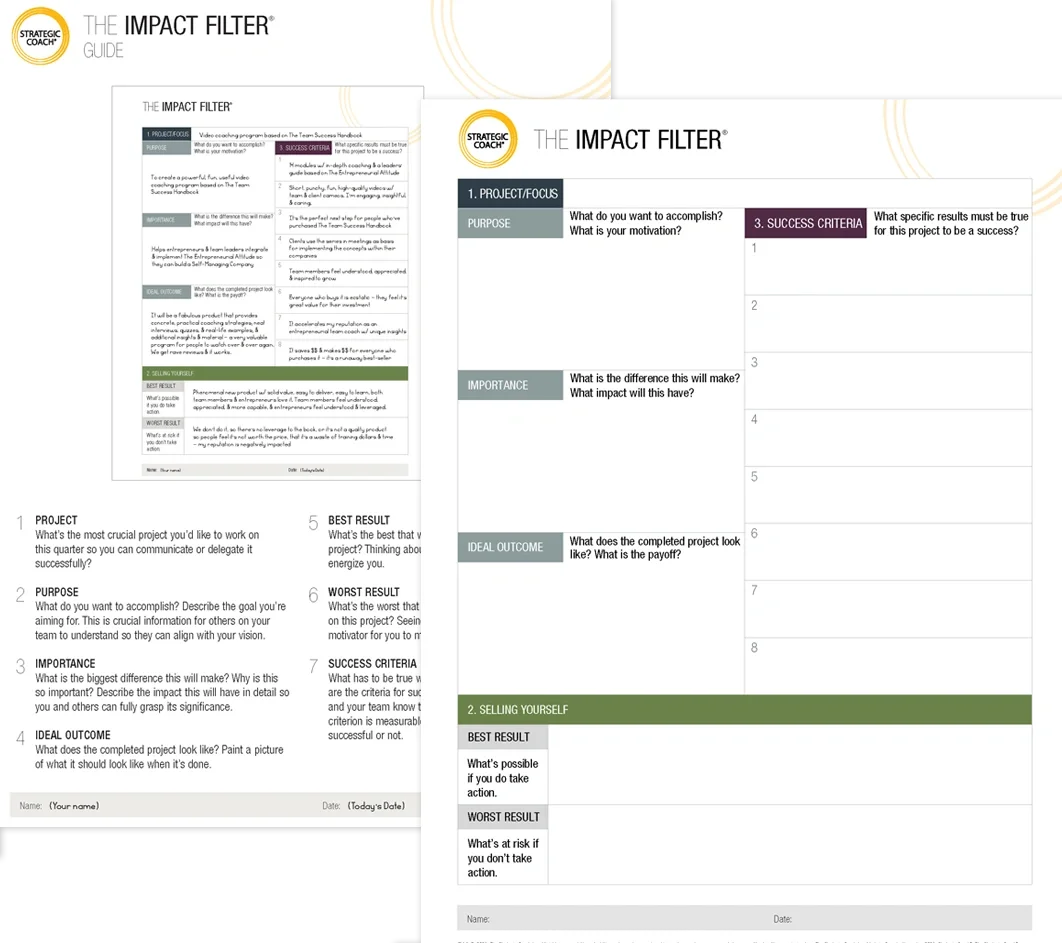
So what Coach allows me to do is leverage this concept that Brooks's new book kind of talks about because I call it a spider sense. And I go around my team and I'd say, my spider sense is tingling. And they're all like, do you have my office wired? How did you know this was happening? And I'm like, it's just that I've seen it. And what Coach allows me to do is kind of magnify that spider sense and also bring in a whole bunch of other inputs into that that I think are really helpful. I tell my entire team, my executive team, listen to the spider sense. You may not have the data, you may not have observed it, but I have the same thing. And I've told my team this is one of my biggest regrets is not listening to it sooner in my career and just trusting that there's something. You know, it's like The Matrix movie, it's like there's deja vu, there's something wrong with the matrix. Dive into that and listen to it. And you need a little still time to do that, which I think Coach kind of lets you work through things and The Impact Filter and all the tools. Dan's tools are phenomenal because, you know, I'm trying to figure out kind of Schrodinger cat problems in my head that are very opaque. But the tools help you kind of funnel those with clarity that I think helps your intuition spider sense turn into actual insights.
Related Content

The Impact Filter®
Dan Sullivan’s #1 Thinking Tool
Are you tired of feeling overwhelmed by your goals? The Impact Filter is a powerful planning tool that can help you find clarity and focus. It’s a thinking process that filters out everything except the impact you want to have, and it’s the same tool that Dan Sullivan uses in every meeting.