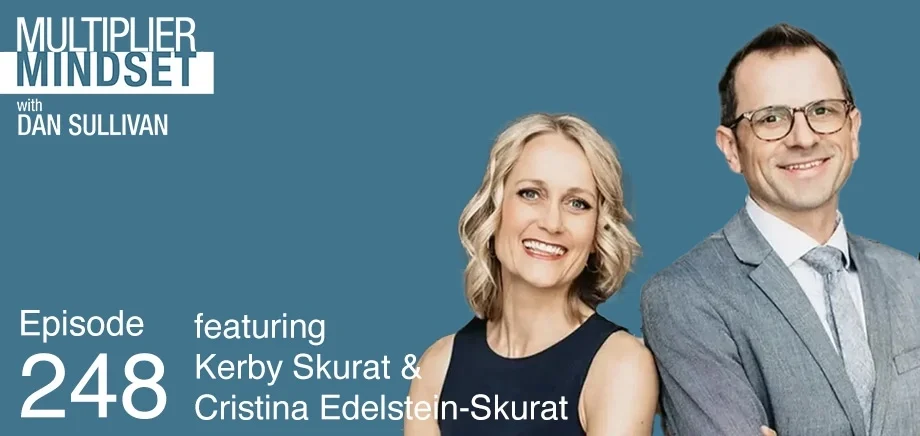
Growing A Business Without Breaking Your Bond, with Kerby Skurat and Cristina Edelstein-Skurat
April 08, 2026
Hosted By
 Dan Sullivan
When life partners become business partners, tension can quickly intensify—or multiply everything that matters. With the right tools and mindsets, that partnership can become extraordinary. In this episode, Kerby Skurat and Cristina Edelstein share how Strategic Coach® has helped them build a thriving business and a strong marriage at the same time.
Here’s some of what you’ll learn in this episode:
- How life partners Dan Sullivan and Babs Smith co-run Strategic Coach.
- What Strategic Coach has helped Cristina and Kerby achieve with their business.
- How Cristina and Kerby grew their real estate business into a $10‑million‑a‑year company.
- Cristina and Kerby’s core values.
- What led Kerby to the decision to shut down a $16-million company.
- Why both members of an entrepreneurial couple should attend Strategic Coach workshops.
Show Notes:
Many entrepreneurial couples end up with an almost adversarial business relationship that spills into their personal life.
Unique Ability® gives each partner a clear lane, so “best with best” teamwork becomes possible instead of competitive.
Entrepreneurism usually shows up early in life and quickly becomes a lifelong way of operating.
Choosing the entrepreneurial path means you’ve opted out of the job market and into creating your own game.
Strategic Coach provides the structure, tools, and community that support this unique way of life.
There’s an art to staying in your lane, especially when both partners are strong‑willed and driven.
Every individual has a distinct way of creating results, and honoring those differences turns conflict into collaboration.
Real data, real statistics, and real projections give you the confidence to make clear decisions and smart adjustments.
A business can be big and profitable and still be the wrong one for you.
Shutting down a good company can be the smartest move if it frees you up for great opportunities.
Time away from your team, in a room with other entrepreneurs, often leads to the biggest strategic decisions.
Hearing other entrepreneurs’ success stories can inspire you to take action on your own goals.
Strategic Coach workshops create a thinking space where you can focus on what could be, not just what is.
Getting help at deeper personal levels, like marriage counseling, can dramatically improve your business teamwork.
Strategic Coach tools work just as well at home as they do in the office.
In a team of any size, the speed of the leader determines the speed of the pack.
When both partners are in the same coaching environment, it’s far easier to stay aligned on vision and decisions.
Resources:
Your Business Is A Theater Production: Your Back Stage Shouldn’t Show On The Front Stage
Everything Is Created Backward by Dan Sullivan
The Millionaire Real Estate Agent by Gary Keller
Who Not How by Dan Sullivan with Dr. Benjamin Hardy
How To Sell Transformation Using This One Question
Do You Know What’s Keeping Your Clients Awake At 3 A.M.?
Your Life As A Strategy Circle by Dan Sullivan
Episode Transcript
Dan Sullivan: Hi, this is Dan Sullivan. I'd like to welcome you to the Multiplier Mindset Podcast. In the next episode of Multiplier Mindset, this was really fun watching the husband and wife going back and forth. We have a lot of married couples who are in Strategic Coach together, and they've seen many examples of husbands and wives not really making it in business. It's almost like an adversarial relationship, or they run into difficult issues inside the business. But the interesting thing is that they're having the same sort of conflicts in their personal life as a result of this. And I would say that the one tool that they learn in Strategic Coach, which changes everything, is the whole concept of Unique Ability, that every person has a Unique Ability. You're born with it. This isn't something you learn by going to school. It's just the way that you take action to get results. And we're different from each other. So in our case at Strategic Coach, this was started with a husband and wife team.
So my wife and I have created Strategic Coach. And the way that we look at it is that we have a theater, a live theater. Babs Smith, my wife, she's in charge of the whole theater. She's in charge that everything in the theater actually works, how the theater markets itself. And I'm responsible for creating what's on stage. I'm creating the performances. We've grown 250 times since our very first year. I used that as a benchmark. I said, how much did we make in the first year? And it was the most we had ever made. And now we're 250 times that. What I loved about the conversation between Kerby and Cristina in this episode is that they each are taking 100% responsibility for who they are at their best, and then you have best and best actually creating teamwork with each other. The other thing about it is that I got this enormous sense of a passion for learning. They love learning new things. They love seeing new ways to look at things better, to hire better, to have very skilled people who are also in their Unique Ability, inside their company, and I'm sure it looks that way outside their company, too.
You know, entrepreneurism is a very, very interesting choice in life, okay? And my experience is that it starts very early, like at eight years old, that the entrepreneurial individual starts focusing on things that don't go along with the crowd. It's not necessarily money, but they're just interested in activities and in topics and in various other ways of looking at the world. And they keep developing. And sooner or later, they're hard to hire because they've got their own very, very strong views about how to take action and get results. And so entrepreneurism is basically what you do. And the other thing is, it's a life sentence, that once you decide to be an entrepreneur, you disappear from the job market. You have a hard time explaining, hey, where did you work for the last five years or 10 years? And you don't have an answer for it because you were an entrepreneur. So I always tell them, just recognize that this is the way you're going to be for your entire life.
And it all comes down to teamwork with other people who are uniquely talented. I just love what Kerby was talking about. They had a $16 million company that would have been successful going forward, but it wasn't great. And he said, I'm not interested in good, I'm interested in great. So if you think about that you're performing in the best possible way for yourself, but you're also in a business that really rewards you for being your best possible self. And then you have that between two people who are the owners, and then you have that same relationship between yourself and everybody who's part of the team. And what you notice is that that starts working in the market too, that you have customers, you have clients who are also motivated in the same way. And they're looking for just working with great people. They're looking for creating great new things. And this is what Strategic Coach is all about. And all this is about not just your entrepreneurial life, but it's about your entire personal life, okay, that everything fits with everything else. Everything reinforces everything else.
So I'm just so delighted that Kerby and Cristina were willing to tell us some of their experience so that we could share it with you and share it with all the other entrepreneurs. We've created a tremendous philosophical school. It's like entrepreneurial philosophy of just recognizing that you've chosen a totally unique way of going about your life and that there's a community and there's a structure and there's a whole system that totally supports you in doing this, is what Strategic Coach actually is.
Cristina Edelstein: Okay, well, I'm Cristina Edelstein, married to Kerby Skurat here. We're in Plymouth, Minnesota, and I primarily focus on our real estate team. So we have a real estate team, one of the larger ones in the Twin Cities area.
Kerby Skurat: Yeah, Kerby, as Cristina just mentioned, we've been building our real estate business since 2008. I started then and Cristina joined in 2010. Since then we've started the home building remodeling company, the remodeling one I sold. And then out of that came just a home building company that I brought to like, I don't know, 20 million in revenue, which was sweet. Then we shut that down because of a number of reasons. Coach helped me think through that. We launched a software business out of our real estate team, which is now expanding and growing into a bunch of different states. And last year, just by way of thinking about some of the tools that Coach uses, like The Triple Play, I started a hard money lending business and that hard money lending business has gotten to a million in revenue and I think I'll net 400 grand this year, second year in business. So Coach has helped inform a lot of our thinking entrepreneurial and helped us produce a lot of good ideas and a good profit. And yeah, we're just crushing it. So it's awesome to be doing this podcast with you today.
Cristina Edelstein: Well, I actually met Kerby because he was dating my roommate originally. They didn't work out. He stayed friends with everyone because everyone thought he was great. And then I was about to move to Africa to the Democratic Republic of Congo. And then he asked me out because at that point, then I guess he figured, oh, I better ask her out before she moves away. So we basically started dating a month before I moved. He was working at General Mills at the time. So, and I had been working for a local non-profit doing economic development. So working with entrepreneurs, but mostly low income immigrants, just rooting for the guys that are struggling, ladies that are struggling hard. So that was great. And I loved it. So when I moved to the Congo, it was a program there that was helping women that were victims of sexual violence and other things like that at a hospital. But it was actually another economic development program. So I've always kind of had this business interest side of it.
So I did that for a little over a year. Right after I moved there, Kerby decided he was tired of working for corporate kind of stuff. So then he was like, I'm going into real estate and I'm starting this to other companies unrelated entirely. And he's like, I'm going to use all my 401k in savings, every penny I have. So I got that call, I feel like it was within a month of having moved to Africa. And I was like, well, I guess this guy's an entrepreneur. And if he's going to make it, he wanted something to work out. And if not, I don't know. I wasn't very invested, so I was like, whatever, you know. But I think I knew what I signed up for, I guess, at that point. So real estate is the one that worked out. But he flew out there to Africa and he surprised me. I didn't know he was coming out. So he arranged this whole thing with my roommate, and for the record, this is a war-torn zone. So you have to, like, long travel through Europe and Kenya, and then finally Rwanda, and you have to take a bus ride through the mountains in Rwanda, and then someone has to take you across the border.
He did all that, which is pretty admirable. And my roommate managed and we like shared a car, shared a room with no electricity. So there's like no space. Somehow she managed to smuggle him in and have him at a nice restaurant. And she managed to get me to show up there looking nice. I'll spare details for another time, but then all of a sudden he walks up from the lake and is like there and I'm like, what are you doing here? It was so hard to fathom because it's obviously across the world, but he gets on one knee and proposes and so there you go. So then I ended up flying back and we got married in 2009. So we just had our 16th wedding anniversary this summer.
Kerby Skurat: Yeah, so after General Mills, I went and did commercial real estate for a year, was mentored by a very amazing entrepreneur, kind of gave me a lot of thinking and clarity around that. I didn't stick with him, but I left and did residential real estate. And it was 2008, the market was in free fall, I was doing short sales and all that. Just kind of started reading a book by a guy named Gary Keller called The Millionaire Real Estate Agent, and very similar to Crouch, it takes you through a process to kind of climb a ladder and build a team and whatnot. So I started thinking about building that, and I got to solo agent, building the thing. And I was talking to Cristina after we got married in 2009. First year, I did 13 homes, and then 24, and then 27. And by that year, it was towards the end of the year when it usually slows down, it wasn't. And so I was saying, hey, I'm gonna either have to hire somebody to help me, or you should get licensed and we should do this together, which usually is a way to get divorced. You go into business together, and it hasn't happened yet, but we're still hanging on it.
Cristina Edelstein: Not yet, never.
Kerby Skurat: Yeah, ever. But started doing that, and we went to 60, 120, 154, hired some people, 192, and now in 2025 here, we're right now sitting at 867 pending and sold for the year, so should be about 10 million in revenue. It’s the first time we're going to hit 10 million in revenue, which is pretty crazy for our real estate practice. And then that's outside of the hard money or the software stuff that we've got going on. So it's a really cool story, and it really has a lot to do with just putting in other people's great ideas, Coach being one of them. We're an EOS company. We've been on EOS for a decade. I know Geno Wickman is a traction, and he was in Coach. And so there's a lot of just that internal thinking that happens, and we've just been putting good ideas in place, every quarter making better improvements to the business, and that's kind of where we're at today.
After a lot of learning and marriage counseling and whatnot, we've definitely figured out the art of staying in your lane. So Visionary, Integrator, Cristina's Integrator. I'm a thing manager, Cristina's a people manager. Very good with people and very good at sales, very good at tactically getting people to … not in a slimy salesman, but more of in like, hey, what's best for the client? We're going to do that every time. And that's why we've grown so much, because we take care of people and we do that. And so to answer your question about Cristina, she's just a really good leader and she's really good at identifying problems and helping leaders solve those problems collaboratively. So with Cristina, that's why it works so well with us in business together.
Cristina Edelstein: I'm going to paint a picture for you. So before the market crash, I think there was something like 19,000 real estate agents in the Twin Cities metro area. And then obviously by ‘08, when everything was crashing, people are running away from real estate. When I got my license in 2010, it dropped down to like a little over 7,000 agents. And the reason I bring that up is because I would come home—I had gotten a job doing marketing when I came back from Africa. I was trying to figure out what I wanted to do, because I didn't know at the time, since I'd been kind of working in a different world of non-profit. But our AC broke in the third story of our condo unit that we were renting. And the guy didn't fix it all summer. And so I would come home in the middle of the summer—Minnesota summers get very hot. And every time I would find Kerby sitting in his boxers with sweat pouring down his back, hustling and just getting it done, talking to the banks, getting the next short sale done, like going and showing homes. And by then, because I have a marketing mind, I'd been helping him develop a brand and work on marketing and starting to build a database and like all that kind of stuff. So I was already kind of like helping him. But I think when I look back now, it's like, okay, we didn't know our core values at the time, but they're humble, hustle, grow and learn, positive attitude, and never problems, only solutions.
So seeing that every day, and Kerby's just a thirsty entrepreneur, but very strategic. And so very, very good at numbers and spreadsheets and systems. And so I think some of the things that really we complement each other well in is he's very focused, very futuristic. He's able to figure out ways to structure and record data. And now we have phenomenal reporting so that every person in our company actually has access to their metrics or to the right data and the people that they manage. And it's been a game changer, honestly, because, and not everyone can do that. It honestly is like a Unique Ability, especially in real estate. Like real estate, nobody knows their numbers. They make up numbers. Like I see people post stuff about their sales or stuff. And then you go look at it and you're like, there's no way you're there. Like, where does your math math? And so anyway, having real data and real statistics and real projections has given us such a good ability to make informed decisions or know where to tweak to improve. And that's just one of the many strengths that Kerby brings. He's really good financially in money side of it. So it's no surprise that the hard money lending side of it is working out well because he has the banking relationships and understands money, understands the needs that the investor has. So anyway, I could go on.
Kerby Skurat: I've always been mentored and had really good mentors. And so I started that home building company in 2020, and the first year crushed it. Like, you know, it was one of those where one of my friends said, everything Kerby touches turns to gold. He said that pre-2020. He didn't say it in 2021 and 2022. In 2021, we had the lumber that happened in the lumber industry. I didn't have a lumber at the end of my contracts. And so I lost a bunch of money in ‘21. And then in ‘22, the rates went up big time. And so I lost a bunch of money in 2022. So we had a good business, good team. It was all built on EOS. And I had to make the hard decision of like, yeah, this is one that if I kept doing this, I probably could get out of it and work out of it. But it just became one of those things where, as I step back and use some of the coaching and tools and thinking time that I had, I was like, you know what? This is not me. This is a good business, but it's not a great business. It's not a business that I want to be in.
So making the call to shut down a $16 million a year company is kind of a big deal for sure, knowing that I'm not a quitter. And so I think that, for me, was like one of those things where parts of it were my Unique Ability, but a lot of it was not. So just knowing that like, hey, even though it's got the revenue, it's not the right thing for me, and being willing to just say yeah, I gotta shut it down, has actually freed me up to now look at the software business, which we're growing and blowing up and have a CEO that's now actually leading and running that for us. And then also this hard money business that just launched in ‘24 is already wildly profitable, very, very efficient. But that hard money business would not have happened had it not been for the building company, because I flipped the table; I was getting banked and building spec homes. And so I basically used a version and my own version at that time of The Triple Play to say, if I put this together and put this together and put this together, I can now, you know, build this. And that's what hard money has become for us, is the unlock for profitability, easy, lucrative, fun, as Joe Polish talks about.
So yeah, it's been great. If you know, you know. So trust your gut is probably the adage there. And then not knowing what's next. I mean, I think that there's so many tools that Coach has in the events to be able to go to these quarterlies and get out of the business, get away from the people, not that the people are bad, but get away from people and just think with other entrepreneurs and be like, what do you think about this? Or learn and ask questions about what other people are doing. I mean, I met so many people that were in hard money through Coach or a version of something like that where I was like, oh, well, I won't share names on who they were, but I'm like, if that guy can do it, I probably can do it, you know. So, it was one of those things where that was a helpful learning. So, I think it's getting around other sharp entrepreneurs, and that's what Coach is. I mean, when you think about what Coach is, it's the opportunity to be in a curated environment with really good food and to think about what could be. And that's why this business became what it is. It's like, man, I think I can do this hard money thing. And you just use the tools and use the people and you build something new.
Cristina Edelstein: I've got a quick thought too. Amidst many of the tools, one of my favorite sheets has become the 30-60-90 summary, because I'll be there and I choose to just use the book that they give versus technology because I get more distracted, I have more access to things. So I'm writing my stuff and I'm thinking, I'm underlining, and I write my notes, and you honestly end up with like a hundred things that you want to walk away doing. Everything sounds right, every book they recommend, or somebody says something, and so this sheet helps me really think about what are the things that I really do want to consider actually taking the true action, knowing that you can't implement everything. And I do periodically review this. So ironically, I did this morning, I was having my clarity break. And one of the notes that I'd had on here, because I'm in the middle of trying to make a decision and get clarity. So you asked about like, how can somebody know, right? I don't know if it's an exactly like a strategic tool or if somebody just said it there, but it was with Chad Johnson. But it was basically like, hey, with decisions, you do the three to one.
So three, you start with three. What are all the facts? And then two, what are all the feelings that you have about it? Because we're humans and we have a lot of feelings. We're very passionate people. We're not passive. And then finally, one decision. So it's like facts, feelings, decide. And I was like, interesting. So I actually did that about the thing. And the more that I did both of those, I realized I'm only hanging on because of my feelings. In this case, it has to do with a Who, right? But at the end of the day, you're like, if the facts aren't aligning, no matter how much my feelings wanna root for something, or I feel attached to it, or I'm afraid of the consequences, the decision actually became really clear. So the point is with Strategic Coach, there's so many tools like that that help give that clarity. So, anyway, for what that's worth.
Our most challenging season was in 2014 and ‘15. And it's because at that point, we were selling around 200 homes and having babies and trying to build and develop a team. But you have to keep in mind, there's a lot of couples that work together where like maybe the wife is the assistant, right? And maybe the husband's a Visionary and she's like the ET, I'm the Working Genius. I'm not that at all. I am a DG, I'm galvanizing, discerning person. So dynamically, we don't function like this, you know, like an assistant level at all. So we have two very, very strong willed, very driven people, but with very different strengths and styles. That's not easy. And at that time, Kerby had a business partner for the home building remodeling company, the first company of the building ones that we had. And it caused a lot of aches, right? Like it just wasn't a good fit, but it really bled a lot into our marriage and into our decision making. We already had our own dynamics of figuring out what marketing should look like or how much to spend or do we hire people and manage and obviously very different opinions. Him as a thing manager and me as a people manager, very different.
So we ended up in marriage counseling. Aside from also coaching with other stuff, but we actually out of choice, we still go to marriage counseling. We joke marriage enrichment because she's tried to kick us out, but we're like, no. I mean, honestly, if every person, but especially every entrepreneur, if we give ourselves the gift of getting help at other levels, we will grow towards becoming the best versions of ourselves. That was probably our lowest point in our marriage and in our business relational dynamic. I kind of look back and I'm like, I don't know how anybody worked with us. We had conflict. Some of our business meetings weren't great. And so we've learned and grown a lot, like Kerby alluded to earlier, understanding each other's lanes and understanding each other's expertise and strength and when we can respect each other and how we can honor each other's strength. And now I feel like we do. It's a gift to feel like you've got it, right? Like you're passionate about your perspective, but if we can't listen to each other, we're not actually going to make the better ones, or always be fighting. And then you end up with a far better thing all in. And then the other thing was, do you want to be right or do you want to be loving? Obviously useful for marriage, but I think even in general with your employees or teammates or business partners, it's like, asking ourselves that question, do I want to be right or do I want to be loving? And both of those, I think, helped us through that season. And we continually use those kind of as a foundation of our conflict resolution and working through things.
Kerby Skurat: We have a, so real estate business is our main one. The hard money lending business is kind of a cash driver. And then 2022, we started a software company that we've now raised outside capital for, but we funded that ourselves until August of this year. So we put a significant investment in that one, still burning cash, but we're growing and expanding rapidly. And then we have our rental portfolio that we kind of use. That's really a bank account. ‘Cause a lot of that is paid off real estate that we use as a line of credit to fund a lot of our hard money lending practice.
Cristina Edelstein: And then we no longer have the home building companies.
Kerby Skurat: Home building is done.
Cristina Edelstein: [Inadauble] one and close the other.
Kerby Skurat: And then as a Visionary, I've got like six that I'm ready to start when I find the right Who. So Who Not How has become the jam. I get into trouble, and this is maybe for those at home, if I don't have the right Who, it shouldn't be. It just can't be gone until the right Who comes. And so patience, patience, patience is my problem. I've already got it built. It's already done. It's just I don't have the right Who, because if it becomes me, everything goes sideways at home. So that's the other learning for those in at home is like, you got to have the Who if you're going to build something. So, yeah. And it comes back to what I talked about earlier, like thing manager, people manager. So for me, one of the ways that I'm growing a lot is just through the people development side, like actually being willing to have those hard conversations. So hard conversations are like people conversations are my biggest challenge. If you give me a spreadsheet and you give me a business idea, I can build a pro forma. You know, I've become a billionaire on spreadsheets. I'm a billionaire on the spreadsheets that I built. So I'm really good at that side of the equation. The people side is the hardest challenge for me.
Cristina Edelstein: We have four kids, so I spend the majority of my time really just on the real estate business, and I'm the Integrator there. I have a phenomenal team of leaders, but that is the majority where I put my time. So in regards to the other businesses, Kerby and I have a same-page meeting every week, and we recently have added a big-picture meeting every other week because we realized that it's not a good space for my brain to go from tactical decision-making around, whether it's various family decisions or various business decisions, like do we give this person this kind of raise or not based on the recommendations from leaders or whatever it is, depending on whatever the category is to like, hey, should we do this business or not? Or is this a right move for this business or not? So that I feel like has been helpful. So I think I'm kind of like a consultant, I feel like, to Kerby's ideas within our portfolio and, you know, this is the current stage of life. I'm sure once we don't have kids at home we'll figure out what that looks like, but I think regardless in the past, I used to think oh, when our kids leave the home, I'll just grind more like I did before.
And now I'm like, why would I ever want to do that? I want to be able to create great pathways for people and I want to live in my Unique Ability and I want people to enjoy my kids and my husband and vacations and our church and contributing to life in different ways. So I don't know that my work hours are going to change dramatically, as much as I think we're going to continue to grow in our strategy and intentionality, right? Like, so even just this last week, we were kind of working on a little bit of a formula for ourselves on business ideas. But is it, is it kind of like fitting these things as plus plus minuses or minuses or in these other categories, like yeses or nos? Kind of like EOS has right person, right seats. But for business ideas, we didn't. But I think it's helpful to kind of have that to be able to filter through so that whatever we're choosing is kind of self and life-giving. Like I look at Kerby, it doesn't matter that the building company could have made a ton of money. The amount of joy he has and energy with the hard money one is so much, 10 times better for me. It doesn't matter money-wise the difference, it's the best thing for you.
Kerby Skurat: And then going back to your question about how do we do it all? So the Who Not How method is actually translated into our personal lives as well. So we have four kids, so we had a nanny that watched our kids and she was extremely helpful, but after our kids were all in school, we kept her on part-time fractionally to help us with certain things that we need to have get done. And they're not, you know, we use kind of dollar productive versus non-dollar. They're not dollar productive for us to do. For her, it's employment and she loves it, right in her Unique Ability, but for us, it's not what we should be doing. And we want to show up for our kids when we get home versus like having to whatever.
Cristina Edelstein: So she's got the meal prepped and things like that. I want to help my kids with their homework, talk about their day, help them problem solve that. I don't want to be like too busy because I'm chopping onions. Some people love cooking. I cook out of need when I have to, but I want to hang out with my kids.
Kerby Skurat: So that's the household side. And then like, I've got a guy that once a week, he's a handyman. He just shows up and takes care of the list for the week. So I don't have to think about it, because if I don't have somebody do that, I do that, or I'm thinking about it or whatever. And so it's just a way for me to just put all of it on a sheet. Him and I share a Google sheet. I record a loom video. I give him direction for two and a half minutes. And I'm like, all right, man, let me know if you have any issues. And that's been the process. So it's like the delegate and elevate, Who Not How, you know, for us to be able to get our stuff done and get our life done. It's been real good.
Cristina Edelstein: From the day we got married, we've never owned the TV, never watched TV. So we will watch an occasional movie. And before everything was available easy on apps, we used to do like workout videos. But that's, I think, you know, people are like, how do you do it? Well, you save a lot of time if you're not watching two or three hours of TV a day. And that's how we're raising our kids too. And you know, everyone makes their own choices. But I think there's more time available. It's just about how we use it. Everything's a choice.
Kerby Skurat: To use an analogy, I want a fire that's roaring. And if you don't have new big logs, or new gas, or new kindling, or something to keep it rolling, it's not going to keep rolling. And so Strategic Coach, every quarterly, or every new book that Dan puts out, or every new podcast that you guys put together with the various team members that you've got working, that's just another log on the fire of the entrepreneurial storm that we're trying to, storm in a good way, that we're trying to build, and the fire, and kind of growing it. So entrepreneurs need that, and they need to get out of their own vacuum. Like if you're living in your own little bubble and you're thinking about, oh, this is a good idea. Sure. That's fine. Or watching endless YouTube videos. Sure. That's fine. But when you go and tactically grab a piece of paper and you get coached by a guy like Chad Johnson, who is the man, either your life transforms or you don't want to transform. Those are the only two options. You don't sit stagnant. You either transform or you don't want to, but you can't go to Coach and not change.
And so I'm a big believer in continuous improvement. Tony Robbins never ever stopped learning, never ever stopped growing. Cause as soon as you do, you die. I read a quick blurb this morning about Clint Eastwood. He's 95 years old and he's still making movies. He's not quitting. Dan Sullivan is Clint Eastwood. He is not quitting. He shows up every day and he delivers, over delivers, and he consistently finds other people to help him over deliver. This community is super rich. It's like off the charts rich and it's because Dan started something back in whenever it was and he's got these people that like, keep showing up, and they're like, this guy's the man. Dan's like, no, you're the man. I'm going to write a book about you. And then all of a sudden, it's just like this massive fire of people rolling. So that's, I don't know, if you want to be part of a great fire, like show up. It's phenomenal. So.
Cristina Edelstein: Yeah, when we first started, we would go to a lot of real-estate-specific ones, right? Like real-estate-specific coaching events or programs, and they all have their merit, industry-specific things. But at some point, Kerby and I realized we're entrepreneurs, not realtors, and there's a big difference. And so while we still participate in some stuff that is industry-specific, because it's important to grow, if that's your only world, it's very tunnel vision or the next shiny squirrel. And there's nothing in most of those industry-specific worlds that are encouraging you to have a balanced, like a healthy life, not really balanced,—I don't believe in that—but like where you're intentionally making choices about your personal and business life and success. And Strategic Coach really does do that. Okay, your Lifetime Extender, and even just having that intentionality of like, wow, if I want to have a certain future, what are the decisions I'm making today on my personal health, my spiritual side, my family relationships? And so all the tools really that Strategic has, you can use them in your personal life as well.
For example, one of my notes there was, oh, I think I should do The R-Factor with one of my children because I want to understand her psychology better and what motivates her, because she's not as easy for me to understand as maybe one of my other kids, right? And so whether you're doing that with a client or a family member, what a gift. I mean, to seek to understand people with such a good question. I love being able to get even one solid principle each quarter that I'm like, wow, I'm going to take this back with my business. If you do that, you will probably keep coming back to Coach. If you don't, you're probably wasting your time and money because you're not learning anything. You're just feeling like you went to something. And I can think of so many examples where I'm like, oh, I did that. And then now we're experiencing the benefit of that in our company. So I love that.
And I think if you're a couple, I see a lot of married people that are married in business together, working together, where only one will go to the coaching development. And I think that's a huge problem, personally. Kerby and I have always done our coaching. We've gone together. We did all the Tony Robbins back in the day, but I can't even begin to think about how different our frameworks would be if he'd only gone or if I'd only gone or even if you go to some and you're trying to share with the other, it's just not as experientially the same thing. So I do feel like that's helped us stay aligned and secretly we just add an extra day in there for a day away to like come down, think on a date, and that's really really nice, because you're already going traveling for business.
Kerby Skurat: Yeah. The one thing is like on the investment side, anybody that makes an investment in any program, they come through the thinking lens of like, is it worth it? Does it make sense? Is this really worth, you know, 10, 15, 20 grand, depending on whatever zone you're in or whatever. I think that's the wrong question. It's like, how are you planning to grow? Because I can look back on the money that we've spent in this program. It's 10, 15, 20, 30x easy, easy, not even close. And then if you have a team of any size, the speed of the leader determines the speed of the pack. So for those that are showing up as leaders and truly want to lead from the front, like what Cristina shared, if you just showed up and the only thing you mastered for your three-year journey was The R-Factor, D.O.S., and The Strategy Circle, and you just help people in your organization master The R-Factor, D.O.S., and The Strategy Circle, it's impossible for you not to make more money than the investment that you make into Coach every year. Impossible. And it's probably like the best return you could ever get if you just did those two tools, only those two tools. But there's so many more, right? The other thing is, if you're not gonna sign up, start reading the books, because you can't have an excuse not to read the little itty-bitty 90-minute books. And if you read Who Not How, and you don't agree with him, stop being in business, period. Like just stop; you should be done. So for what it's worth, I'll leave with that.
Cristina Edelstein: Or you're just self-employed, which is different than being an entrepreneur, right? I would encourage that if anyone's thinking about Strategic or is it, just pick one thing that you're gonna really implement. I think one of the things that really like highlights for me in my brain is the Front Stage/Back Stage side of things. Because when we did that whole exercise, I realized while our front stage with our clients is off the charts, but our back stage, the front stage to our agents, to our internal team, isn't really at the same level, and why would they not be, right? So I came back with a vision and it's a super clearly mapped out process and pathway and vision and development of all types, not just real estate, right? So I do like a start with your why training with them, really getting to think deeper, things like that.
But our retention is amazing now. We still have turnover of the people that end up not being good fits. Like you can't always know if they're going to be culture fits or if they're going to do the job until they start. But our retention rate on people we want to keep is super high now. And we have agents that have been with us for years and years, which is not that common, especially because people like to bounce around in teams. For me, I'm like, I can tangibly show that a specific tool and strategy that I was challenged to think about is like a living thing that now is just part of our company. Our current trainer, she's never seen it without it. She doesn't even know what a mess it used to be before in comparison, right? So, I don't know. It's exciting to think about that and it's exciting, like Kerby said way earlier in the conversation, but every time there's something new, every time we go back, so it's like, well, what am I going to learn this time that I wasn't thinking about? Like the last thing I was thinking about was my front and back stage when I showed up in Chicago that time. But what is going to happen when we go in December now? And what am I going to learn? And what thing am I going to be able to do that's going to help our businesses, our people, our life be better?
Related Content

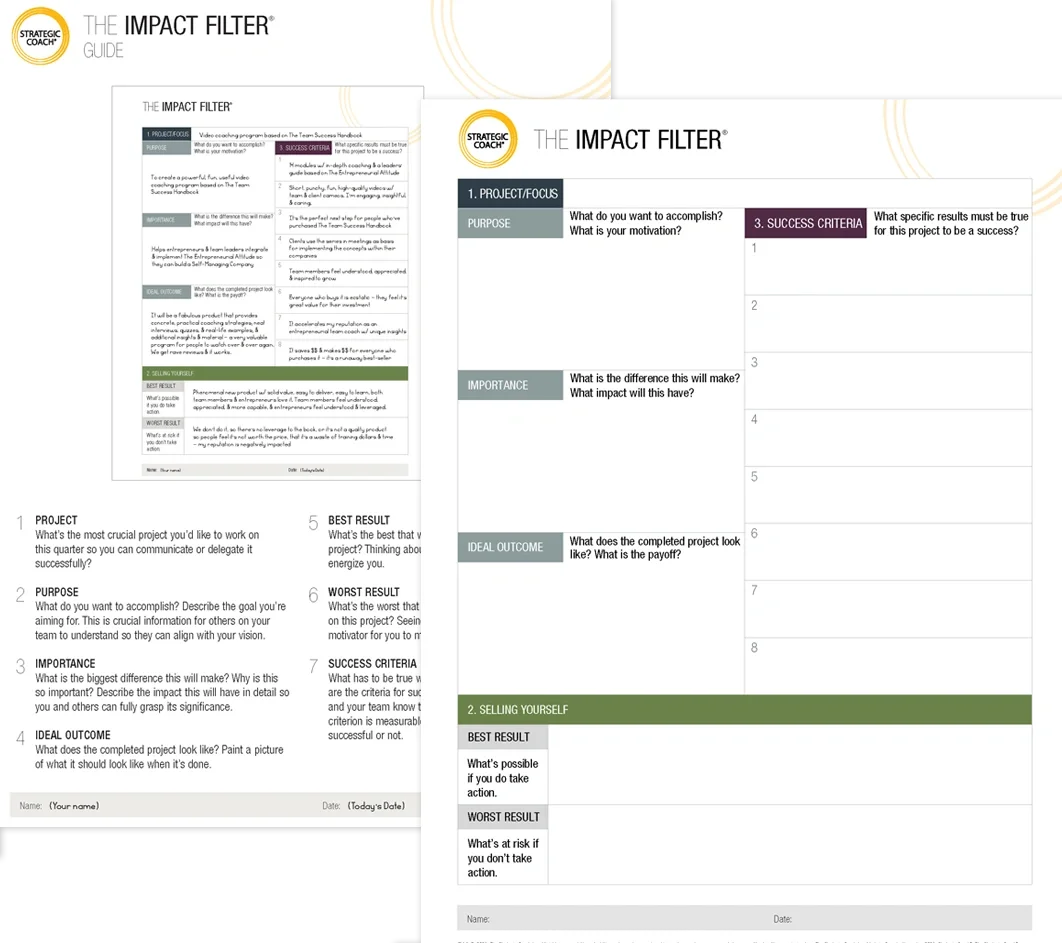
The Impact Filter®
Dan Sullivan’s #1 Thinking Tool
Are you tired of feeling overwhelmed by your goals? The Impact Filter is a powerful planning tool that can help you find clarity and focus. It’s a thinking process that filters out everything except the impact you want to have, and it’s the same tool that Dan Sullivan uses in every meeting.