The Greater Game: Chapter 10 – Greater Courage
September 03, 2026

Hosted By
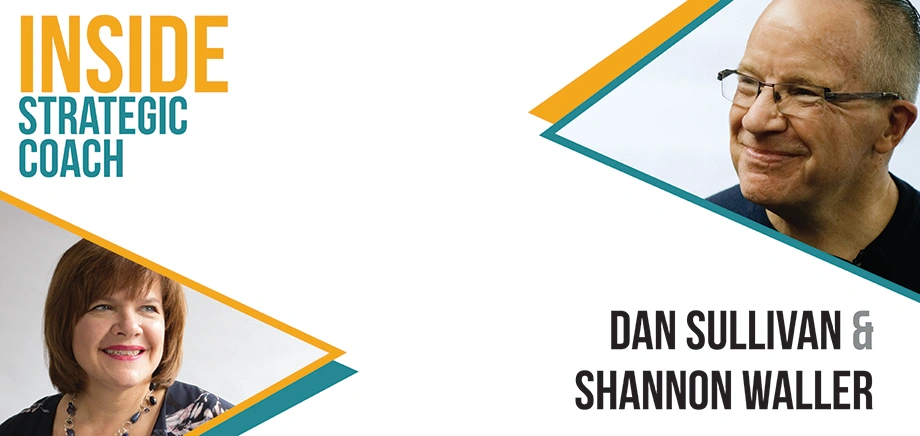
 Dan Sullivan
 John Bowen
Greater Courage is the final of the 10 Multipliers in The Greater Game, and it may be the one that determines how far you go. In this episode, Dan Sullivan and John Bowen discuss why fear can point toward your biggest opportunities, how courage builds new capabilities, and why a growing company gives entrepreneurs the confidence to keep taking bigger jumps.
Show Notes:
The Greater Game Dashboard™ gives entrepreneurs a way to measure their progress over time.
Becoming an entrepreneur takes courage because you’re taking responsibility for your own financial future.
Many entrepreneurs wait for proof that something will work, but fear can be a compass pointing toward the right opportunity.
Taking on something that makes you more capable requires courage.
Courage is easier to recognize after you’ve practiced it than before you take the first step.
AI can be a phenomenal teammate, but it can’t replace human judgment, coordination, or big-picture thinking.
Given how many businesses fail, becoming an entrepreneur can seem like an irrational choice, but courage makes it possible.
Creating a 25-year vision for your life and business can feel scary, especially when you share it publicly.
The high-tech breakthroughs of the past 50 years show that individual entrepreneurs can create new capabilities that change the world.
Each time you consider taking another jump, the emotional risk can feel just as great as it did the first time, but the price of avoiding courage is losing the excitement that comes from growth.
Resources:
The Greater Game by Dan Sullivan and John Bowen
Episode Transcript
Dan Sullivan: Hi everybody, it's Dan Sullivan, and I'm here with John Bowen, and this is the podcast for the tenth chapter of our newest book. It's called The Greater Game. We believe that this is going to be the essential, fundamental book. It's going to be the Bible of entrepreneurism; that basically as the model goes deeper, as quarter by quarter goes by, we have greater and greater research to back up our dashboard, where you can go every day if you want to, but certainly every week, every month, every quarter, and actually have a quantitative measurement of your progress as an entrepreneur. This is the tenth chapter, but this might be the most important chapter, and this one is on courage, greater entrepreneurial courage, because it takes a lot of courage to become an entrepreneur, John. If you remember back to your start, then I remember mine, and every entrepreneur that I've ever talked to over 52 years takes a lot of guts to become an entrepreneur.
John Bowen: I was thinking about, as you were saying that, Dan, is that I have a fantastic wife, 46 years. She grew up at IBM, good corporate job, doing well, and so on. I don't know how many times in those early years she said, do you think you should get a corporate job versus this. And I was fairly successful early too, type thing. And I had a lot of friends kind of put their arm around me and say, John, you know, someday you're going to need to get serious about this stuff. You know, this is where the courage to really keep on going went. Nobody gets out of life unscarred. Stuff is going to happen. And if you're an entrepreneur, you're going to have some major downturns along the way. And unfortunately, in our research today, we saw fear as a stop sign. So many people just stop. They're waiting for evidence, you know, like there's going to be a magical signal that this is going to happen. And, you know, one of the things we write in the book is fear is a compass that, you know, the fear really helps you point you in the right direction. Those things that you're most afraid of are probably things you have the biggest opportunity for.
Dan Sullivan: You know, we start the whole series here, the chapter one. In a few minutes, you'll show the pyramid of growth that we're talking about here, John. But if you think about ambition, the way we describe ambition in the very first podcast here is that ambition is a result of acquiring new capabilities. Every time that you commit yourself to actually acquiring a new capability, the payoff is that your ambition immediately expands as a result of the new capability. I would say that it's the actual courage that you experience, which prompts you to say, I've got to become more capable here. So we've actually created a complete loop so far, with number 10 looping back to number one. You know, I'm at 82 right now, and AI just came into my life three years ago. And I said, you know, in all my entrepreneurial life, I think that this is going to be the most fundamental new opportunity to acquire capability. And, John, you're way ahead of me.
John Bowen: I mean, you were like a shark at a beach party with your enthusiasm and your …
Dan Sullivan: Well, I thought just as you did, too, that …
John Bowen: I forgot the book you wrote, one of the earliest ones I read of yours, with the microchip, and, you know, calling that paradigm shift. That was a big one. This is bigger type.
Dan Sullivan: This is much bigger. But I was feeling very, very comfortable because, you know, I'm a writer. And I would say that my main way of influencing all the other growth in my company is new writing, new books, new concepts and things that turn into podcasts and everything like that. And I've been thrilled of how ambitious I have become as the AI capability gets greater month by month, quarter by quarter. You know, I'm going to be way more powerful five years from now, 10 years from now. The amount of really high quality impactful, compelling writing that I can do five to ten years from now. I'm talking about in my late nineties. But it's basically, I have to face the fact that you have to go back to the courage that I had at 30 years old that prompted me to stop a good job in an advertising agency. I could have made a lifetime out of being a copywriter. And I said, no, I've got something I want to do out in the marketplace. It's easier to look to courage after you've already practiced it than before you practice it.
John Bowen: It is. And I want to bring up, too, on the courage side, you know, really, I'm going to go to AI again, because, Dan, nobody would have ever expected you at your age or me at my age, and I'm going to be 71, really embracing AI. You know, it's not that I didn't have trepidation. It's not that it didn't stump me on different parts and so on. But it's those things that we're afraid of that are going to make a big impact. And it has. I mean, one of the reasons we wrote the book was one of the major changes going on is the ability to use AI to augment you. You know, it's a phenomenal teammate. It doesn't yet have the judgment. It can't coordinate things. It oftentimes can't see the big picture that you can. And boy, to use these tools, I'd love to think that's giving us even more courage, but you got to deal with the fear first. If you look at the number of statistics of businesses being started that have failed over the years, nobody in their right mind should want to be an entrepreneur, but it's that courage. And I do like how you tied together ambition or greater multiplier ambition in the beginning. I always think of that as the vision. And just putting a 25-year vision of what you want to accomplish, what your life would look like, that's scary, particularly if you share it publicly. There's fear. And it's that courage to go build it that makes a huge difference and will change your life and everyone that you work with.
Dan Sullivan: Yeah, we've got a great story here, the chapter 10. We've actually got three really terrific stories. But the one that appeals to me most is Keegan Caldwell, and Keegan is, from my experience, I think he's the greatest intellectual property lawyer in the world, simply because I've benefited so much from the unbelievable capability that Keegan has created. And Keegan's, by his own testimony, he'll tell you that he had a very raggedy teenage years and early twenties years, but he's got this amazing sense to look at something that an entrepreneur has created and understand immediately whether that has intellectual property value. You know, there's copyrights, there's trademarks, but the biggest value that your creativity can have is that it's a patent, especially the stamp of the U.S., United States Patent Office.
Just in the last three years, a couple came through the other day, and we're up to 85 patents right now. And this is property. It's like physical property. It's like a home. It's like acreage. It's like art on the wall. It's like jewelry in the jewelry box. That your ideas as an entrepreneur can have lasting value. You get paid for it, because usually your creativity is a function of retail. I would call it retail creativity. Somebody's got a problem, you put together a solution, the solution works and you get paid for it. That's retail. But what Keegan has talked to us about, no, he says this has lasting value. Whatever you got paid retail, the lasting value, the property value may be much greater because that can be multiplied a thousand times out into the world. You have one solution that you do yourself, but what you've created can have a million solutions. And we know that from the high-tech breakthroughs of the last 50 years, that single individuals can actually create new capabilities that change the world.
John Bowen: It really is. I mean, you and I've had the discussion with Peter Diamandis. Peter, with the expansion of AI, is saying, geez, I don't know if IP is going to be important. I initially went that way. I'm now in your camp. I think it's going to be more important than ever. We devoted chapter 4 to property, the greater multiplier of property. And we lay it out. And one of the things, if you want to expand beyond yourself, you've got to be able to document. And then this is, again, where AI comes in so powerfully. I'm going to go kind of the rags to riches story. Paul, you know well, and I just thought he was always fairly successful. Paul's in my Free Zone coaching, and he had a major exit. Maybe give a little of the backstory because, I mean, this is a guy who gave up everything, his family house, and made one big bet. I'm not sure I would make it as big as him, and that may be why he's flying around in his private jet now.
Dan Sullivan: Well, Paul Abel was born in South Africa, and then things got dangerous there, and he moved to Israel, where danger is always there. And then he and his family moved to San Diego, and they did the smart immigrant thing, but they bought into bagel franchises, and Paul had ownership of that. By Paul's estimation, he was doing really, really well, but he's got a restless spirit, I should call it. And he got this idea almost from personal experience, something that happened, that he ran afoul of compliance issues as his company, and it cost him a really big fine. And the fine was one thing. And he is in California, so who would have ever thought that could happen? Who knew you could get into regulatory trouble in California? But he turned it around.
And this is, again, the example of what entrepreneurs do. They take a problem that's for them and they solve it for themselves. And then they say, I wonder how many other people are facing this problem? And they can get blindsided because they don't know. And what he mastered was the compliance world where you have effectively communicated to your employees. So it's basically, you know, you've got a company—let's say you have 50 employees, could be any number of employees. And even more complicating these days, they can be across state lines, they can be across municipal lines, so that the responsibility that you have as an employer is that you have to have fully and clearly communicated to them what their rights are. And he did this, first of all, just with posters, paper posters.
John Bowen: I remember during the pandemic, we were having our Zoom coaching calls and Paul would bring up his poster. I thought, oh, that's a nice little business that he's got.
Dan Sullivan: But then what he did is, because so much of payroll had been automated now, it's all digital, you get paid by an electronic signal that goes to your bank, but you get a statement that comes along, a digital statement, and he said, let's just put all the compliance rules on people's statement. And that multiplied it 100x and multiplied it 1,000x. But again, from a standpoint of the type of individual Paul is, at a certain point, he got a huge payout. He got a big payout for his bagel shops, and now he's on to his next thing. He's on to whatever appeals to him next.
John Bowen: I think, you know, one of the things, it's so hard to get the first client for every entrepreneur, then 10, then 100 and so on. Paul, before selling it, built it to over 200,000 subscribers. You know, these are huge numbers. And this is where, when you start the multiplier, ‘cause Paul really did this.
Dan Sullivan: Paul's done all four levels.
John Bowen: Yeah, he raced through, he struggled a little bit, I'll share that he basically lost everything three times. So, you know, let's get that security right in the beginning. No shortage of ambition, motivation, great guy, humble guy, got the IP on this compliance stuff, started building the community teamwork autonomy, and just really created a new market, was committed to it, and had the courage to see it through. And I do know he's off to his next adventure as well.
Dan Sullivan: Yeah. John, you and I can talk about this because you're very ambitious at 71, with good reason. And I'm very, very ambitious at 82.
John Bowen: The future has never looked so bright, Dan.
Dan Sullivan: Yeah. And I have to tell you, the biggest obstacle that I've seen to entrepreneurs finishing with a happy life is what happens when they think that they've run out of courage. The thing about courage is each time you think about having another jump, the risk is emotionally just as great. The entrepreneurial coin—half the motivation to be an entrepreneur is the excitement level of the entrepreneur. But I have to tell you, the other side of the excitement coin is the courage side, that if you think you're going to get to a point where no more courage is involved in being an entrepreneur, your price for having no more courage is you have no more excitement. I think you're more excited than I've ever seen you since I've known you, and I think I'm more excited. So nothing comes for free. Everything has a cost, and the cost of greater excitement in the future is that you have to have greater courage in the future.
John Bowen: Well, and one of the things I see so much, Dan, is that people get stuck at a level. They get their foundation for freedom. They get their energy for expansion. Many people stop there. Maybe they get the collaboration and multiplication, but they never give the opportunity for exponential impact because they're afraid. They don't know how to do that. And this is one of the reasons why we're creating the community, you've created Strategic Coach, is that you don't need to be afraid. And it's afraid not of losing money. If you made it to level three, you're getting offered some pretty big checks. And it's kind of like, geez, I'm afraid to continue the business growing and have that exponential impact where I'm creating the market, I've made this big commitment, I have the courage.
This is not our research, but I just read recently, I can't remember who, that within a year, 70 percent of the entrepreneurs that sell are disappointed. They got the wired funds. I can still remember when I sold my advisory practice. I really didn't want to. I was CEO, but I didn't own 50 percent. I owned just a little under. My two partners, a little older than I, we got offered 16x earnings. They said, let's hit it. And I get to choose who we went with, but it ended up being a great opportunity because I got to build this business. But can we grow this? And I think that's one of the biggest fear that entrepreneurs have, that they never reach their full potential.
Dan Sullivan: Yeah, the other thing that I think a great deal about is how much my growing company actually protects me. I think what happens with entrepreneurs who sell out and they think they're going to be happy with retirement is the day after they sell out and they no longer have that company structure. There's a lot of dynamic qualities about a growing company. You have phenomenal teamwork inside. You have great value creation relationships with your clients. You have deadlines, which I happen to love. You're never so productive as if you only have enough time to get the result. But there's the sense of making a real impact on the world outside of your company and that it's great today. It's the best you've ever done. But a year from now, it's going to be greater. Five years from now, it's going to be even greater. That's a tremendous protection. And so the company is the vehicle that allows you to be increasingly courageous.
John Bowen: Yeah, it provides you a platform. I mean, yeah, I had a big check bank account after selling in ‘98, but I didn't have my whole team around me anymore. And I agreed to do one year. My wife and I said, okay, we're going to take one year, travel the world, do all this stuff and so on. About six months in, we said, enough of this. And she goes, go start another business. And the reality is that it's hard to build platforms. It's okay to sell your business. Certainly, that's not the market that you want to serve. You're unhappy with it. Realize that. But then, does it make sense to reinvent? I'm in Silicon Valley. I'm in a very affluent area. I got to tell you, I have a lot of friends who have made a lot of money who really aren't that happy in life. You know, you cannot play golf five days a week.
The chairman of SAP owns a golf course that I overlook, CordeValle, and it's one of the top golf courses in North America. I remember I've played maybe five or six times a year, only when people come out to visit me. I find this more fun, Dan, and I know you do too, the building part. And this is where, you know, if you're on a journey and it's okay to get off—my parents did. They went sailing around the world. They only made it to Venezuela before all the Venezuela problems were a problem and decided to stay in the Caribbean. They stayed on sailboat for seven years. I think that was one of the hardest things in the world. I'd fly down every six months, help reposition. You got to pick whatever your passion is. And boy, the ability to make an impact in today's world with a platform has never been greater.
Dan Sullivan: Yeah, I think the big thing is that encourages people to not have any more courage is that they don't have any numbers to actually measure their life when they stop being courageous. And my sense is the dashboard that you and your great team, based on your research in this project that we've put together, is really the key that every week, every month, every quarter, you can measure where are you with courage right now as an entrepreneur. And there's something about turning what is essentially a subjective experience into a number that allows you to immediately clarify the next actions that would prove to yourself, first of all, but then prove to everybody else. He's getting more courageous as he gets older. She is getting much more courageous as she's getting older. And I think that's the biggest thing that we can have, that if you have the numbers that remind you on a frequent basis, and you have increasing numbers on a frequent basis that show that you're growing, you won't lose what you've had, and you'll always be gaining more of what means the most to you.
John Bowen: Oh, and Dan, you and I agreed to a 25-year partnership. We're two years into it. So we're surveying every month over 500 successful entrepreneurs. So we're enriching the dashboard. And let me just walk through this real quick, because I want to show you one, particularly the valuation part, why this courage is so important. Again, if you are listening to this, it's a very creative name, thegreaterdashboard.com. You go in, we have, as we've talked about, the 10 Multipliers. Just go through, answer the questions, 15 minutes or less. And once you have it, you'll have your own profile. You can go in. One of the things we're doing is new, but the entrepreneur pulse. This is just the first month we're making it available to the dashboard, and we're going to continue to enrich it with stories because Dan and I, our passion is about story, having entrepreneurs be successful in the impact they make. And this shares what we're seeing, where the confidence is.
We launched the book May 26. We started it this year. We're going to be doing this for the 25 years. And what are the singles that you should be looking at? What's moved this month and why? And I'm not going to go through all the statistics, but again, this is where you can really see the difference in how you can move from being that owner dependency to this enterprise that we talk about. But the real value of the dashboard is your own numbers. It's going to share with you. Remember, we flashed on the screen the pyramid. Well, we want you to be able to execute all 10 of these. We talked about Paul, how he really did that and took off. Well, we have opportunity here to grow more too. The top score would be 100. This is a demo one. And then, you know, it'll tell you where you are in financial readiness. The greater security is so important. Your gain, where if you go in and rescore yourself where you are, the biggest change.
Also, if it's appropriate, it's going to recommend a couple of things. One, if you have some financial gaps, you should probably get a second opinion. We have a company doing that. It's called VFO Connect, Virtual Family Office Connect. You can read about our belief system in chapter two. You know, you don't have to change advisors. It's just getting a second opinion. Also, you've heard Dan and I, you know, certainly if you listen to 10 podcasts, you know, I'm a client of Strategic Coach and I would give it credit for being one of the most important things I did in my life. And why is not only Dan and team helping us think through with thinking tools our strategy and how we can execute and how we can race through these four stages of the pyramid.
But even more important, I think, is with fellow entrepreneurs, always you're doing it together. And you don't usually get in a room like that. So you can get a starter kit. There's no commitment or anything there. And they'll do a discovery meeting with you. One of the things that Dan and I love is, you know, neither of us are in the market to sell our businesses, but the valuation, having that, this is pretty low. You know, as we go through all 10 Multipliers of four stages, you know, really the one question for you should be, and this is why we have the dashboard, is the architect, is it complete? If you're over here where this demo is, you know, three to five times EBITDA on the valuation, you're competing for market share, you're managing all kinds of dependencies, you are indispensable.
There was a time where we all wanted to be indispensable. We don't want to be that anymore. We're reacting to markets, we're pivoting at pressure, we're avoiding fear. What we are suggesting The Greater Game by playing it, that you can get into this 5.4, where you architect the ecosystems, you build a platform, you multiply your unique genius, your Unique Ability. You engineer absence so that you gain autonomy. You create categories, your market category, you're making it. You compound the vision through this courage we talked about, and you run toward fear. And that's what creates that huge multiplier.
And one last thing on the dashboard is that you can then compare how you stand, you, your peers, the top 5.4, and all entrepreneurs who have participated. And this can be a tool that you can go back to on and on again and really see how you're progressing on The Greater Game. And I know, Dan, you are and I am. We're excited to see how you execute this and make an impact, because this is the only way the economy moves is fellow entrepreneurs.
Dan Sullivan: Yeah, I just did it about three weeks ago, John, and I was happy for the score and I was eager for more.
John Bowen: Yeah. I just did that. I go, yeah, maybe you should update mine too, one more time. And we're all works in progress. Don't get discouraged. This is where we can identify what are the vital few things that we should work on and then go make them happen. Dan, why don't we wrap it up here? What would you close off on?
Dan Sullivan: Well, I think that we've journeyed through the 10 podcasts. We started this process before the book actually came out, but now we're getting feedback from the world about the impact of the book, and I'm sure it's going to give us new ideas for new podcasts on each of the 10 chapters in the future.
John Bowen: I'm looking forward to the journey. It is opening up. We both have had some great conversations, and very successful entrepreneurs have told us they've read it two or three times and the framing and they're trying to see how they can be even more successful. And I encourage you, it's so easy. I always remember reading The Seven Habits. I think the title is Stephen Covey's Seven Habits of Successful Individuals, and most people read it and then can't remember any of the seven. This is where it's really important to not only read the book, but let's put it into action. These 10 Multipliers, four stages, one question, you know, is the architect complete? It's never complete, but we're marching to it. You can build an unbelievable platform that you can change so many people's life and do well by doing well. Dan, why don't we wrap it up here?
Dan Sullivan: My feeling is that this will continually grow, that there's two major growth structures that are happening in the world right now, just based on my being a news junkie. And one of them is that more and more people are choosing to create businesses rather than to go into debt with higher education. It's very clear to me that this is happening. And the other thing is AI is always going to get better and more useful. So if you put those two together and you're an entrepreneur, you've got enormous number of factors in the world that if you choose to become an entrepreneur, it will give you the ability to be an exponential entrepreneur the next 25 years.
John Bowen: Yeah, there's so much capital available. If you have domain knowledge, you know, a term subject matter expert, the ability to build a company almost overnight. You know, Dan, as I was writing the book with you, on my seventieth birthday, I started three more companies. I thought that would be a great birthday present, and they're all doing well. And this is the opportunity that we all have. And as entrepreneurs, the world needs you. You need the world. Let's go make an impact together. I'm looking forward to seeing you playing The Greater Game.
Related Content


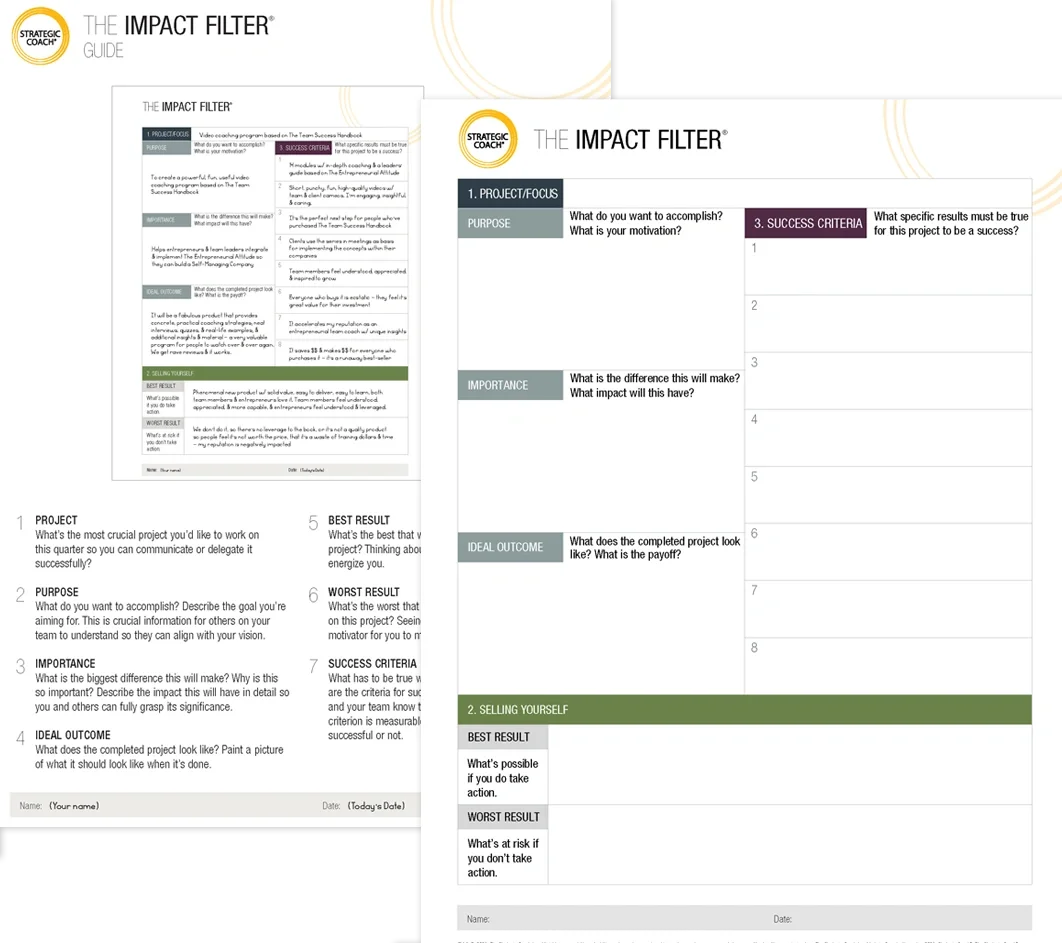
The Impact Filter®
Dan Sullivan’s #1 Thinking Tool
Are you tired of feeling overwhelmed by your goals? The Impact Filter is a powerful planning tool that can help you find clarity and focus. It’s a thinking process that filters out everything except the impact you want to have, and it’s the same tool that Dan Sullivan uses in every meeting.