The Greater Game: Chapter 4 – Greater Property
June 10, 2026

Hosted By
 Dan Sullivan
 John Bowen
The Greater Game is now available, and it’s the next-level playbook for already successful entrepreneurs who want to go 100x. Dan Sullivan and John Bowen explore “greater property,” the fourth of the 10 Multipliers, and how transforming your unique genius into intellectual property gives you both peace of mind and a bigger, more durable net worth.
Show Notes:
Greater property is how your unique genius becomes your empire.
You already have assets that can be appraised, and that’s a key part of your net worth.
Just a few years ago, the Patent Bureau in Washington opened the door for education and entertainment to be turned into patents.
In 1980, most company value came from tangible assets, while today many trillion‑dollar companies get 80 to 90 percent of their valuation from intangibles.
When you create shortcuts that other people can use, that’s intellectual property, and there’s a specific price and process for getting it protected.
The creativity you get paid for has long-term value when you take the right steps to turn it into protected property.
Many entrepreneurial companies are still overly dependent on their founders.
When you become the market architect instead of the main operator, your valuation multiples increase dramatically.
Your intellectual property makes you uniquely visible and valuable in a world that’s mostly not distinctive.
It’s far more enjoyable when your business can run without you needing to be there every day.
Intellectual property is the new currency in an exponential, idea‑driven economy.
Resources:
The Greater Game by Dan Sullivan and John Bowen
Episode Transcript
John Bowen: Well, welcome to our fourth podcast, Dan Sullivan and John Bowen. We're going over The Greater Game. We want you to join us on this journey. Today, we're talking about one of the most powerful multipliers there is—"The Greater Property: How Your Unique Genius Becomes Your Empire.” We're at stage two on the pyramid. We're using our energy for expansion. Dan, you have become such a powerful believer in IP where, quite honestly, I wasn't. A mutual friend of ours, Peter Diamandis said, you know, with AI, IP is dead. You have won me over totally. And as we were writing the book together, it just became so obvious where I missed. And we got to talk to Peter a little bit more. But Dan, give us a little bit of why you're such a big believer in IP and why this is so important if we're going to have the energy for expansion.
Dan Sullivan: Yeah, one of the interesting things about property, and you know, everybody we're talking to has property, they have real estate, you know, they have a great lifestyle, and these are assets that can be appraised and that's part of their net worth. One of the things that's happened, and I think it's a function of the technological change that's occurred in the world—when we first started Strategic Coach as a workshop program in 1989, right off the bat, our means of communicating entrepreneurs to think about things differently is we created thinking tools. We've mentioned a few of the thinking tools on the podcast, and the thinking tool is just a structure where we ask you about your experience and we have you come up with the best of your experience, and then we put the best of your experience together, and then saying, if you put this together in a new way now, what will it produce? And it'll produce new processes, new products, new services.
And what's happened in the whole world since the microchip has progressed and it's created the internet, an entirely new kind of property has been created that can be seen that if you look at the valuations of large corporations, 1980, you go back to 1980, you look at what their valuation is, it was fairly conventional. It was buildings, property, it was equipment, it was fleets, you know, it was real estate and everything, but it was all tangible property. What happened, and it happened about six or seven years ago, the Patent Bureau in Washington made a fundamental breakthrough and they said that education and entertainment now can become patentable. So you put together a great entertainment show, you can patent that. Our thinking process is, and we have 250 or more right now, I think there's more than 250, and we're gradually putting them through the process. We have a phenomenal intellectual property lawyer who's assisted us with this, and each of the patents is gradually—I just got two of them today before we started. And I said, well, that feels good, you know.
And these are appraised, like there's house appraisals, there's real estate appraisals, there's appraisals for your ideas. If you go back to 1980, that 80 percent that was tangible, now you take the largest corporations, a lot of them are tech companies right now, and you look at them, we now have trillion-dollar valuations of large companies. 80 to 90 percent of their valuation is based on intangibles, on new ideas and processes that they put into digital form. And this is providing great capabilities for everybody else. The consumers are the real buyers here. So what I've been gradually demonstrating in the Program, I said, look, every quarter, I'm going to tell you where our patents are. Well, the last quarter, we got them framed. So, you know, you have enough wall space for all these. Well, that's going to be a good problem. Well, we put the first 40 up. We have cafes in our conference centers, and there's 40 frames. We just started with 40, and we're up over 80 right now. And I said, what is that? And I said, that's a multiple of millions of dollars of value that's sitting on the wall.
And there's something that really is interesting when you realize that the ideas that you use just to do your day-to-day business, but you're doing it in a unique way, you've come up with a new way to create shortcuts for other people, this becomes intellectual property, you know, and there's a price for this, there's a process for it, and you have to pay for the process. But generally, whatever you pay to go through the process, you're going to get a 20x return. That's at a minimum, you're going to get a 20x return, sometimes it's greater. And the world is supporting you in this because more and more we're living in an intangible world and intellectual property. So I have hundreds of my Strategic Coach clients now who have thousands of patents. And you also have copyrights, you have trademarks, you have trade secrets, you have trade design. But your creativity that you get paid retail for has a lasting value if you go through the right steps.
John Bowen: Well, let me share the research, Dan, too. So I'm sure some of you are going, geez, I don't know. This seems like an awful lot of work. And the world has really changed. So it's opened up like crazy for you to have these knowledge-based Unique Ability patents and other trademarks and so on. And I want to show you, if Dan didn't hit you, I'm going to give you the numbers that will. Because, you know, again, we're talking, we're now at number four. And what we're doing here with four is, you know, again, it's the greater property, it's your genius. And one of the things that we find is so many entrepreneurs are founder-dependent. So the typical EBITDA, the multiplier on earnings before tax and depreciation amortization, is a multiple of somewhere around three to five. This is, you know, taking all industries. Obviously, there's going to be differences on different industries. But when you start moving toward the self-managed team, you can make a big impact. And that's 8 to 12. That's where you're no longer dependent.
We're going to go into more how you can really create your own markets. But if you are the market architect, all of a sudden the multiples just go up so dramatically. And I really love this line, Dan, your genius either becomes your empire or your prison. And one of the things we want to do is make it your empire. I think this is one of the most important multipliers, that once you take care of yourself, you know, from both the ambition to get started, you've got your security taken care of, you know, hopefully like a virtual family office, and then you're moving up and you've got your motivation. Well, now we're really building some major assets, this intellectual property, and it makes you so distinctive in a world that is not very distinctive at all.
Dan Sullivan: We talked in the previous podcast, the motivation, that you get paid for your contribution in dollars because you have a particular skill. But you also get paid emotionally if, in expanding your success, you're expanding other people's success. And that's the basis for motivation. Continuous, always expanding motivation, is that your success is actually multiplying other people's success. There's a really interesting way of looking at this. You've got a great house. Over the years, it's appreciated. And you're thinking about selling it, and you should clean up. And you go into the attic, and somehow, through some set of circumstances, you find a Rembrandt that's been packed away in a box somewhere, because you bought the house from somebody else and you have it. And whatever you thought the value of the house was, it just became very, very tiny compared with the Rembrandt. That's what intellectual property is. It's like you discovered a Rembrandt in your attic. Not only one, but maybe a Cezanne, maybe a Picasso, and everything like that.
But here, you actually created those paintings. This is your unique development of your company's skill and your skill, and it's been validated by going through the intellectual process. You copyright everything, you get trademarks for everything, but the big jump is the patents. The patents are the nuclear weapon of the intellectual property world. I went through a valuation with somebody who's a terrific seller of people's companies, okay, and I gave them, you know, this is where we were before we started the patent process, and, you know, we're a very well-structured company, you know, we have lots of processes in our company, and he gave me a valuation, and it was in the three to five percent thing, and I said, but in the last three to four years, we've now turned our thinking tools into patents. And he says, well, it's a rough estimate, but he said, whatever valuation I gave you before, it's now three times what I gave you before, just because of the patents.
John Bowen: Well, you and I were talking, I did a little deep research, you know, using Google Gemini, and it very quickly found all your patents and it said, you know, raise how you would value. I mean, this is common knowledge, other than so many times we're so busy as entrepreneurs that we're not protecting this, and it's a missed opportunity. And then people want to work with people that own intellectual property. Dan, I want to go into Keegan Caldwell. He's been one of the great resources you've had at Strategic Coach. You've introduced me and many of the other entrepreneurs you work with. And Keegan's really made a difference in all our lives. But I'd love you to just share a little bit of what he's done because it's interesting. You know, we think really, you know, he was a high paid employee working 80 hours a week, but it was his own firm and he hated it. And he started then creating the IP. And, you know, why don't you tell the story there?
Dan Sullivan: Well, the big thing was that just as far as his involvement with IP was, he was a patent clerk in the U.S. Patent, and he began to analyze how patents came in the door and how they proceeded. We had patents before we met Keegan. We had three or four, and it took forever to get the patents. That was partially the issue, but what Keegan created is a phenomenal process where your patent applications are written in a particular way. I call it patentees. It's a language that I don't understand, and he has diagrams that translate how the value is actually created, that when he puts them in, and there's an accelerator in the Patent Bureau where, for extra money—I mean, the Patent Bureau makes money. It's the one part of the government that actually makes money. They're a profit-making part of the government out of, you know, skill and what they do for you. But what he realized was that he could shorten enormously the process and the speed by which you get a patent back. You know, I average about a patent every two weeks and I just sit there and it's just like, whoa, there's another one. You know, it's like Christmas that never stops. The chimney gets bigger and the presents get bigger.
John Bowen: Well, intellectual property in today's world is the new currency. We're creating all kinds of value, and if you're not doing it, you're falling behind. And I want to give a little framing on this, is that this is a core shift that Dan and I are asking you to do, because what most of us as entrepreneurs have been taught is we should optimize. You know, let's work on 2x. We're going to, you know, work harder on our current model. We're going to get it right, damn it, you know, right away, I think. We're going to fight the physics. You know, we're just, through hard, hard work, we're going to make it work. You know, we're going to get linear growth. You know, we're going to be satisfied with that 10 percent a year, 15, whatever it is. And we're going to be stuck in that 3 to 5 multiplier. And the big thing is you are the business. And it's very fragile, you know, as we all are.
So what we want you to do is move over here to the architect. And I don't know, I love 100x. That's why the book is all about 100x, The Greater Game. We're no longer going to just do incremental. We're going to build platforms and ecosystems. And this is really, as we were writing this, Dan, I got to expand. I got to do this. You've already built your ecosystem. I have now new models, exponential growth, and all of a sudden, wow, what a difference. And the business runs without you. And that's where it's really powerful. It doesn't mean you have to leave the business. It's a lot more fun when it can run without you. And it's built on the multipliers. These 10 that we're talking about right now, the IP, Dan, and I mean, you know, you've been one of the leaders in moving from this optimization to the architect mentality.
Dan Sullivan: Yeah, and I think the big thing, it's just a new world, you know, and this really happened with the microchip. You know, there is a very famous Moore's law that Gordon Moore, who became one of the founders of Intel, but he just noticed that this new thing, which was called an integrated circuit, he just noticed that about every eighteen months to two years we get more computing power and the cost of the computing drops in half, so it's a 4x,and he had measured one and then eighteen months later and then he had a third one and he said, I just wonder how long this goes. So that's been going for roughly sixty years, and that's where the exponential growth in the world is coming from, is the application of microchips to every other invention, every other piece of machinery, every other part of process. But it's also the application of the microchip to the microchip to create more powerful microchips.
So the whole thing is that we're living in a new world. We're living in an accelerating exponential economy. If you have your mindsets right and you have built your business around the 10 Multipliers that we're talking about here. But not only that, you're getting the measurement that tells you that you're making great progress. And I can tell you, you could take every other concept that we do in The Greater Game book and you could do it. But if you don't do the measurement and you don't compare your progress with other people's progress, you'll stop.
John Bowen: No, it's so true. And, you know, one of the things you and I are going to say over and over again, because this is really fundamental to both of us, is we want to bring people, our fellow entrepreneurs, on this journey together. We have, you know, the privilege of being where we are. We've got all kinds of empirical research. We're studying every month now, 500 entrepreneurs, successful entrepreneurs. what's working for them, what's not, where is their confidence level, what lessons can we learn? And then, you know, Dan, with your organization, we've got the applied experience, you know, on the individual’s specific, and we bring that together. And it's a wow, and we bring it together. So it's easy for you to get. I mean, certainly get the book. But once you've got the book and you start reading, you'll see at the end of each of these chapters, multipliers, we have a little tool to go through.
But Dan and I have created with our teams thegreatergamedashboard.com. If you're listening to this, there's a QR code on the screen now. And it's The Greater Multiplier Index. It's an assessment that you can do. It takes 15 minutes. You can see where you score. You can get everything in plain English. You're going to see each of the stages of The Greater Game Pyramid, the three moves that we would do if we were you using the tools that we have. And then you're going to get the Entrepreneurial Pulse, a monthly benchmarking of how you're doing against your peers. And one of the things we all want to do is, I live in Silicon Valley. I'm in a pretty affluent area. There aren't that many entrepreneurs even when I go out. It's hard to explain what I do, you know, with some of the local friends. On the other hand, I love getting together at Strategic Coach with my peers, with entrepreneurs, and you can do it as well at the dashboard.
So just come in, take the assessment, you click on here, a whole bunch of questions will come up, you know, a small series for each of the multipliers. You can go, once you've got that, you'll be able to sign in and you'll have the ability to go and look at how are you scoring in each of the stages, each of the multipliers. you'll get an overview of your financial readiness, with greater security is the second multiplier; any changes since you last took it, the three moves that we would have you do and why, and then again, you know, one of the things that's so important is your security. That's the VFO second opinion—make sure to take advantage of that—but with vetted financial advisors who deliver an amazing experience. But what they're going to do is do it a second opinion for you, where you are now, where you want to go in the gaps.
And one of the things, you know, this is why, Dan, I'm in Strategic Coach, the acceleration. I want to have those thinking tools. I want to have the people that are there. And we were talking about IP. One of the things that can happen is, it will measure where we think. We're not going to buy the businesses back at these multipliers, but we're going to show you what the predictive analytics says through the way you answer these, where you stand right now. And you can see this is a demo one, but you can see the valuation. And then one of the things I love is you'll get the peer. You can see against all entrepreneurs, the top 5.4 in your revenue range, where you are. This is going to give you guidance. We're going to keep on building this up, Dan, because we are committed to the journey. But why don't you wrap this one up if you would.
Dan Sullivan: Yeah, I think the big thing here is you can sort of consider everything you've done as an entrepreneur to stage one of your entrepreneurial lifetime. You've done the hard work. I mean, it's not easy being an entrepreneur. And we want you to know that all the work that you've done up until now has brought you to a point where you can take advantage of the incredible acceleration and incredible exponential growth. And it's going to be easier, much, much easier than stage one. Stage two is it's all reward from now on. You did all the hard work. You did all the investment. Now you get the return on all of your investment.
John Bowen: So let's capture that right now so you can make an even bigger impact, create value for others, and do well by yourself. And what we have here is, you know, get The Greater Game book, join us on the dashboard, thegreatergamedashboard.com, see where you are, get access to the new research, and then join us in the greater community, where your competition becomes your multiplier.
Related Content


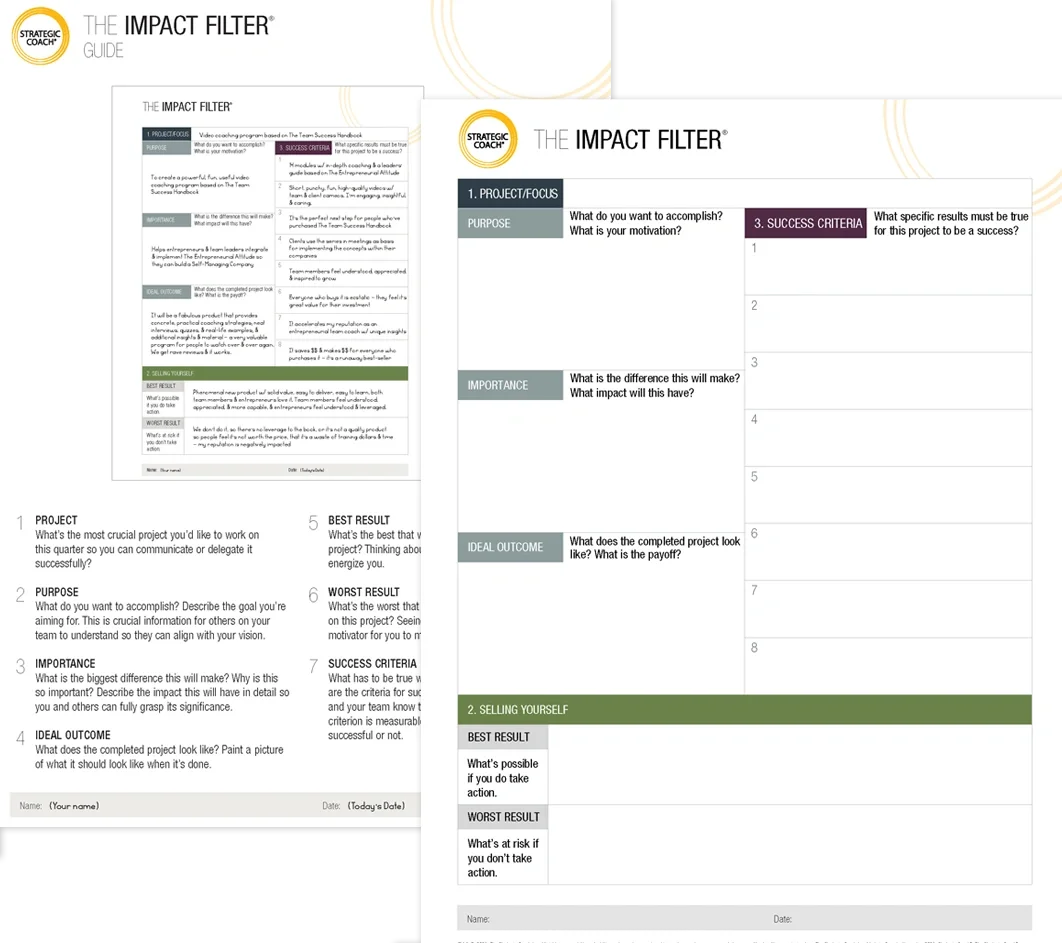
The Impact Filter®
Dan Sullivan’s #1 Thinking Tool
Are you tired of feeling overwhelmed by your goals? The Impact Filter is a powerful planning tool that can help you find clarity and focus. It’s a thinking process that filters out everything except the impact you want to have, and it’s the same tool that Dan Sullivan uses in every meeting.