Three Profiles Top Entrepreneurs Need To Know
October 20, 2026
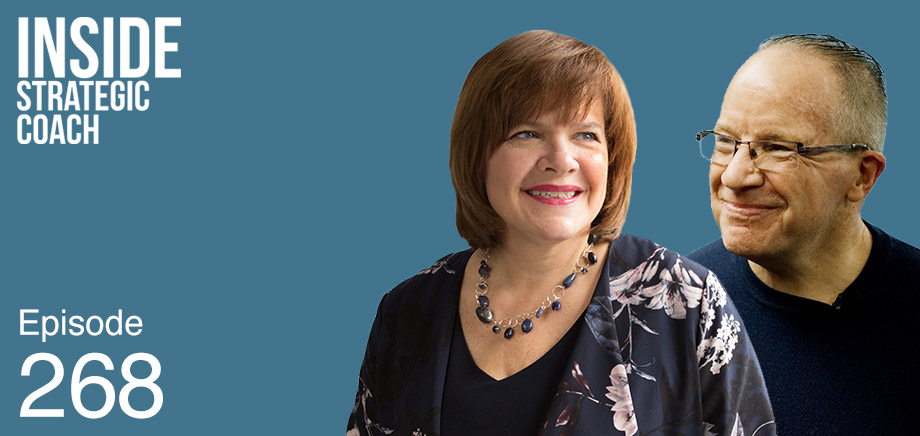
Hosted By
 Dan Sullivan
 Shannon Waller
For decades, The Strategic Coach® Program has been helping entrepreneurs live their best lives. One of the first things new members receive is a set of three psychometric profiles. Business coaches Dan Sullivan and Shannon Waller explain the importance and the benefits of what they call the “Strengths Package.”
Here’s some of what you’ll learn in this episode:
- What sets the Strengths Package profiles apart from the many other options available.
- The concept that’s the cornerstone of The Strategic Coach Program.
- Why receiving profile results nearly 35 years ago was the most liberating experience of Dan’s life.
- How using profiles improves teamwork.
Show Notes:
The three profiles in Strategic Coach’s Strengths Package are Kolbe, CliftonStrengths®, and PRINT®.
The three Strengths Package profiles are extraordinarily valuable at getting to the very central concept in Strategic Coach, Unique Ability®.
Kolbe profiles tell you what activities generate happiness in your life, and what activities give you problems and failures. It measures how you can be relied on to take action.
While using profiles doesn’t guarantee success, not using them guarantees failure.
You never learn less by testing out a new idea.
Profiles provide users with a shared language.
The PRINT Profile deals with your underlying motivation, or your “motivational identity.”
Resources:
The Gap And The Gain by Dan Sullivan with Dr. Benjamin Hardy
Who Not How by Dan Sullivan with Dr. Benjamin Hardy
In our previous episode, Dan Sullivan and Shannon Waller explained how entrepreneurs can turn their unique knowledge into capabilities that grow beyond themselves. Listen to The Entrepreneur’s Guide To Becoming An Invention Machine.
Episode Transcript
Shannon Waller: Hi, Shannon Waller here and welcome to Inside Strategic Coach with Dan Sullivan. Dan, today we are taking a question from one of our clients because we use three profiles. And actually, thanks to our brilliant designer, Cathy Davis, we now offer these profiles to people just when they start. So it's part of what we call the strengths package that as soon as you register for Coach, you get these. And it consists of three psychometric profiles, Kolbe, CliftonStrengths, and the PRINT profile, which is called the Why of You. Now, this person kind of wanted to know more about them. I think they've only completed one of them. But what difference does it make and why do we do it? I thought, oh, well, I'm having a conversation with Dan. Why don't we talk about that? And I'm someone who's very active with profiles and certified in a bunch. But I thought this would be an interesting conversation, Dan, because it ties into Unique Ability. And you've had your own experience when you've done the profiles. So let's talk about the value of profiles and why we found it so, I'm going to say, strategic to include in our conversations in Coach. What's your take on profiles in general?
Dan Sullivan: Yeah, well, first of all, I think there's probably thousands of things out in the marketplace that simplify people's lives, that you're this type of person. And I think the dating platforms did that, that you have this kind of person, you have this kind of person, you know, and they're based on large volumes of information. So they've actually tested millions and millions of people or thousands, whatever the case is going to be. And they ask you questions, and the way you respond kind of determines that you're this rather than that. So I would say that. And some of them are Mickey Mouse, they're like reading your astrology in the newspaper. You know, you're a Taurus, so be prepared for some big opportunity coming along this week, you know, something like this.
But the ones we use are actually time-tested over an enormous number of years with millions of people, and they're extraordinarily valuable at getting the very central concept in Strategic Coach, which is Unique Ability. So if you go right to the center of the Strategic Coach universe, the concept that is the foundation for everything, it's sort of the cornerstone for the whole building, it's Unique Ability, and that is you're born with something that you find extraordinarily easy to do, and you're very, very good at it. But because it's so easy, you don't take it seriously because you've been told that you've got to really, really work to find out what you're really, really good at. And these tests kind of indicate that lead a happy life, do more of this and don't do any of this, you know, basically.
And our first experience of this was with Kathy Kolbe. And Kathy Kolbe created the Kolbe Index. You know, it takes about a half hour. And I think it's what, 34, 35?
Shannon Waller: It's 36 questions.
Dan Sullivan: 36 questions, and you just say, this is more me than that is. And then they have a algorithm that they actually come at you probably about four or five times going after the same thing. I don't know the background to it, nor do I care. But the big thing about it, when I got my profile... In those days, you did it on paper, and then you had to send it, this is early '90s. And it came back, and it was the most liberating experience of my life because I could see the profile that they gave me. It's four numbers. And mine was a 2-2-10-4. And I immediately saw that all the happiness in my life came from when I was doing activities described in this profile, and all the troubles and problems and anxieties and failures I'd had in my life when I wasn't doing that.
So I was sold on it. Then we started to do our team in that, and it had a very, very positive effect. Positive in the sense that people really felt good about it, but the other thing is, their teamwork improved. And they could understand why they should be doing this rather than doing that. So it was very, very gratifying. Then we introduced it to our clients, and the clients liked it, and the clients did it for their team, they did it for their family, and they did it for their customers and everything else. So I think there's hundreds of thousands of these profiles have come directly from us to Kolbe to do it. So that's one of the profiles that we use to line up, especially when we're bringing someone new into the company. You know, we have our role description. We need this kind of person and they have to find it really easy to do. They do it really, really well, and they love doing it. And it doesn't guarantee success, but my feeling is, not using it will guarantee failure.
Shannon Waller: <laughs> That's a great description, Dan. I love that. And just to add a couple of distinctions about Kolbe, every single question is a check and balance for the other, because you actually answer most and least, and how you do that, your consistency determines what your profile is. You're very consistent, I might add. As was I. And it's fascinating because it measures a part of the mind that has been known about by early researchers but unable to measure. So cognitive, your brain power, your mental horsepower, that's IQ tests, SATs, all that kind of stuff. That's your speed of learning and retention. And there's your personality of which there are a kajillion profiles, everything to very valid and reliable, validated ones, and they're reliable to everyone to which Avenger are you? Also, one of my favorites, not exactly reliable. So to your point, there's a lot of different ones out there.
But until Kathy Kolbe, they'd known that the word conation existed. It's your will, it's your volition, what you will or won't do. Not what you can or can't do, not what you wanna do or don't wanna do. It measures how you will actually problem solve and take action, which last time I checked was how we work together, taking action. It's validated and it's reliable. And anything that wasn't all correlate with personality or intelligence, those questions were stripped out. So it really is essential. Now, how well you do something has to do with your brain. What you take action on, what you care about, that's gonna be measured by something else. But how you can be reliably counted on to take action, that's what Kolbe measures. So it's really unique in the world of psychometric profiles because the only one that's a validated instrument to do that. And so I love knowing it for our clients because it tells us how we can best serve people and then who we hire. I profiled my sister before I hired her. And she was like, what do you mean you might not hire me? I'm like, well, this is what the job requires. I don't want to make you unhappy...
Dan Sullivan: Or make us unhappy.
Shannon Waller: Make us unhappy. I profiled my husband before I married him.
Dan Sullivan: Yeah.
Shannon Waller: And he has the same profile as you, which is interesting. It's just been one of those pivotal points. And it helps people really be trusting of that Unique Ability concept, Dan, because they're like, oh, this is how I'm constructed. This is how I can be of value. This is how I can be of use and not try to be everything they're not. One of your core concepts early, early on is, work on your strengths. Don't work on your weaknesses. All you'll have is really strong weaknesses. And Kolbe was the first tool in the toolbox that really helped to support that.
Dan Sullivan: For me, my life is incredibly simpler. This is almost 35 years since I've done it, but I've gotten better and better at following the suggestions of Kolbe. I have three questions that I ask myself in any situation, and it's actually got some humor to it. There's a problem, and my first question to myself is, is there any way of solving this problem by my not doing anything? Generally, the answer is no. You have to at least talk to somebody about the problem. The second question is, what's the least I have to do to solve the problem? And the third one is, who is the other individual who can do the least so I don't have to do anything? But it happens once a day. It happens four or five times a week that somebody tries to delegate something to me, and I say, it's not going to be me. And I can just feel myself, all my shields come up and things bounce off. I used to be Mr. Velcro and now I'm Mr. Teflon. Everything used to stick to me, and nothing sticks to me now. But it's been extraordinarily useful. So we have a long-term, 35-year relationship with the Kolbe company, and it just works perfectly with us. And I think the reason is that we're a very action-oriented program. Our client base is action-oriented entrepreneurs, and it's crucial for them to get this right.
Shannon Waller: Yeah, it really is. And to know and appreciate and have language. And by the way, it's spelled K-O-L-B-E.
Dan Sullivan: K-O-L-B-E.
Shannon Waller: Not the cheese. K-O-L-B-E. And Kolbe Corp is a phenomenal partner. There's no question about that. So it's really the fundamental profile that we use. But since then, we've actually stacked on a couple of other ones. So CliftonStrengths and PRINT. CliftonStrengths comes from The Gallup Organization. So, Dan, when you got your CliftonStrengths profile back, used to be called StrengthsFinder, now it's CliftonStrengths, what was the impact of that on you?
Dan Sullivan: Well, it was a different feeling for one thing. You know, the Kolbe was really, really liberating. I just felt liberated. I mean, it gave me instant forgiveness for everything bad and everything stupid and everything that was a failure in my life because I realized I was just the wrong person in the wrong place at the wrong time for this activity. But the CliftonStrengths is radically different because Kolbe tells you how you'll take action to get the best possible result. But the CliftonStrengths says, what should you take action on? Okay, and I have five. You get five.
Shannon Waller: Top five.
Dan Sullivan: Top five strengths. There's 34 strengths. My top one is Ideation, and that is that you're fascinated with ideas. You create ideas, which, duh.
Shannon Waller: 85 patents, Dan?
Dan Sullivan: 85 patents, 62 books.
Shannon Waller: Hundreds and hundreds of trademarks and copyrights, yeah.
Dan Sullivan: Yeah, so that's what I do. And the other thing, the number two is Maximizer, which means I'm not interested in making average people better. I'm interested in making already great people maximize what they are. So I'm not interested in bringing people up to an acceptable level. They're already way above an acceptable level. I just want to take them greater. And number three is Self-Assurance, which is really useful because I come up with a lot of ideas, and I have an in-built confidence that I can never get into trouble with a new idea.
Shannon Waller: Right.
Dan Sullivan: OK. So I come up with a new idea. I tell people. They like it. They don't like it. It works. It doesn't work. I don't have any emotional response to that. Things work or not. And there's more where that came from. So it doesn't really matter. And I've got a graveyard of bad ideas. I take them out and bury it. Or it's too early and it's not the right place and that, so you never learn less by testing out a new idea. My number four is, first of all, I have been made to understand that there isn't a lot of this, and it's Context. Passionately, I want to know where things come from. I want to know how things connect with each other, which is also very useful for Strategic Coach. And number five is Activator, that ideas are worthless unless they lead to action. So if you put the Kolbe together, you know, mine is take action, but this is what you should take action on. So this is a good refresher for me.
Shannon Waller: Oh, that's good. That's good.
Dan Sullivan: I'm performing very well from these two profiles.
Shannon Waller: Yes, you are. Yes, you are. Just wait till we get to PRINT, which is really fun. So Dan, I appreciate you going through what your five are, which is really fun. And you do get the 34 and they're rank ordered. So we'll tell you what's your top five, your next five to seven. I also find it highly entertaining to look at the bottom 10. There's four different themes to the strengths. So one of them is relationship building. The other one is strategic thinking, which you have a few. The other one is influencing. And then there's executing. Activator is an executing strength. I have Arranger. That is the only executing strength. I also have a 2 in Follow Thru, so it saves my bacon a little bit. But five of the nine executing strengths are in my bottom 10. So the message that I got from that was, so Kolbe tells you a lot with whom you need to be in teamwork, your complement, not your similar. But then so did CliftonStrengths. Oh, I need to make friends with people who are really good at getting stuff done. That is not factory installed with this human. It was very useful. And so I can tell you who my executing friends are in the company. Because they are brilliant at getting stuff done. And their challenge is, they're always looking for interesting projects to work on. There is no lack of interesting projects with you or with me. They're not gonna get bored, put it that way. So that's really kind of fun.
So for me, CliftonStrengths gave a sense of direction. And you're gonna laugh, Dan, because I have Maximizer number one and Strategic number two, and I did mine in 2012, so long time ago. And I was like, I'm Strategic? I looked up and went, where do I work again? Hmm, Strategic Coach. It was one of those duh moments, like, yeah. And then I discovered I really am strategic, right? I hadn't had a word for it. And that's partly why I love the profiles, is it gives a common language, and you actually talk about your Unique Ability in the form of creating a language as well. It gives a language to capability, gives a language to Unique Ability, gives a language to strengths that we might not have had. And it's validated because Gallup at least has done, I think it's tens of millions of profiles that have been done. So it's kind of fascinating to know that of the 34, and they profiled 100,000 people even to figure out those 34. So pretty valid results. So it's super useful. And then you also know with whom you're working. What are their strengths and how can they be complementary to you too? Which I know you use CliftonStrengths that way as well.
Dan Sullivan: The big thing is that I think who you are and what you should be doing is just stage one of all these profiles. You know, you want to be in your Unique Ability, but your Unique Ability only has value if you're in teamwork with other people.
Shannon Waller: Yes.
Dan Sullivan: My big thing is teamwork. And in the CliftonStrengths, there's a couple of things that are very low on the 34, which is a great strength for me. One is that I never compete. I have zero interest in competing. And I think it's close to 30 or might be 31 or something. You know, it's barely a vapor in the gas tank. You know, there's nothing there. I just see no interest. I see no thing in competing, but I'm a really great collaborator. You know, I really love collaboration. So it's very important for me to know that and not get into competitive situations, but also don't get into situations where other people are highly competitive. I had a practice marriage in the '70s, and she was ferociously competitive. You know, when I first became an entrepreneur, I said the really easy part was getting rejected in the marketplace. But then I had to go home, and that's when the real trouble started.
Shannon Waller: Another aspect of this, which I find fascinating, and that is that there's a balcony and a basement version of your strength. So there's a high-level use of it and there's a not-so-high level. There's a raw, like a really basic and then there's a mature version. So if people are misusing their strengths, like every single strength has to be managed because it can go too far. It can go to an extreme, which is kind of fascinating. But again, it makes sense in teamwork because then you get to collaborate and you get to share. All capabilities are useful to some degree. And how do you do that? I just looked it up, Dan. 37,788,478 people using their CliftonStrengths to thrive at work and everywhere else. So they're at 37 million right now, which is kind of wild. I love that.
So the last profile that we've added in consistently for our clients is one that was introduced to us by our fabulous coach, Adrienne Duffy. And that is the PRINT profile, which was instigated by The Paul Hertz Group. So Debra Levine and Paul Hertz. It's really interesting because it's actually 100% in that motivation realm, which is your underlying motivation, your motivational identity, they call it. It's a cousin or inspired by Enneagram, but it is not Enneagram if anyone's familiar with that. So it has nine different measures, but then they've really made it dynamic questioning and added in Jungian psychology and things. And when you got your result back, oh my gosh, it was such a great way to capture who you are and why you do what you do. So it's the underlying why, it's your unconscious motivator, is what PRINT measures. So can you talk about your 7-3 result because I think that's…
Dan Sullivan: Yeah, it's really interesting. So it kind of tells you when you're great to be with for other people and when you're a real load for other people. I mean, that's the way I interpret it. It's very interesting because you got nine things, but there's eight times nine. It's 72.
Shannon Waller: There's 72. You're right.
Dan Sullivan: 72 different profiles. And it was very interesting. I think it's page 8 of the report.
Shannon Waller: I think the new one is page 8, because I was saying that and someone corrected me.
Dan Sullivan: Page 8, and it just shows you when you're at your best, this is how you come across to other people. This is how you impact other people. This is why you're valuable to other people. And when you're at your worst, this is what you look like. And I saw other people's profiles, and they didn't mean anything to me, but when I got my page, I could find a specific experience for every one of my Best Self, and I could find a specific experience of my Worst Self, Shadow Self. And the thing about it is that, I'll explain the 3 first, because the 3 is kind of in service of the 7. The 3 is, I'm really all about success and achievement. You know, I'm driven by success and achievement, but the reason is, I want big parties. I enjoy life, I want to have lots of fun, and success and achievement pays all the bills. I want bigger and bigger parties, I want more fun and everything else, but you gotta pay for it. And it fits perfectly. The other thing is that what I got from it is something that I've experienced, and that is that I am endlessly ambitious.
Shannon Waller: Mm, nice.
Dan Sullivan: As long as it ends up as a good time.
Shannon Waller: Yes, which is kind of interesting, Dan, because I look at Strategic Coach, I look at the company, and it's actually, if you look at what we coach our clients to do, it's how to be unabashedly ambitious and enjoy their lives and be happy. And those two things are not separate, they're not apart. I mean, the aim of the Program is 100% your PRINT. Which is kind of fun because you get people out of "The Gap." So 7 is to enjoy life and be happy, and 3 is to succeed and achieve. And so not only is that true for you personally, it's how you want the world to work for you. It's also what we create for other people. And mine is not dissimilar. Also happens to be the same as Babs's. Babs is your wife and Bruce is my husband, and between the four of us, we have two PRINTs. It's kind of funny.
I'm a 7-8, so is Babs. So 7, to enjoy life and be happy, and 8, to be strong and self-reliant, which also means don't tell me what to do. Will not end well. Which also means I want to be happy my way, which means that I enjoy things like watercolor and baking and also chainsawing. Who knew? But it's kind of fun. And then I also, you know, succeeding and achieving is how I could have that freedom to do that, which is kind of cool. So it explains, like, people who have an underlying motivation that's similar really get each other at a really fundamental level.
One of the other parts about PRINT, it's actually one of my favorite reports. You actually get three different reports with the profile. You get your Best and Shadow selves, and then you get your Trigger Report. And that's what takes you, it's when your unconscious motivators are not being met. And that will take you from your Best to your Shadow in a heartbeat. And you won't even be aware. You're just all of a sudden triggered. And it's really important that people take responsibilities for your trigger. So it's something that triggers someone else may not trigger me and vice versa. So, if this is a blind spot, you need to make it a spot, is what I heard someone say, which I think is good.
You know, you can either exit the situation or pause or ask questions. There's some great coaching in there. And the last one, Dan, if you were to fill it out, you probably haven't seen it for a while, but it's called the role alignment, which can be really useful when you're looking at someone who's currently employed with you or perhaps going to be employed with you. And you look at, does this job— And then it puts it into sentences. Does this role, will it meet your unconscious motivators? And you can score it one, two, three, or four. And last time I did it was threes and fours all the way down. So if you want to create a cool role for yourself, that's actually a great way to check it. So you actually get a lot of depth in the profile, which is cool.
Dan Sullivan: We've done a couple others over the years, but these are the solid three that we use. One of them was DISC.
Shannon Waller: I love DISC.
Dan Sullivan: Yeah. I'm a DI, which means I'm pushy. I'm sort of pushy.
Shannon Waller: Yes. Dominate or direct and influencing.
Dan Sullivan: Dominate or direct. And the I is…
Shannon Waller: Influence or inspire.
Dan Sullivan: Yeah. Influence. So I had that one. And then we had Working Genius, which has, if you're putting a team together, you can't have all the same kind of people. And there's certain people who you just don't want to put together at all. But when I started working with AI, this was Perplexity, and I took all my numbers from the five tests, and I said, give me the 10 characteristics of the individual who has these five profiles. And it was remarkably accurate. It was dead on how I actually experienced myself.
Shannon Waller: AI has been such a phenomenal integrator for large amounts of information, including about you, which is super cool. And so yeah, feeding the different profiles in is brilliant. And just for one more second about Working Genius. So this comes from the Table Group and Patrick Lencioni, if anyone's familiar. And there's a great book by that title. And the profile is 25 bucks in 10 minutes. Just go to workinggenius.com and do it. It's not one we include with our package, but I highly recommend people do it. And it measures what part of a creative process you wanna be a part of. And every process requires, as they say, every letter. So you've got Wonder, big 30,000-foot view asking the questions. Invention, coming up with answers to those questions and really figuring out, oh, we could do this, this, or this. Discernment, so you and I are both invention discernment. So discerning which of these ideas make sense now, the solution. Then, and once you and I have done the ID, we're kind of done. But then we need someone else to galvanize people into action.
Dan Sullivan: Babs is a Galvanizer.
Shannon Waller: Yeah, she is. So she takes the idea and then galvanizes it. And then you also want Enablement, which is what kind of support do you need once you've been galvanized? Really appreciate people who are supportive because that's not factory installed in this human. I appreciate that very much. And then Tenacity is cool because it gets it across the finish line. If we're talking elevation, this is the 5,000 feet to landing. This is actually what makes the idea happen. Every project needs every letter, and some of them, you know, that's your genius, your top two. You've got the ones where you feel competent, and then your frustration. That's the bottom two. And I think Wonder and Tenacity are my frustrations. I don't enjoy the Wonder part, like, why is the world like this? I'm like, I don't know. You probably would enjoy that more. And then Tenacity, it's like my follow through and everything else is long gone by the time we get there. But that's who I need to be friends with, are people who love to do the things that I don't, which is really fun.
So the only other thing I want to say about this, Dan, is that it's all a perspective. If you think about someone's Unique Ability and putting it into Perplexity or any of the other great AIs, it can give you this. Does it completely nail your Unique Ability? No, but it does give you a good pathway, and it gives you language. Otherwise, it's like trying to look at your skin from the inside. It's really challenging. And why we love the profile so much is it's one step of our Unique Ability process, which has eight steps. It's one step, but it's such a crucial one to actually give people the tools they need to be able to have confidence in their Unique Ability.
Dan Sullivan: The thing that I find interesting, because we've got 35 years of using the tools and testing which tools are better, because we're trying to blueprint success. If somebody new comes in, that they actually land on the first day. We've given a lot of thought to the role we want them to play, and we've taken a lot of care to realize that we don't put the wrong person in the wrong situation. I like hiring people. I don't especially like firing people. And I don't especially like trying to do too much course correction with people. I want them to be useful on day one. But from all the profiles, there's two things I don't think you can test. And if there's a profile out there that does this, I think it's really hard. You can't test for character. And you can't test for ambition. They show up as not dependable, or they show up as problematic, and I don't think you can test for that.
And the other thing is that you can't test whether they actually have any motivating purpose. I mean, there's intelligence tests too, which I think they have to have some chips. But I think if they have the right attitude and they have the right instincts, it works. And we give people a lot of rope to, not to hang themselves. But we don't know for sure someone, I mean, you're a good example. You were hired for sales. But you've turned out to be a program inventor. You've turned out to be a great public communicator. You've turned out to be a great coach and everything like that. But it took a while to sort that out.
Shannon Waller: Yeah.
Dan Sullivan: That's why you want to have a profitable company is that you've got a budget for experimentation with people. This is great. This is a great talk.
Shannon Waller: Yeah, I think so, too. I appreciate our client who asked it. I love that, Dan. There's room to experiment. We also do like to stack the odds in our favor and in the person's favor. And I think for our clients, it really helps them stack the odds in their favor too, because it's like, oh, here are some dimensions to you and some ways of describing how you naturally strive, what motivates you, what your strengths are. And I like Gallup's definition: A strength is talent times investment. And strength is where you can have near perfect performance. I'm like, ooh, that's sexy. I want that.
So these are just additional tools to help you go in the right direction and not distract you from other things. And it also, I think, Dan, if we want people to take their own experience seriously, it kind of eliminates that comparison that people are so tempted by. So I just love these profiles, and I've been one of the people who's helped bring them in. But to my mind, it just sets people in such a powerful right direction that I get very excited when people embrace that and make full use of them and appreciate just who they are and what they're up to.
Dan Sullivan: One of the interesting experiences, we have unusual longevity for our team members. I mean, you're 35 years, and I think we have four over 30 now. We have a growing number over 25, over 20.
Shannon Waller: Lots over 10. Lots of people over 10.
Dan Sullivan: Lots over 10. And I think the reason is that, where else can they go?
Shannon Waller: It's so true. Because the longer you're with us, the more we're playing to your strengths.
Dan Sullivan: The more we're getting you deeper and deeper into what you love doing, the more and more you're producing great, great results. But one of the interesting things is that we have a situation and it's not working, and I say, you know who we have to bring in here? We have to bring so-and-so to do this. And you can just say, oh, we need them.
Shannon Waller: Actually, that's a great point, Dan, Who Not How—
Dan Sullivan: We need a monkey wrench.
Shannon Waller: Well, and we think about Who Not How, this gives you a way to articulate the "Who" that you need, right? Even before you know their name, you can know the type of human that you're looking for. So I love that. Just because I always like to make sure people have a practical thing that they can leave with. So if you're in Coach, if you've joined Strategic Coach, even if just you paid your deposit, you will get the codes to do your Kolbe, your CliftonStrengths, and your PRINT. So take a few minutes to get those done. None of them take forever, unless you're second-guessing yourself. And if you're not yet in Coach, you can go to kolbe.com, K-O-L-B-E dot com, and do your Kolbe A profile, your index. That's the one to do.
If you are interested in CliftonStrengths, you can go to gallupstrengthscenter.com is how you can go do that. And get all 34. Don't just get your top five. There's gold in them thar hills. So you want all of them, and they've lowered the price for the all 34, which is fantastic. Now, we will include this in the show notes. If you are interested in doing your PRINT profile, you have to get it through someone who is certified. And as a result of your connection with Strategic Coach, you can have access to a discounted price for PRINT. So that's a special offer that we'll include in the show notes so that you can do that too.
Dan Sullivan: And you can do it all online.
Shannon Waller: All online, just get the codes and off you go. So fantastic, Dan. Thank you very much for kind of doing the exploring of it. And I think it's so valuable to hear your experience with it because that's fun and people get to know you better and understand how you look at this information in terms of how it serves you and your Unique Ability. So thank you. This was fun.
Dan Sullivan: That's great. Thank you.
Related Content


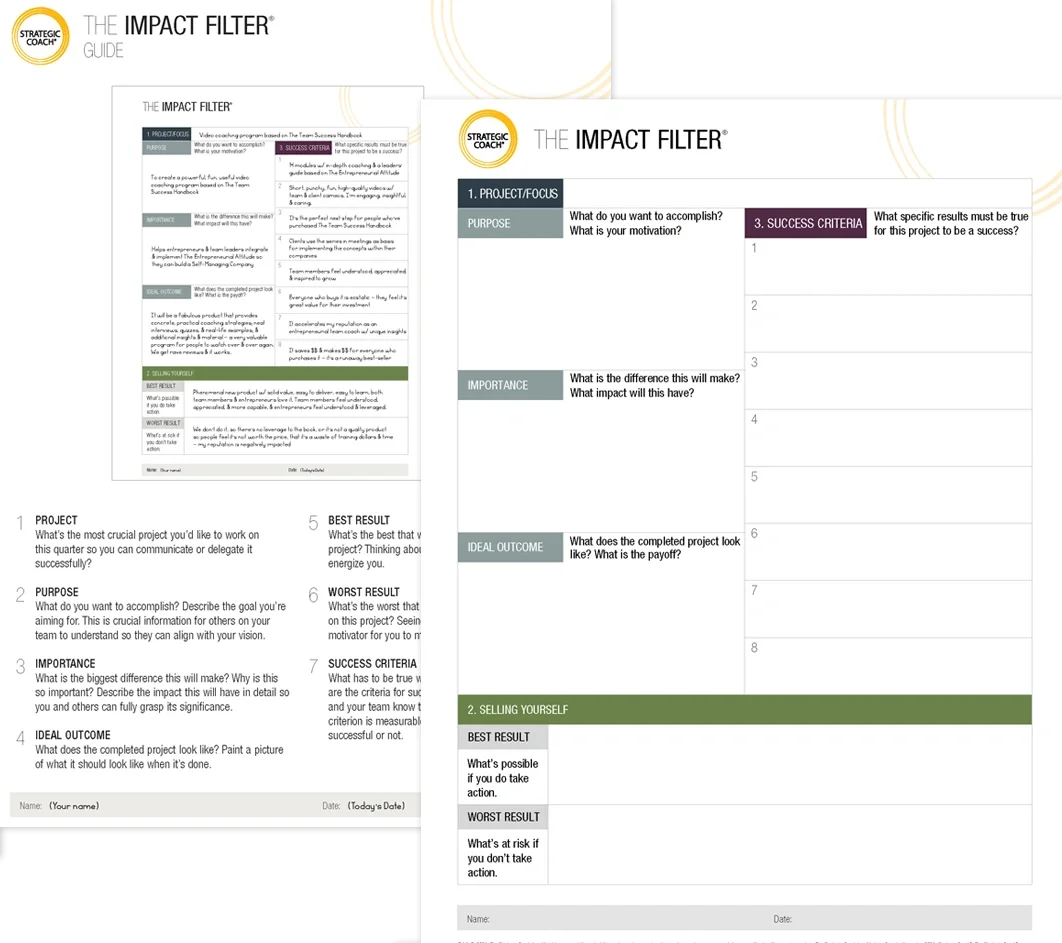
The Impact Filter®
Dan Sullivan’s #1 Thinking Tool
Are you tired of feeling overwhelmed by your goals? The Impact Filter is a powerful planning tool that can help you find clarity and focus. It’s a thinking process that filters out everything except the impact you want to have, and it’s the same tool that Dan Sullivan uses in every meeting.