The One Word That Stops Entrepreneurs From Taking Action
September 22, 2026

Hosted By
 Dan Sullivan
 Shannon Waller
Entrepreneurs like being in action, but too often they get stuck in an in-between phase on a project. Business coaches Dan Sullivan and Shannon Waller discuss the dangers of maybes and the benefits of making clear-cut decisions.
Here’s some of what you’ll learn in this episode:
- The new Strategic Coach® thinking tool that reveals where you’ve been successful saying either yes or no—not maybe.
- What’s led to Dan having very few maybes in his life.
- A question you can ask yourself to lead you into action.
- Why having made a wrong decision can still be a good thing.
Show Notes:
Both yes and no are strategically useful. In your past, you either said yes and took a complete action, or you said no and prevented yourself from getting into trouble.
Paralysis is in the middle of yes and no. This is where maybe is.
When you’re saying maybe, you’re not committed or certain, so you keep yourself in a state of suspended animation.
Your brain is what directs you toward and enables action, and it operates incredibly quickly.
You can give your brain some help by deciding yes or no, and eliminating everything in the middle.
Every week, look at your list of prospects and keep the yeses. “Maybe” kills you, “yes” rewards you, and “no” teaches you because you’re developing discretion.
For some entrepreneurs, their research phase doesn’t start until they’ve made a decision and are in motion.
When someone’s stuck in the maybe phase, it might be because they’re scared of making the wrong decision. They favor definitely not failing over potentially succeeding.
Instead of worrying about making the right decision, you can make a decision and then work to make the decision right.
Discovering what works for you leads to increased discernment.
No matter how long you spend on research and planning, you won’t know if your idea works until you engage with the marketplace or your clientele.
Resources:
The 4 C’s Formula by Dan Sullivan
Multiplication By Subtraction by Shannon Waller
Episode Transcript
Shannon Waller: Hi, Shannon Waller here and welcome to Inside Strategic Coach with Dan Sullivan. Dan, you have a particular perspective on the word maybe or the situation maybe. And I was kind of inspired by when you said, I have very few maybes in my life. I prefer to be in action and maybe doesn't have any room in that conversation. So, tell me about that. First of all, I like being in action, you like being in action, our clients like being in action, but a lot of people do seem to get stuck in this in-between phase. So, let's talk about maybe. What does maybe mean to you and what difference does it make in your life if you go that direction or you don't?
Dan Sullivan: Yeah, where this came up recently was we created a tool called Your Best Yes Is Your Best No. You know, where in your entrepreneurial life you've made a clear-cut yes decision and it was a big payoff, and then in your life where you made a clear-cut no decision and it was good. Then we had people put them together and take the yeses and nos and come out with some insights, you know, and it was a very good exercise. And usually people would say it was where I said yes and the yes paid off, but frequently it was about they had said no, and thank goodness I said no. But there was a clear-cut understanding that both are strategically useful. The whole point is that you either said yes and you took a complete action, or you said no and you prevented yourself from getting into trouble, but there was no paralysis in the middle, and paralysis is where maybe is. You're not saying yes, you're not saying no. You're not committed, you're not certain, but you keep yourself in a state of suspended animation.
I just went through a whole series of tests at our great clinic in Maxwell in Nashville, Tennessee. And I was talking to our great doctor, David Haase. He said, you know what your brain is for? And I had just gotten really, really good cognitive scores. Best ever, actually. So they show these brain scans. There's about 19 different things for measuring the brain. And you have three colors. So you have two shades of green. You have light green and dark green. And then you have red and yellow. And the cognitive scores show if you're green, that means, compared to the general population, you're in the top 75 percent. Yellow means halfway. It's like stoplights—red, green, and yellow. And then you have red, and red is you're below par. You're not really doing well. So that was three years ago, and this time I had 18 greens, and I had one yellow, and that was motor speed, how fast I respond to things motor-wise.
And then we got into this great discussion of how much improvement I had made, and he said, you know what the brain is for? He says the brain is for action. He says if we didn't have to act, we wouldn't need a brain. But he says your brain is what directs you towards action, enables action. And the brain operates very, very fast. It operates at like a trillion decisions per second. The human brain is just unbelievably fast. And he says that from the standpoint of when you tap a button or something, they can measure how fast you tap the button. I'm a bit slow, and I think that's been a lifetime. I think I've been kind of slow going from thought to action in my lifetime, and I think that's why I've had a lot of injuries. I've had a lot of orthopedic injuries in my life, where my brain was one place and my body was in another. Achilles tendons, both of them broken, tore my meniscus, broke my right arm. So I've got a history of my body and brain not being quite in the same space.
And he says, the brain is for action, and the better your brain is, the better your action. But you can give your brain some help by deciding yes or deciding no, and eliminating everything in the middle, not having maybe. And I tell salespeople, you know, we have our great sales team who fill up our workshops with new entrepreneurs. And I said, every week, look at your prospect list and say yes or no and get rid of the maybes and just go for the yeses. They haven't signed up yet, but clearly they're heading towards the yes. And I said, make a judgment call. And you'll notice that your sales will kick up, not necessarily that your prospects are any better than they were, but you're not spending time with people who are maybe. Maybe just kill you. Yes rewards you because you get the sale. No teaches you, because you're developing discretion about, is this a yes or a no? And you make your mind up. But if you keep calling someone and their maybe says, yeah, well, I'm going to do it, but I'm not quite ready yet. They're not going to do it unless they're yes or no. So that's really what I talk about. And I've noticed as I've gotten better as an entrepreneur, as I've gotten better as a coach, I just don't have a lot of maybes in my life.
Shannon Waller: Well, I like that. And one of the things you said, I prefer to be in motion and maybe doesn't support that.
Dan Sullivan: Yeah.
Shannon Waller: Right. And you've said, Dan, before that we were talking about Kolbe, actually. So your Kolbe M.O., how you naturally take action and strive and problem solve. And it's like you learn by doing. Right? Your research is after the decision, not before. Some people's action is before the decision, which is a Fact Finder approach. That works, too. But when you're in motion, when you've made the decision, that's when your research phase kicks in, so to speak.
Dan Sullivan: Yeah.
Shannon Waller: Yeah.
Dan Sullivan: Well, what about you? You seem to be an action person.
Shannon Waller: I'm exactly the same. I might need one more piece of information than you.
Dan Sullivan: Yeah, I don't do it with a chainsaw, though. You do it with a chainsaw, which seems to me more impressive. There's no maybes with chainsaws.
Shannon Waller: No, it's amazing how quick it is to cut off a branch or cut down a tree. Literally, like cutting down a tree, if it's medium size, five minutes, maybe less. It's pretty interesting. But Dan, you just got turned on by a leaf blower. Well, sorry, that's an inappropriate way to say it. Dan, you recently discovered the joys of leaf blower.
Dan Sullivan: Yeah, I like leaf blower.
Shannon Waller: That'll work on your motor skills. So this is really powerful to me because I see some people, not everyone, but some people really get stuck in that maybe. And to me, it's a mindset or a psychological approach where they're scared of being wrong. They're looking at other people's assessment or judgment of themselves rather than their own sense of discretion, which is a great term to bring into this. What keeps people in maybe? Maybe that's the better way to ask the …
Dan Sullivan: No, I think you just nailed it. Their greatest fear is being wrong. They favor not failing over succeeding.
Shannon Waller: Ooh, that's interesting.
Dan Sullivan: They could be born that way, so I'm going to discount being born that way, but I think it has to do with, you know, your childhood conditions, what your parents were like, and your formal education. And I think formal education, which is a little bit like a bureaucracy, it's children's introduction to bureaucracy, and then some of them spend their whole life in jobs or employment where they're in a bureaucracy. I think that the rule in bureaucracy is nobody got fired by saying no, but a lot of people got fired by saying yes.
Shannon Waller: Oh my gosh, that is so true. No one got fired for saying no, but lots of people got fired for saying yes.
Dan Sullivan: I think there's a greater penalty for having said yes, you know, and it was seen as a mistake or it cost time, cost effort, where no is pretty efficient.
Shannon Waller: Yeah. But it's interesting, what might be a quote-unquote success strategy in a bureaucratic organization or structure is actually, I'm going to say contraindicated for being an entrepreneur because …
Dan Sullivan: Just the opposite.
Shannon Waller: Yeah, you're not rewarded for saying no, you're penalized for saying no. Let's talk about that for a second, Dan. So how can people get in motion faster? Yes or no? And then I love the expression, make a decision and then work like heck to make the decision right, rather than worrying about making the right decision. I was coaching a client on that who was like, oh, how can I learn more about this concept and this tool before I take action? I'm like, dude, just take action. Your Program Advisor's coaching you to do that for a reason, right? You actually discovering what works for you; that's actually where your discernment's gonna come in.
Dan Sullivan: Well, let me ask you a question about that because you have much more in-depth understanding of the various profiles that we take. We use Kolbe, we use StrengthsFinder, we use PRINT, we have used DiSC, we use Working Genius and that. Am I just reflecting my bias as action-oriented, and so I want to get into action as fast as possible? Therefore, not doing action, either yes or no, my bias is towards action.
Shannon Waller: That's a great question, Dan. To my mind, no, this is not just a statement of bias. This is actually an entrepreneurial success strategy to say, yes, work like heck to make it right. Get the feedback from the marketplace.
Dan Sullivan: Well, it's going to fail fast if you're going to fail.
Shannon Waller: Exactly. I was quoting Professor Mike Tyson, as you call him, which is, you know, “Everyone has a plan until I hit them.” So you can plan and you can research and you can do all this stuff, working hard to make it right, but the marketplace has a vote, right? Your clientele have a vote. And until you're actually engaging with them, you do not know. So you can do your part to be responsible, deliver a quality offering to the marketplace, but then you need to be into motion. Now, do I want a Fact Finder not to fact find? No, that would be a terrible thing. But get into motion with your fact finding. Right? Get into motion with your Follow Thru planning. Get into motion with your idea generation as a Quick Start. Get into motion as an Implementer who's going to build physical quality. It's when we hold back on the striving that I think is so, the word dangerous comes to mind. It's a little dramatic, but that's what is not functional, is when we don't actually strive the way we need to. We don't do it our way, and we hesitate thinking it's someone else's way. As you said, they're more afraid of failing, usually in someone else's eyes. Otherwise, it's just information.
Dan Sullivan: Do you think it's more social than anything else?
Shannon Waller: Yeah, and emotional than it is how you strive or something like that.
Dan Sullivan: Yeah. And there's an absence of agency with maybe.
Shannon Waller: Ooh, talk about that. There's an absence of agency with maybe.
Dan Sullivan: Yeah, what agency is, as I understand it, or how I apply it to myself, is that no matter what happens in the future, I'll be able to handle it. I might as well go into action and get there.
Shannon Waller: I love that. Yeah, there's no fear. I love that.
Dan Sullivan: Well, I think there is fear, but …
Shannon Waller: There's courage, though.
Dan Sullivan: Yeah, there's courage, yeah. Well, the other thing is, I mean, there are some things which are just common sense, like believing that the law of gravity doesn't apply to you, you know. I mean, there's some things that I think are pretty universally true, you know, that gravity applies to you just as much as it applies to anything else. You know, we have levels of entrepreneurs in Strategic Coach. We have three levels. The most successful ones are the ones who are prone to action, and what they want to know as fast as possible is whether they made the right decision. But they can't make the decision until they've actually taken action.
Shannon Waller: Right. Yep. And to that point, they also iterate quickly. They don't stick with an incorrect decision or one that the marketplace is not rewarding. They're like, oh, okay, feedback. Let's take it. Let's move with it. Let's do something different instead. And so they don't get stuck or trapped with that either. It's kind of like, this is the psychological part for me, their ego is not in the way. It's all an experiment. It's all information. It's all learning. Let's go. You know, this is validated by some other Ontario people I follow, which is like, speed to market is a thing, right? Like don't ship perfect. Now, I'm a fan of quality, so there's always that, but do your best effort and go. So it's a matter of, again, letting the marketplace treat it as a collaborator. Treat it as something that has useful information and that you can't know it all.
This is why I like split testing and marketing. The smartest marketers on the planet test, test, test. They can think they know, but half the time they'll come back with a marketplace that goes, no, I don't like that fancy version. I like the simple one. Okay. Right. So I think to your point, the most successful entrepreneurs are prone to action. They put something out, they learn quickly, they make it better as it goes along, and they're not dissuaded or discouraged when they don't get the feedback that they wanted or that they hope for, or at least they don't let that discouragement stop them. Is that your experience with them too?
Dan Sullivan: Yeah. Our other tool, which is The 4 C's, is that you expand your ambition by developing new capabilities. You can only develop a new capability by taking action into an area that you're not good at yet. And that requires commitment, number one. First C is commitment. Then there's a period where you're scared, but you keep moving forward even though you're scared. Might be five minutes, might be five days, might be five weeks. And then you develop a capability. And I think capability is actually created out of commitment and courage. So it doesn't necessarily look like what you envision the capability would be, but you develop a new capability—that's the third C, so Commitment, Courage, Capability, and then you get Confidence, which allows you to do it at a higher level.
Shannon Waller: It's interesting as you say that, Dan, because what I was thinking is that commitment and courage are internal experiences. No one else knows what your commitment is or that you are experiencing courage in that moment. When it starts to become visible is when it becomes a capability and they see your confidence level. I think a lot of times, we've talked about this with social media, we're comparing our insides to other people's outsides. So, people really go into The Gap thinking, oh my gosh, everyone else is super confident about this and I'm scared, witless, right? But that's not true. That person had to go through commitment and courage to get where they are. So, it's an interesting time that we're living in where I sometimes see people being more cautious than ever before because they have all of this other evidence of other people being so successful and they're thinking, oh, I'm not up at that level, not appreciating that that other person went through exactly the same process. So what's your coaching to someone who is in that maybe phase? I was going to say dithering, which isn't very flattering, but who's in that in-between, I don't know, should I, shouldn't I? When someone's in that phase, what's your coaching to them, Dan?
Dan Sullivan: Yeah, I do it with a time sense. And one of the reasons why people can't make a decision is because they're experiencing emotions which are confusing them. I have situations, this wouldn't be so much of a business situation, but it would be more in an entrepreneur's personal life. And it has a lot to do with a decision they have to make at home, but they've been putting it off. And the way I do it, I said, okay, it's a year from now and you haven't done anything about this. Is that okay with you? And they said no. So we know it's not going to go more than a year. And then I move it back to six months. Is it okay if you haven't taken action in six months? And they say no. And they're making decisions as I ask the question, because I've moved them into a different time realm with it. I'm not asking him to make a decision right now, I'm just saying how far into the future can you afford not to make a decision? Then I get him back to 90 days. And, you know, that's a good time frame in Strategic Coach because we operate in quarters. And usually if you can get him back to 90 days, then it's not okay that I haven't made a decision 90 days from now. But depending on the situation, I'll say, what about a month from now? And then I leave them alone because there's a commitment that within a month they'll make a decision. Usually they make it faster once I've gone through that thinking.
Shannon Waller: Dan, that's brilliant because sometimes I will coach myself, especially if I'm bothered about something. It's like, am I going to remember this five years from now? No, I remember this three years from now, no, one year from now, no, so stop worrying about it, right? And I like that decision, if it's still true a year from now, like if you haven't started your exercise program a year from now, will that bother you? Like, yeah, it will, six months from now, three months from now, because otherwise it's just this big blob out in front of you. And when you put it into a time sense, it becomes so much more real. I remember with the story that opens in Multiplication By Subtraction, which is how to gracefully let go of wrong fit team members, the entrepreneur in our Team Leader workshop was like, oh, yeah, well, 90 days from now, I'll let this person go. And then he got this phone call on the way to his plane, it was a three-and-a-half-hour trip home, that he found out his clients were not happy. So he stewed about it the whole way home. And then he gets home and talks to the business owner. And the guy's like, why are we waiting three months? Anyway, I think it was 8 or 10 days later, that person was gone. So when you accelerate the time frame, it crystallizes the thinking in a way that's very powerful, because it just brings this cognitive thing into practical action.
Dan Sullivan: You're bringing the future into the present, and which future works and which future doesn't work. Because they can tell the penalty that they're paying, and usually it's an emotional penalty.
Shannon Waller: Yeah, it keeps you from delaying the inevitable. I think that's really wise. Well, thank you, Dan. This is such a fun conversation, because we all get stuck in maybes. But when you can reduce the quantity in your life as you have, and recognize that when you expand your sense of agency, in the sense that no matter what happens, you have confidence you'll be able to handle it. And then if you're stuck on something, add in that sense of time. You've really got a formula for great yeses and great nos, as we started off.
Dan Sullivan: I'll tell you something that I've noticed. Even where I've made the wrong decision, it always felt better than making no decision. And the reason is I took action. First of all, I've changed the situation by making the wrong decision. I'm dealing with something totally different, but now I'm sort of fresh. Okay, you made a wrong decision, so what's the right decision? How do you correct yourself? How do you transform the situation? Anything that prevents you from action, you just don't have any energy. Maybe kills your energy. Not only that, but it wastes time, it wastes effort. And the other thing is you're the only one that knows what's going on.
Shannon Waller: Yeah, so it's an internal conversation, not something that's necessarily external. You and your therapist.
Dan Sullivan: Well, I think that's a lot of what therapy is about.
Shannon Waller: Yeah, is sorting out a lot of maybes. I love that. So Dan, thank you. To me, this is a very proactive approach to life and one that certainly mirrors how I endeavor to live and some great coaching. So thank you very much.
Dan Sullivan: Thank you.
Related Content

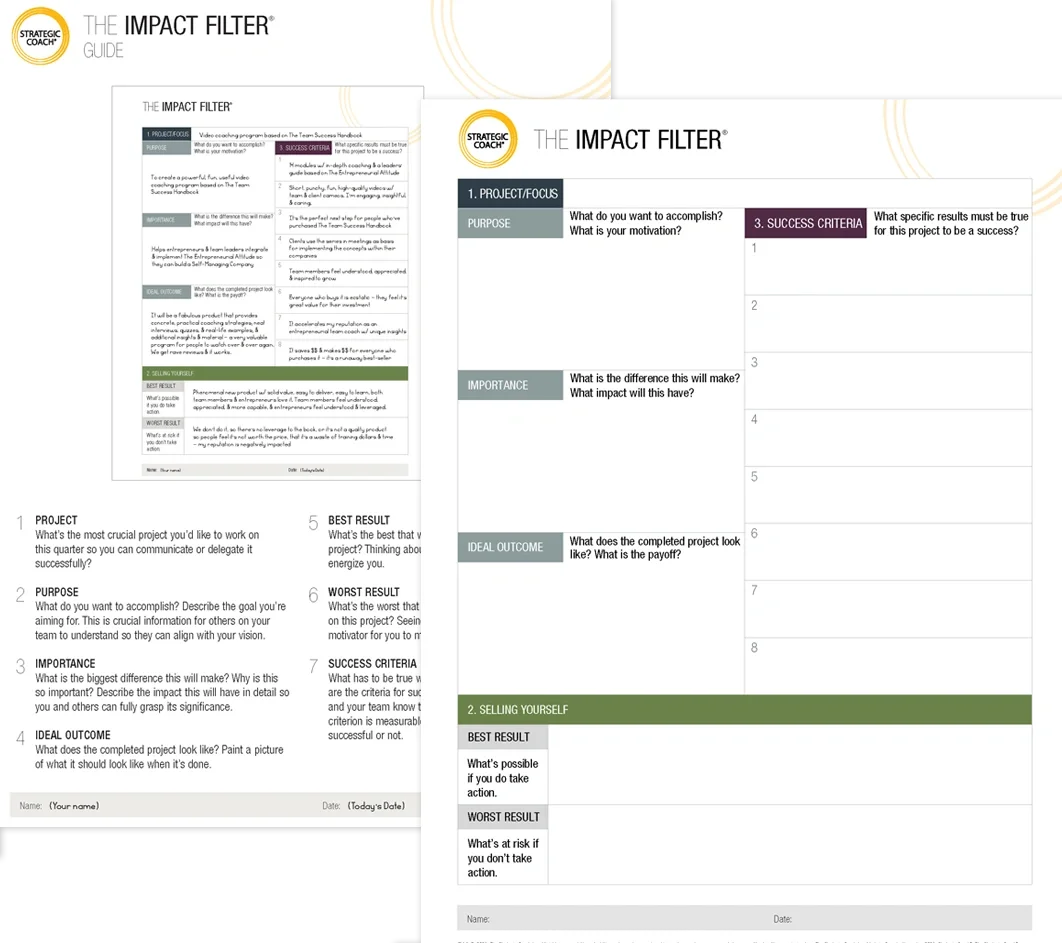
The Impact Filter®
Dan Sullivan’s #1 Thinking Tool
Are you tired of feeling overwhelmed by your goals? The Impact Filter is a powerful planning tool that can help you find clarity and focus. It’s a thinking process that filters out everything except the impact you want to have, and it’s the same tool that Dan Sullivan uses in every meeting.