Yesterday Creates Tomorrow
September 08, 2026

Hosted By
 Dan Sullivan
 Shannon Waller
What if the best way to create a better future is to focus on making today a great yesterday? In this episode, Dan Sullivan and Shannon Waller explore a simple, rewarding way to approach time that can reduce stress, sharpen focus, and help you feel more satisfied with each day as it happens.
Here’s some of what you’ll learn in this episode:
- Why the last seven months have been the best of Dan’s life.
- Why engaging in this process reduces stress.
- Why Dan hasn’t been feeling any pressure from his ADHD.
- How this system creates a more satisfying daily experience.
Show Notes:
What you do today, and how you think about it, shapes your experience of tomorrow.
Start each morning by deciding what would make today a great yesterday when you wake up tomorrow.
When you focus on creating a great yesterday, tomorrow becomes less about worry and more about the commitments you make today.
Creating great yesterdays can reduce the stress and regret you carry from the past.
When tomorrow takes care of itself, you can feel less pressure and anxiety about the future.
Getting emotionally attached to future possibilities can create anxiety because those possibilities don’t yet exist.
Each future possibility you become attached to competes for your attention today.
Focusing on today can improve your concentration by freeing you from stress about the past and future.
A simple point system can make daily progress more visible, playful, and satisfying.
There are no punishments in this system—only rewards for actions that move your life forward.
An activity is more valuable if you do it consciously.
Resources:
The Gap And The Gain by Dan Sullivan with Dr. Benjamin Hardy
Not Being Bothered by Dan Sullivan
Episode Transcript
Shannon Waller: Hi, Shannon Waller here, and welcome to Inside Strategic Coach with Dan Sullivan. Dan, we are working on a super fun project, our latest book, called Yesterday Creates Tomorrow. And you're having fun with it, I'm having a blast with it, and I've totally gotten into it, well, the practice of it, more than any other quarterly book, and that's saying something, because I love them all. So, first of all, I want to ask you, because Yesterday Creates Tomorrow is the title, what does that mean?
Dan Sullivan: Well, the neat thing about this idea, concept, is that we're asking the readers of the book just to rearrange what they're doing with three ideas that they're very familiar with. Everybody knows what yesterday means, everybody knows what today means, and everybody knows what tomorrow means. But it's the way you arrange them and what order that you do them in that makes all the difference in the world. Okay, so I'm going to tell you what the payoff is for doing it the way that we do it. And that is we're creating essentially a new relationship with time. okay, everybody's familiar with time. They've spent years on time. Some people have spent 10 years with time, 20, 50 years, truly has spent 82 years with time. And I had a feeling all along that there's a better way of doing it.
And just to give a shout out, it's a client by the name of Lior Weinstein who gave me the idea on this, and it was a story he told about being in a conference with other parents talking about their children. And everybody else in the circle, when they were going around, they said, well, my biggest commitment is that I give my children a great future. And got around to Lior, and he says, you know, I don't really know that much about the future. And he says, I don't know what my children are going to do with the future, so I consider my job to give them a great past. So every day when I get up, I commit myself to making sure that what I do with my children on that day, they'll remember as a great past, okay? And that was about two years before we got started on this project.
There was something about that idea that I found fundamentally powerful. And what it was that is what we do today and how we think about what we do today that actually determines to a large extent what our experience of tomorrow is going to be. So I just started playing around, and I came up with this time system that right now I'm seven months into, and they've been the best seven months of my life. Okay, and I'm 82 years old. So I put in 81 years, but the last seven months have been just amazing seven months. And the reason I'm doing that is that I have today, I have yesterday, and I have tomorrow. And the way I arrange it is that when I get up in the morning, I plan out the entire day and everything I'm doing. It's about 16 hours. Get up, 16 hours, go to bed, and the entire 16 hours that I'm going to spend today, including what we're doing right now, is so that tomorrow morning when I wake up, this was a great yesterday.
Shannon Waller: So you're making sure that you have a great past.
Dan Sullivan: A great yesterday. I'm having a great past. Linking it back to Lior is the way I'm creating a great past. Tomorrow morning, I remember I had a great past, and then now I'm in a new today, and what am I going to do in the new today? I'm going to spend 16 hours creating another great yesterday. Okay, now I got two great yesterdays in a row, and then the next morning when I wake up, I have another great yesterday, and I'm gonna spend that today creating a great yesterday, and that creates tomorrow. So my entire notion of tomorrow is a function of spending today creating a great yesterday. So that's the trick.
Shannon Waller: Oh my gosh, I love it. We'll get into some of the hows and wherefores in a little bit, but it's had a very profound impact on you. I mean, you said it's been the best seven months. So what does that look like? I've been doing it roughly for, I would say two weeks. So I'll share my much more limited experience. I was a little slow on the uptake on this one. But what difference has it made to you, Dan, both when good things happen or when challenging things happen? What difference has it made in terms of your behavior so that it is always a great yesterday?
Dan Sullivan: The great thing about this is that I'm learning a lot of new things as I go through the process. So as I speak to you today, I've had seven months in a week—yeah, 218 days. It's funny, I wear an Oura ring that measures your stress level, it measures how you're sleeping, measures your exercise. And about 30 days ago, I got a note and it said, you know, you've been using the Oura ring for five years. Every night I get a report on my sleep and said, we just want to tell you your last three months have been the most stress-free of those five years wearing the Oura. And it simply reinforced what I was experienced. My life has become very stress-free.
So where was the stress coming that I was free from? Well, it was actually coming from three places. One is all sorts of angst I had about the past. I don't have that anymore because I've just created 218 great yesterdays. Okay, so the stress from the past is gone. And the other thing is my anxiety and pressure about the future has disappeared because tomorrow takes care of itself. Tomorrow is just what happens after I wake up tomorrow morning and remember that I had a great yesterday. Then it's today, and I do it again.
So I've essentially eliminated tomorrow as an actual experience. It's just what happens after I get up. But immediately it's today. And I used today to create a great yesterday. So I don't think about tomorrow. I mean, I've got things in my schedule, so if I'm going to have a great yesterday, tomorrow morning is that I did the things today that are needed for tomorrow. But tomorrow doesn't mean anything more than commitments I've made, things that are scheduled, and experiences. I've got no more of that …
Shannon Waller: Anxiety.
Dan Sullivan: Anxiety, worry, angst. And I am one of those entrepreneurs, and there are many of them, that I've been clinically diagnosed as significantly ADD. Here's the interesting thing about it. I haven't felt that ADD pressure for about 100 days now. And I got an insight into why that is. I think what ADD is, is that you see something in the future as a possibility and you immediately get emotionally engaged with that thing in the future, but it doesn't actually exist. So you've projected a thought out into the future that is exciting, but then it's anxious because you haven't actually achieved it, which would be okay if it was one thing, but it isn't one thing, it's 25 things.
Shannon Waller: So true of ADD.
Dan Sullivan: And each of those 25 things that you've engaged with in the future, that doesn't exist, wants your attention every day. And so when you try to concentrate today, you're being bothered. What about me? What about me? Dan, what about me? You gave birth to me, now feed me. And for the last hundred days, I don't have that anymore. It's gone.
Shannon Waller: So in terms of that stress that you were talking about, Dan, it was the past. It was the future.
Dan Sullivan: And the other stress is I'm not getting done today what I should be getting done. I can't concentrate today on what I should be doing. So my concentration has been superb. I think when the stress from the past disappeared and the stress from the future disappeared, I was left with today, and there's nothing to be stressed out about, because all I have to do is the things that I have to do today. So, what do you think about that? You've been at it for two weeks. What's it doing for you? You know, and the other thing is, I don't find anyone, when I tell them this, they're not intrigued by it.
Shannon Waller: I'm finding some of the same things that we've talked about off this conversation. So I set up my day, and there's a scoring system, which is highly entertaining. You have managed to gamify days, which is quite the trick.
Dan Sullivan: Gamified human life.
Shannon Waller: Yes, you totally have. Well, it's been incredibly galvanizing. Just some things that I've been up to. So I have projects of cleaning up some messes in my house. So it could be clothes that are now too big, which is a nice problem to have. But in the past, I would have tried some on sporadically, put them in a pile, and then left them there for quite some time and then they talk to me, right? It's a mess. So now, especially because it's gamified and there's points involved, I'm like, okay. I tried on this many pieces of clothing—reward myself for that and then I'm like, I'm not just gonna put them on a pile. I'm gonna find a bag for them Okay, then I'm gonna put them in the bag, but I'm gonna put them in my car, and tomorrow, they're going to a friend at the office And there's no punishment in this system, which is also part of the genius of it. Every single thing I do that's even a small movement ahead in something that will make my life better, my home better, my relationships better, my mental energy better, my emotional energy better, is I'm now paying attention to it and giving myself points for that.
And the other circumstance, Dan, because you and I both travel a lot and flight delays seem to be a normal part of that. Anytime I'm in a situation like a flight delay and I do not react negatively, I get points for that too. I was delayed going to see my daughter in Montreal a couple weeks ago. I was cool as a cucumber. I was gonna try and get a seat on an earlier flight, wasn't available, what have you. I'm like, cool, chill, communicated what I had to, sat in the airport, made good use of my time, points for that too. It just means that I'm not losing my you know what, and I can be proud of, and that's not an emotion I relate to a ton.
Dan Sullivan: It's actually satisfying.
Shannon Waller: Thank you. That's a much better way.
Dan Sullivan: I think it's just a satisfying.
Shannon Waller: Yeah.
Dan Sullivan: Daily satisfying experience.
Shannon Waller: Yeah. I handled that well. Points for me.
Dan Sullivan: Yeah.
Shannon Waller: Right. So it's fun. I just start showing up as my best self. Stuff happens. I get it done. It's fun. It's energizing. There's no shoulds. You know, I should do this, whatever. It's more like, oh, I'm going to make today really amazing. I wonder how many points I can get. Yeah. I mean, so it's just very enjoyable.
Dan Sullivan: What had occurred to me after I had been doing it for about two or three weeks, I said, this doesn't have enough bite that I'm going to stay with it unless I come up with some sort of point system.
Shannon Waller: Yes.
Dan Sullivan: So I had had three weeks’ experience and I noticed that there's just things I do before I go to bed. There's things I do after I go to bed. There's things I do during the day because of meals. There's things I do around the day. And there's actually about 30 little things that I do. So I said, if I do these consciously, you know, if I'm confident in my brushing my teeth, it's more valuable. So if you do these things and you're conscious, so that was a rule that I said, you only get points if you're conscious that you're doing them. So there's a big collection of them, you know. There are things like making sure all the lights are out, all the lights are on. Nighttime, lights are out, you know, and lights on. You know, I'm the dishwasher in the family, so I did the dishes and I made sure everything was clean, the kitchen was clean afterwards. So these are things I do every day, but doing them consciously in such a way that I give myself points for them makes the day much more meaningful and memorable.
Right off the bat now, after seven months of this, the overnight total is about 80 points. Now here's where the points come from. There are certain things that are really small things and they get a one. And there's things that are bigger. There's something that you do a little bit extra and they get a five. And that takes care of the repetition things that I do during the day. But then, because I'm in a creative business and we're creating new thinking tools for Strategic Coach and I have Zoom meetings and I have podcasts and I write books and everything else—so for example, this podcast that you and I are doing, this is such an important idea that I'm granting it a 25. Okay, because this is going to go out to thousands of people and this is a major book, so I'm saying right off the bat this is a 25. So where I started in the first part of the journey when I was three or four weeks in, I might get 50 points for a day. Now I'm getting over 200 points for a day, so I'm gamifying … basically I'm gamifying my experience. But what did you find? Because you and one of our other team members created a scorecard out of it. And what's that do for you?
Shannon Waller: It's so much fun. And this will be available in the book. So this is a bit of a teaser. If you're listening to this for the book has come out. It has been so much fun. There's a playfulness to it. And for anyone who's familiar with some of our other concepts and tools, for example, The Gap And The Gain. The Gap is a measure against an ideal of where you think you could, would, should be, if only. It's useful for setting goals, but it's brutal when you measure yourself against that. Instead, when you look back and see how far you've come, that's The Gain. So it automatically puts you in The Gain every single day. Forget once a week, once a quarter, this is daily. And then again, one of our other concepts and tools, The R-Factor Question. This is what has to happen by the time I go to bed for it to have been a great day, that I'm happy with my progress. That's kind of what I'm doing when I'm keeping going on certain projects that before I might have stopped on or I might have distracted myself with a game or a YouTube video or what have you. I'm like, oh no, if I just do this, I'm going to be really happy with my progress.
So it ties in so many of our other concepts and tools, Dan. So anything I'm doing that I'm conscious of, that moves me closer to my goals—it could be anything from as simple as being a good person, you know, it could be cleaning up a mess. It could be making something new happen. They all count. And the scoring cracks me up because it's 1, 5, or 10 or more. It's not two, three, four, seven, eight, nine. No, no, no. You can give yourself way extra points. And I'm pretty much almost never below a hundred, like 135, 150 so far has been where I've gotten to. It cracks me up, but I do it and it's fun and it works. And I'm very incentivized to keep going.
Dan Sullivan: Yeah. The other concept we have is not being bothered. Okay.
Shannon Waller: Yes.
Dan Sullivan: So you were talking about your, you know, what could have been a travel bother. And you didn't get bothered. So what I'm noticing is situations that would ordinarily annoy me, you know, or frustrate me. I just switch the mode and I say, whatever happens in this situation, I'm just going to be cool and calm. But the other thing, when I'm cool and calm, I listen more. So you take what might be a negative experience of the day, and by saying you get points if you respond really well, you respond really well if you give yourself points.
Shannon Waller: So Dan, the other thing we talk about not infrequently is agency. This is a way of taking incredible ownership.
Dan Sullivan: This is 100 percent agency.
Shannon Waller: And it's such a great way of taking ownership of your experience. And life happens sometimes to us, but this is how you can make it work for you, because you have complete control over how you respond to something. Now, have I translated it to not yelling at other drivers? Not yet. That's a work in progress. I'll give myself more points.
Dan Sullivan: That means in the future you'll have a day when you get more points.
Shannon Waller: Exactly right. So when I'm not bothered by that, I'll let you know. That's something to look forward to. But now there's actually a reward for doing that. Before there was … which is kind of fun. So it's a sense of agency, but the other, I think, profound impact, because you talked about being conscious, you give yourself points for when you're conscious of doing something, is you're so much more present, right? You're so much more in the moment and aware and listening, clued into, because you're not distracted by the past or bothered by the past. You're not anxious or angsty about the future. You're here right now, which has, I think, pretty profound consequences for the human mind and brain and soul. So talk about that for a moment, because I think that's a by-product that I don't know if I would have anticipated it, but it's certainly something of experience and you've talked about a little bit.
Dan Sullivan: Well, I'll tell you, there's a personal reward out of this, but the reward goes further. You're my prime example of that. And that is that you can develop a new way of thinking about things for yourself, but it doesn't connect you to other people necessarily. It's an experience that you have. But one of the things I love about this, whenever I talk to anyone, I know they come equipped with a yesterday, today, and tomorrow. So I said, I'm just going to give you an idea of how you can take something that you're very experienced at, of having yesterday, today, and tomorrow, and I'm just going to rearrange the three things in such a way that it's all reward and no punishment. Everything counts, everything you do every day. And today is really great. You had a great yesterday. I've had 218 great yesterdays in a row. So my motivation for today, this can't be the first day that it's not a great yesterday. And what I notice is that you don't procrastinate and put things off to tomorrow.
Shannon Waller: That's what I was trying to say. That's the galvanizing part. It's like, ooh, I can get points for that now.
Dan Sullivan: You get points right now.
Shannon Waller: Yeah, it's so much fun. So Dan, what you're talking about is a streak.
Dan Sullivan: Yep.
Shannon Waller: Right, and that's the gamification part. The other thing I was thinking about—I don't play that many games on my phone, but there is one, and worst case scenario, I might have to restart over something, but they never subtract points, right? There's no subtracting in this one. So if someone's really married to being bothered—this may not resonate—but if someone's actually committed to making progress and being more conscious and being less bothered in their life, this is, I don't want to call it a hack because I feel like that diminishes it, but it's the most incredible strategy, really. And it's fun and it's playful and it's entertaining and it works. That's kind of my bottom line about it. So I can't not do it now.
Dan Sullivan: Yep. So anyway, this book, Yesterday Creates Tomorrow, will be available by the middle of September of 2026. You just go to strategiccoach.com and you go to Knowledge Products. You put in I'd like a copy or e-book copy of Yesterday Creates Tomorrow. And my sense is we're going to create a growing community of people who are doing this, and they're going to have completely new insights about what this does. But I think it's kind of a little idea that has big results.
Shannon Waller: I think so too, Dan. And I love the idea that as more people get involved in the process of it, to share kind of the winnings, the learnings, the experience of it. I know for me, it's improved my productivity and my focus and my happiness. And who doesn't want to be part of that community? Sounds like fun to me.
Dan Sullivan: Yeah.
Shannon Waller: Awesome, Dan. Thank you. I cannot wait to see how far this goes.
Dan Sullivan: Thank you, Shannon.
Shannon Waller: Thank you very much, Dan.
Related Content



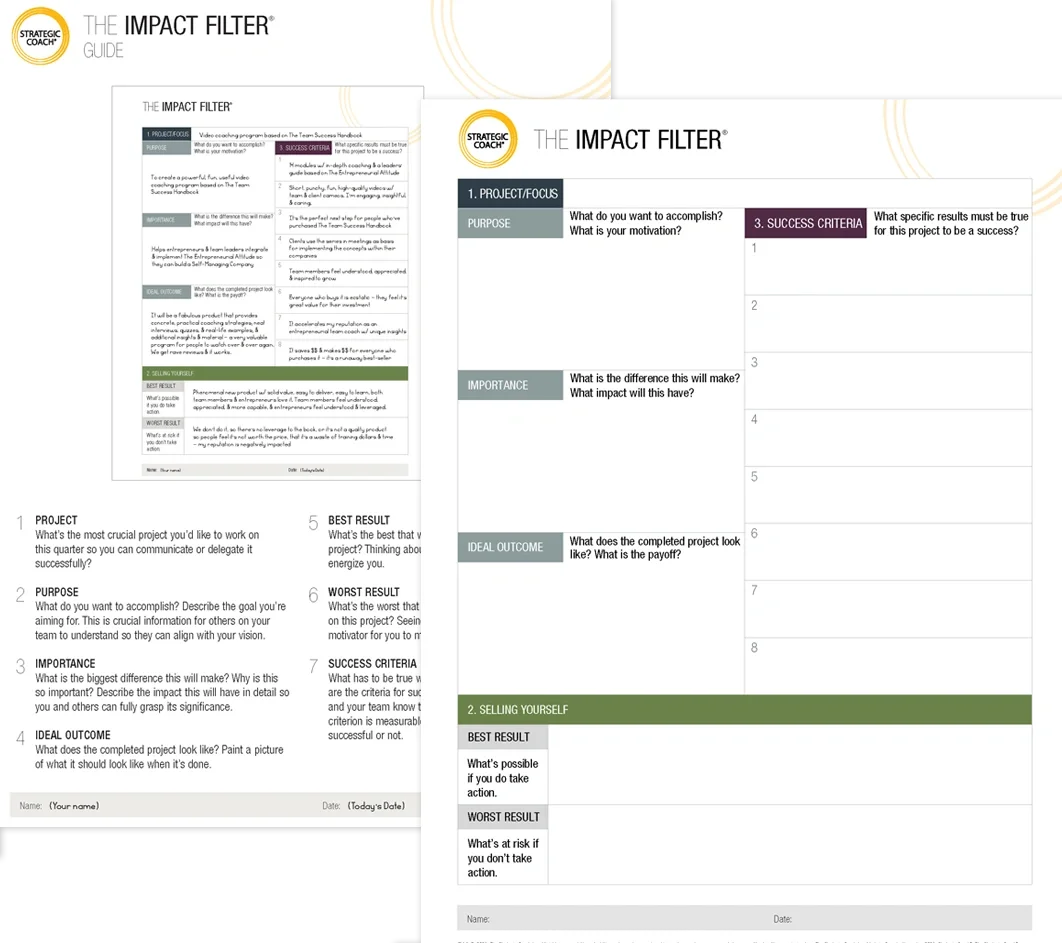
The Impact Filter®
Dan Sullivan’s #1 Thinking Tool
Are you tired of feeling overwhelmed by your goals? The Impact Filter is a powerful planning tool that can help you find clarity and focus. It’s a thinking process that filters out everything except the impact you want to have, and it’s the same tool that Dan Sullivan uses in every meeting.