Failure Is The Fuel To Power Your Next Breakthrough
July 02, 2026

Hosted By
 Dan Sullivan
 Shannon Waller
Failure never feels good, but trying to dodge it or downplay it keeps you from learning what you most need as an entrepreneur. In this episode, Dan Sullivan and Shannon Waller explore why you should let failure be failure, fully feel the emotion, and then transform that energy into better thinking, better timing, and bigger progress.
Here’s some of what you’ll learn in this episode:
- Why people sometimes avoid thinking about a failure.
- Why you should allow yourself to fully experience your first failure.
- Where entrepreneurs set themselves up for the most unhappiness.
- The new Strategic Coach® thinking tool that shows you how you handle your failures and your breakthroughs.
Show Notes:
If you don’t learn from your failure, you’ll fail the same way again.
When you fail, let yourself feel the full negative emotion once, then use that energy to decide what you’ll do differently next time.
A person who keeps failing at the same thing with no learning and no change in behavior becomes a failure in that area.
Repeated failures in the same way can start to erode your sense of who you are as an entrepreneur.
Every failure is sending you a message about your thinking, preparation, or timing, and your job is to pay attention to it.
How you handle your failures and your breakthroughs determines whether you’re actually functioning as an entrepreneur.
Entrepreneurism is a daily back and forth between breakthroughs and failures, and both are raw material for new capabilities.
Many people try to avoid intense emotion, but dodging the feeling of failure also cuts you off from the insight it could lead to.
Most people measure their progress against an ideal, but an ideal is not reality; it’s an unreality that guarantees disappointment.
Often the “failure” is not the goal or project itself, but an unrealistic deadline or short game that ignores the actual capabilities and resources you have.
Your emotions aren’t attached to what happens outside you; they’re attached to how you choose to think about what happens, which means you can respond creatively instead of reactively.
Resources:
The Gap And The Gain by Dan Sullivan with Dr. Benjamin Hardy
What You Can Learn From Failure
Episode Transcript
Shannon Waller: Hi, Shannon Waller here and welcome to Inside Strategic Coach with Dan Sullivan. Dan, this week you and I were spending time together in a Connection Call and you brought up the subject of failure and you made a couple of comments that I found really interesting. You said, I let failure be failure and I experience the full emotions and it only gets to happen once. Let's dive into that because failure is something that entrepreneurs risk. They engage in, they don't often let it define them, but some people would prefer to like, oh, I don't really experience failure. And that's actually, I think what your comment was in response to. So let's dive into this topic about failure. How do you define it, to kick us off? How do you think about failure?
Dan Sullivan: It really bugs me.
Shannon Waller: Yeah, I think it bugs most of us.
Dan Sullivan: First of all, it's very emotional, I find. But I've noticed that the first failure doesn't compare in being unhappy to having a first failure and having a great deal of negative energy about that first failure, and then not learning anything from that, so that I have a second failure. That's a repetition of the same activity, the same habit that I was doing before. And that really, really bugs me. So what I've learned is, when you have a first failure, let the full negative emotion be there. Have the complete experience, and then use the energy. Because there's an enormous amount of energy. It's negative energy, but you allow that energy to say, okay, now how do you have to change your behavior? How do you have to prepare yourself? How do you have to approach this the next time so that you don't have this experience again? So that's my basic approach.
And I find a lot of people, they have the failure and they have the negative experience, but they don't learn anything and they don't change anything. And I think that the importance of failure is that, one, is that you weren't thinking about this properly or you weren't thinking about it at all, but you were expecting something to happen and it didn't happen that way. And it really, really bugs you. But you don't do anything with the negative experience. You don't do anything with the negative emotion. So nothing new got learned and there was no improvement of behavior. So it happens again, and then it happens again, and then it happens again. And my sense is that a person who fails at the same thing with no learning and no improvement of behavior is a failure.
Shannon Waller: Okay, so it's the repeated experience of it without learning anything. So as opposed to experience one failure, that's how they become a failure.
Dan Sullivan: Yeah.
Shannon Waller: Through lack of learning.
Dan Sullivan: Yeah. I'm totally okay to failing the first time. But there have been times in my life where I failed five times in a row the same thing, where my sense of who I was, was becoming negative. And I said, you're being sent a message here. You're just not paying attention. You got to pay attention to this. The other thing is that we just did in Strategic Coach a new thinking tool where you brainstorm all the entrepreneurial failures. So it's specific to being an entrepreneur that you have five or 10 failures; they weren't successes. You were planning on something happening and it didn't happen. It was a complete lack of result that you were hoping to get. It really bogged you down, you lost confidence, you were upset, all that. So just write it down. And then I want you to also do another column where you write down all the breakthroughs that you had, where you tried something and it really worked. Not only worked, but it worked in a way that was much better than you had ever done it before, and write all those down.
It's how you handle those two things really determines whether you're actually an entrepreneur. How do you handle your failures? How do you handle your successes, your breakthroughs? So yeah, it's pretty basic. This is entrepreneurism 101. Because every day it's moving back and forth between those two worlds. Anyway, we go through this whole thinking process, it’s about an hour long, and we get them to compare things and everything else, and very magically, at the end of the thinking process, they begin to say, I should stop fearing failure in new things, because my experience is that every time I've tried something new, and I failed, it was my thinking about the failure that produced the breakthrough. And I says, now you got yourself a real capability. But don't cut yourself off from the emotion of failing.
Shannon Waller: So let's talk about that emotion because that feeling can be so intense. My intense emotions sometimes scare me. I think that's why I tend to avoid it. But you are willing to experience that fully. A lot of people will avoid it. And Dan, out of a failure, definitely a breakdown, you created our model, The Greatest Teacher. And we have a choice about how we respond to those things, that intense negative emotion, either creatively or reactively. So talk about that intense negative emotion, because I think, again, being willing to go there, not being scared of it and being willing to do something creative with it is, but this way we could add some consciousness to that process would be helpful.
Dan Sullivan: Yeah, and I'd like to bring in another Strategic Coach thinking tool here that's called The Gap And The Gain. The Gap And The Gain has to do with trying something new. We call them goals. So you set a new goal. Let's say it's a three-month goal and you get to the end of the three months and you measure your progress. And when you measure the progress that you made doing something new, what's your emotional experience to it?
Shannon Waller: When I'm measuring progress?
Dan Sullivan: Positive. Yeah, when you made progress.
Shannon Waller: Positive.
Dan Sullivan: Yeah. Before you did this, you could only do one and now you can do five.
Shannon Waller: Right.
Dan Sullivan: Okay. Great progress. So there's quantitative basis for saying you made real progress. But what's your emotional response to making that progress? And I said, it depends on what you're measuring it by. And most people measure progress in a way that they're measuring against unreality. And another name for unreality is ideal. They have an ideal, and what the ideal is, how they're going to feel when they make the progress. So they make the progress, but they don't feel that way, and it actually depresses them. Or you could do it another way. That's option one, doesn't matter how much progress you make, it's not gonna make you happy. Option two is that you make progress, and even if it isn't the progress that you thought you were gonna make, it makes you happy. And you say, well, how does that work? And you say, because you're measuring backwards against where you started. I was at a one, now I'm at a five. It's progress, I'm really happy with progress.
But let's say you were aiming for a 10 and you only got to five. I've made progress. The other person could get to nine and not get to 10 and they would think it was a failure because I didn't get to a 10 and I have a sense of how it will feel when I get to 10 and I got to nine but I don't have any of that feeling. It's a failure. And it's just the way your thinking goes. The first way, it doesn't matter what you do, you've set it up so you can't win. You've designed a game where you can't win. And even though other people from the outside are observing what you did, boy, that was a big win. No, it's not a big win. No, don't feel it at all. Can't win that game.
Shannon Waller: I was gonna say, it's depressing.
Dan Sullivan: But it's the basis of how you're going to feel. You've set it up that if you don't feel this way when it's over, it's a failure. It's a game that you taught yourself. Nobody else knows about this game. And they can't understand why you wouldn't be happy with your progress. because they don't know how you've set up your game. My sense is that I'm pretty good with progress. Even a little bit of progress, I feel good about the progress. One way that I have of explaining it is I had the goal right. I had the activity right, but I had the timing wrong. I thought it was going to take three months, and it's going to take six months. But look at the progress I've made in three months. This is a lot more progress than I had before, so it's a win.
Shannon Waller: So Dan, sounds like you're very rigorous about making sure you're very clear on your starting point, and then never, well, not never, rarely, or less time than before, being trapped into that ideal, and so always going back to the starting point, measuring from there, rather than what your original thoughts were. And I love what you just said, and I don't think I've heard you say it quite that way before. It's like, oh, got the goal right, got the project right, but didn't get the timing right. So you're thinking about your own thinking, our last podcast, which is really interesting. So then you can iterate, and then you can make change.
Dan Sullivan: But that I didn't get the timing right bothers me. I said, next time be a little bit more conscious about the timing here or a little less demanding about the timing. But the big thing I have to correct here is that I was thinking about it partially right, but there was bad thinking, there was improper thinking about it. And the other thing is, is your game a short game or is it a long game? I think entrepreneurs, where they suffer their greatest unhappiness is in the scope of the game that they're thinking. It's a project, you know, and you say, I'm going to get this done in 90 days, but you didn't have the capability to get it done in 90 days. You didn't have the resources to get it done in 90 days. You're putting an unrealistic demand, not in terms of the result, you're putting an unrealistic time on how long it's going to take to get it done. My capabilities weren't up to pulling this off in 90 days. If I had had so-and-so's capability and so-and-so's capability and so-and-so's capability and we had great teamwork, we could have pulled it off in 90 days.
And that's learning. But if I do that again and didn't learn anything from the first experience, I'm gonna be really unhappy. So my sense is, when you fail, you fail again. Give yourself the full benefit of the feeling of failure, because that's what wakes you up. That's what convinces you that you did the wrong kind of thinking. Some of the thinking was good, a lot of your thinking was wrong about this, and make this a major emotional lesson in learning, so the next time you try this, you do almost everything better. So anyway, that's my thinking.
Shannon Waller: I like it. I like it, Dan. What you're saying here is very proactive. You're not saying beat yourself up, avoid ever doing it again. Like there's all of these pathways you're not going down. You're saying take it in and learn from it, right? Make it better the next time. Have a commitment to making sure you don't repeat the same mistake over and over again. There's all these quotes that are coming, your quotes, by the way, that are coming to my mind. You have often said there's no such thing as an unrealistic goal, only an unrealistic deadline, right? Or just the very fact that entrepreneurs test and try. You say you're either on the winning team or the learning team. The only time you're on the losing team is when you're not winning or not learning, right? And then we have the greatest teacher, which is often those negative experiences that wake you up. You create a tool originally called The Negativity Transformer, now renamed to being The Experience Transformer, that's in the Program to help you transform those circumstances into something which you can learn from. So you've spent a lot of time delving into this to make sure that people can be on that learning and winning team, not the losing team.
Dan Sullivan: Yeah, you can do this with actual projects, which is where you're really active. You've got a plan, you've got a goal, you know, you've got a time frame to do it, and you can do it that way. Or you can do it that it's more passive, that you're in a situation where you're depending upon other people's doing things right, and they don't do things right, or things are not done right. You're being inconvenienced, you're being made uncomfortable by other people's activity. And how you handle your emotional response to that has to do whether it's a failure or whether it's just an experience, learning. I had one very recently that I talked to you about. We had some bad winter storms. We live in snow country. Going from Chicago to Toronto, snow country at the beginning, snow country at the end. And everything just went wrong. The flight was delayed four times, an hour each time, so we took off four hours afterwards. We would have gotten home at a reasonable hour, now we were late evening, and we had heard that it was worse in Toronto than Chicago.
We got there, we landed, we were on the runway for an hour and a half. We got to the gate, and there was nobody on the gate. There was no crew. The crew came, the jetway didn't work, took a half hour for repair to be made. We got off, the bags didn't come at all, and we got the bags two days later. Okay, so this wasn't an active project on my part. I'm just taking advantage of somebody else's system, and just nothing went. And because I've been in this mood lately that it's not what happens to me that's the issue here, it's how I think about what's happening to me that's the issue. So I recognized it early. I said, you know, it's dicey weather, you know, and everything else. There's been a lot of cancellations. There have been a lot of late plans. I said, I'm just going to treat this as a winning experience regardless of what they do. It was supposed to be a three-hour experience. It ended up being a 10-hour experience. You know, a lot of unhappy people around you, you know, and everything else.
I said, you know, my win out of this is just how I handle it. That was a win. That was a win. That wasn't a negative experience afterwards. I said, you know, I just handled myself really well. A lot of people, they were really angry. They went home. They shared their anger with their social media network. They complained. They wrote letters and everything else. And I said, yeah. Yeah, so again, what I'm coming clear about here is that your emotions are not attached to something outside of yourself. Your emotions are attached to how you thought about it.
Shannon Waller: Right. And Dan, there's a freedom that I'm hearing when you can be choiceful about how you're responding.
Dan Sullivan: That's a good word.
Shannon Waller: I think I made it up. There you go.
Dan Sullivan: Do things choicefully. Yes.
Shannon Waller: Well, if you think about reactive and creative, same letters rearranged, love that fact of the English language. And there's no space between stimulus response. You're just a button waiting to be pushed in a negative way. But you can transform that. You can expect things like, oh, probably a couple of things are going to go wrong. Like you said to Babs on the plane from previous iteration of this story, bet you the jet bridge isn't going to work. Sure enough, you were right. Bet you the bags won't be there, also correct. And not in a negative way, just in a factual way. And one of the things that I think as we mature as human beings, and especially as entrepreneurs, and I look at this in terms of the context of leadership a lot, the ability for people to self-regulate and to show up in a responsive, creative approach as opposed to like freaking out. It's a lot more useful for the person and it's also a lot nicer for the people around you when you can actually manage your own emotions and not get thrown off by them.
And I've had a few circumstances like you where I could have been very upset by travel delays. I was on a United flight and it was delayed for hours and the door was open. It was super, super loud. And I had my noise canceling headphones on and I was like, do, do, do, do. And I'm someone who loves to read, you know, loves to do things. I was just chilling, not upset. And it was so much nicer for yourself. Didn't have not disrupted your own nervous system. So I think there's just a lot of benefits from recognizing that the emotions are internal and it's how you respond to your thoughts, rather than just being this ping pong ball at the whim of the world. So that's a very powerful and constructive approach.
Dan Sullivan: I would say the other thing, and I've just become more and more conscious of this as a capability, that my being upset in the presence of other people doesn't do them any good and it doesn't do me any good.
Shannon Waller: Yes. Very true.
Dan Sullivan: Never. But by being cool and calm in a situation where I might have good reasons for being upset, it always is a positive. It's a positive for them and it's a positive for me.
Shannon Waller: It's something I deeply appreciate about you, Dan. I've experienced you in numerous circumstances, COVID comes to mind, where you just showed up calm, cool, collected, creative, positive, all the things, and where someone else might be wiggly in terms of how it was very centering, very grounding, provided phenomenal direction and leadership where it would have been really easy to freak the blank out. So I appreciate that because I get to tune into you. Where I'm tempted to like, you know, then I'm like, oh, okay, no, stay cool. So, yeah, it's a huge act of leadership when people do that, when you do that. Awesome.
Dan Sullivan: Yes.
Shannon Waller: Yes. Good. Well, what a fascinating conversation about failure. I love every second of this.
Dan Sullivan: Yeah, it's a really interesting thing, but just to sum up what I've learned from the conversation is that the big thing is, don't try to avoid the negative emotion of failure. Failure is failure. Allow yourself the negative emotion, but then realize that your job is to capture the negative emotion and turn it into positive learning emotion.
Shannon Waller: Love that. Yeah. So you're willing to transform it. That's our job.
Dan Sullivan: It's the raw material. It's like uranium. Uranium can fry you, but you capture the uranium and you transform it into powerful energy.
Shannon Waller: Well you talk about it, I use it for fuel. Fuel to get better.
Dan Sullivan: Yeah.
Shannon Waller: Awesome Dan. Thank you so much. As always, fun and enlightening.
Dan Sullivan: Thank you very much.
Shannon Waller: You're welcome.
Related Content



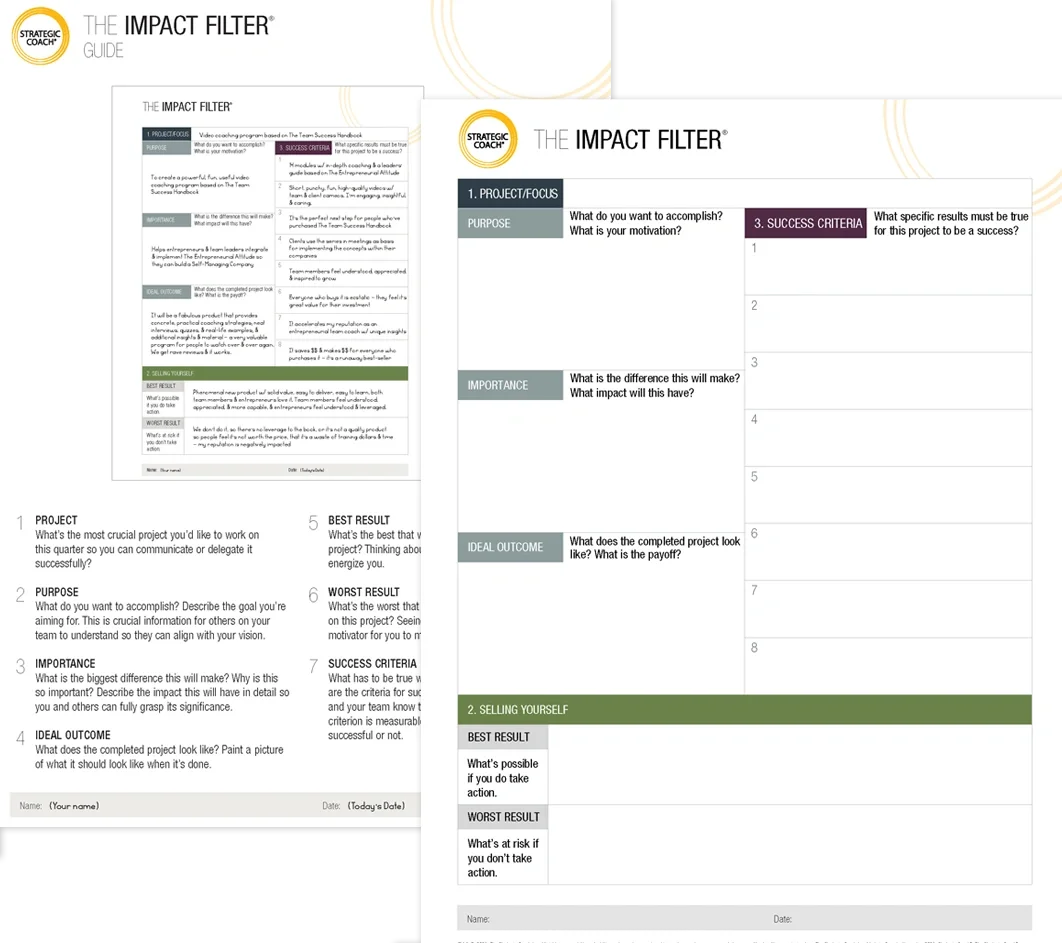
The Impact Filter®
Dan Sullivan’s #1 Thinking Tool
Are you tired of feeling overwhelmed by your goals? The Impact Filter is a powerful planning tool that can help you find clarity and focus. It’s a thinking process that filters out everything except the impact you want to have, and it’s the same tool that Dan Sullivan uses in every meeting.