Feelings Are Fuel For Entrepreneurial Creativity
January 27, 2026
Hosted By
 Dan Sullivan
 Shannon Waller
Today’s media environment constantly tugs at your emotions and makes it harder to think clearly about your future. In this episode, Dan Sullivan and Shannon Waller show how to treat feelings—especially being bothered—as raw material rather than reality, and how to quickly turn intense emotional energy into insight, better decisions, and creative projects that expand your future possibilities.
Here’s some of what you’ll learn in this episode:
- How information overload and constant media input affect the way people think.
- How Dan feeling bothered has led to the creation of powerful Strategic Coach® thinking tools.
- What taught Dan to flip negative feelings into a new project.
- How you can actually change the past.
- A thinking process that helps you separate emotion from any situation so you can respond creatively instead of reactively.
Show Notes:
Modern news and social media are engineered to grab your feelings, which can crowd out your ability to think about your own future.
Constantly reacting to events outside of you makes it harder to think clearly and see where you actually want to go.
Feelings are experienced physically and biologically, not intellectually, which is why they can be so overwhelming in the moment.
There’s a big difference between simply having feelings and using those feelings to trigger real thinking and new ideas.
Strong emotions, whether positive or negative, are early warning signals that something needs to be understood, decided, or created.
When you get deeply bothered by an experience, you can either stay stuck in the story or use that energy to design a better future.
Many of Strategic Coach’s most powerful thinking tools, including The Experience Transformer®, were created because Dan was determined not to repeat a negative experience.
Capturing the energy from a negative event and channeling it into a specific creative project gives you huge momentum—but only for a short window of time.
Reinterpreting past experiences through learning changes how they feel and upgrades your capabilities going forward.
Taking ownership of your emotional responses gives you power, control, and agency instead of leaving you at the mercy of circumstances or other people.
Resources:
Multiplication By Subtraction by Shannon Waller
Transforming Experiences Into Multipliers
Not Being Bothered by Dan Sullivan
Episode Transcript
Shannon Waller: Hi, Shannon Waller here, and welcome to Inside Strategic Coach with Dan Sullivan. Dan, a little bit ago, you said something, I'm like, ooh, I cannot wait to do a deeper dive into this. You said, there are feelings and there's the future. Feelings don't transform themselves. Vision and capabilities do. Please expand, because there's a lot of feelings going on around the world right now.
Dan Sullivan: Yeah, well, it really strikes me the difference in public communications. Let's just say this. I grew up before television was widespread. I was born a year before the Second World War ended, so back then, it was radio, and I remember growing up with radio, you would listen to commentators. A lot of people don't know, but there were nightly commentator shows. There were people who actually had views on the world, and they depending on which radio station you were listening to, and they were syndicated. Gabriel Heater was a very famous commentator. Fulton Lewis Jr. was a commentator. And they would have very, very well-prepared points of view, and they would communicate with them, but you know, you agreed with them or you didn't agree with them.
And then television, in the early days, was just a visual picture of what people were saying on radio. They weren't showing videos. It would be someone talking into a microphone, and you began to realize that, you know, they had well, pointed views. And then there were magazines that had articles and everything else. And gradually, decade by decade, as television took over, and then there was more communication. And then the technology of television changed, and you could bring in videos. And then there were more and more stations, and then it became highly competitive. It started appealing more to your emotions than to your brain, and that's what I really noticed, and bad news was better than good news, that appealing to your brain, scaring people was better.
And now we're into the internet world, and we're into social media world, and my sense is that there's been an overload of things that appeal to people's feelings, which interferes with their ability to see their future. They're being asked to respond emotionally to lots of things that are going on outside of themselves, and my feeling is that it actually interferes with their thinking abilities, because feelings are just feelings. Feelings don't have intellectual content to them. You feel it physically. You feel it biologically. And people are starting to attribute meaning to their feelings without the addition that they've actually use their feelings to come to grips with something, think it through, and come up with a thought or an idea like that. And my feeling is that it's the people who have feelings, I think everybody has feelings, and that they're using their feelings actually to initiate real creative thinking in their brains, that they're coming up with ideas. I'm not discounting feelings, but there's a difference between feelings and thinking.
Shannon Waller: So there's obviously a connection that can be made. Isn't always so how are feelings useful, Dan? I mean, they do provide some very important feedback, depending on what you do with it.
Dan Sullivan: Yeah, well, you're feeling something very strongly, and you've got a lot of energy, it could be negative energy or it could be positive energy, depending on what the feeling is, but you use that, as what I try to do, is I suddenly become conscious of something that needs to be thought about. I said I'm feeling this way. Why am I feeling this? And how do I have to think about this feeling? What is it that it's relating to that I can think about here. A lot of people ask me, where do the ideas come from in Strategic Coach? I said, mostly I'm bothered by something. I'm really bothered by something. I said, you know, this really ticks me off. Here I was going along feeling really, really good, and something just ticked me off and bothered and I said, now one thing is, I want to know what it was, and I want to make sure it doesn't happen again. And that's where all the concepts of the Strategic Coach come from, is that I'm just really bothered by something, and it stops me. It throws me off balance, and it disturbs me. I was feeling good, and now I don't feel good, and I want to know how this happened, and I want to make sure it doesn't happen again. And that's where all the thinking tools of the Strategic Coach come from. And it's the thinking and the thinking tools that actually creates my personal future, and it also creates the future of Strategic Coach. So is that a good explanation?
Shannon Waller: Fabulous explanation, because it's fuel for creativity. There's so many places I want to go right now. You said vision and capabilities do. Feelings don't transform themselves. Vision and capabilities do. So you take that raw material, that's feeling bothered—I'm laughing, because that's exactly what spurred me to write at least my second book, Multiplication By Subtraction—and when I get bothered, I create something new, because I don't want to repeat that feeling. I don't want that feeling in my body. I don't want to experience that again. So I have to get creative. Dan, this might be a good time to tell the story about The Experience Transformer, right? Because you were very bothered by an experience in England, yeah, which was kind of brilliant. Tell the story, because you actually had a choice about how you responded in that moment.
Dan Sullivan: I'm not entirely sure the year about this. I think it was around 1998. I had a speaking engagement in Great Britain, and we were starting to think about having Strategic Coach workshops in London, but we took advantage of this invitation from a large insurance company. So we flew over on a Thursday. We got in very late, and the next morning I gave a presentation a Friday morning. It was at a hotel in London. We had always been an Apple shop. We had Apple computers. I had my Apple Computer. I had my presentation. You know, I would put slides up on the screen and everything like that. We did it, and then I was really hungry, and we were going out for lunch. It was in the morning, and by the time the question and answer and everything that happened, it was around lunchtime. Babs and I, we just went back up to our room, and inside our room was just a little table or little desk near the door, and I just put the computer on the table. And then we went out to lunch, and it was about two hours, and we came back, and when we got to our door, the door was destroyed. The handle was completely broken, and it was obvious that somebody had kicked in the door. We checked very quickly, there was money in the room, there was jewelry in the room, other things, and the only thing that was gone was my Mac. My computer was gone.
The back story to this was I was writing a book, and the deadline for the book was a week Friday, when we got back, the completed manuscript had to be sent back for our team to edit it and put it together and everything like that. And the complete manuscript was on the computer and I hadn't backed it up at all. You know, it was harder to back up things in those days. You did it with discs, and I was always kind of sloppy about that. So anyway, we had a full schedule. So that evening, we had a client dinner that we went out to. And I'm sitting there and I'm saying, I just lost my manuscript, and I've got a deadline next Friday. Okay, so I was churning. I was feeling discomfortable. I was feeling really, really bothered. I was feeling really bothered by it. And so we came home on Friday night. Was about 10, 11, o'clock, and Babs was just really tired, you know, we had jet lag and everything else. And she said, I'm just going to go to bed. And I said, I'm wide awake.
And I was sitting there, and I was thinking about recreating the manuscript right from the beginning so that we could hit our deadline, and we had a commitment to have the book printed and ready for a big event. So, you know, there wasn't a putting off, there wasn't a postponement, and it was okay. It wasn't okay. So I had that pressure coming down on me. So I was sitting there and I was just feeling paralyzed. I was just feeling very, very paralyzed by it. And I said, I have no energy whatsoever to create that manuscript. I don't know how I would do it. And then I was sitting there, and I said, but what if I created an entirely new book? What if I just use this opportunity, just forget about the old book. And we had authoring software on the computer, Quark Express, in those days, your designer was there too, and our designer was in London with us, our computer designer who could actually create an outline for a book, actual layout for a book and everything. Sean, who's our original computer artist in the company, and I got really, really excited, and I just sketched it out. You know, I just took some sheets of paper and I sketched it out. We were going to meet him for breakfast the next day anyway, so we got together at breakfast, and I said, this is the deal, and everybody knew about what had happened, so it wasn't news to him. So I said, let's just get together for two hours and I'll just tell you how many pages it's going to be. I'm going to do the page design. I'll show you where all the illustrations, all the graphics will be, and everything else. And he was going to be there for the next week anyway, and I said, so I'm just going to create a brand-new book.
And long story short, over the next five days, I used his computer, because he had the identical computer, he had the software, and I created it, and he was downloading and sending text so that they could actually look at it. I was on the team receiving the book. I was doing graphics, and the graphics were being sent by fax, you know, great technology. And the next Friday, he flew back to Toronto with the desk, and everything was edited. We hit the deadline, and it was a much better book than the one I had lost. I got back and I said, I just did something amazing. I just pulled off a real trick. And what I came up with is that when you have a really negative experience, it's really bad because you feel bad. But if you can flip the negativity into a new project, you can use the really negative, the sense of loss, the sense of just being blindsided by, you know, external you're really inconvenienced, you know, you're really inconvenienced, you're really pissed off and everything—but if you can just capture that energy and throw it into a totally new project. You have all the energy in the world, but you have a short window in which to do it, so you got to get on it right off the bat. That's the proper use of being bothered.
We actually created that into a tool where we focused on negativity at first, but then we realized that it could be a totally positive experience too, and you're really excited and you're really incredibly motivated, but you have a short window of time in which to capture the energy and put it into something creative. Okay, so going back to the original statement, there's your feelings, and then there's the future. You have to do something between the feelings and the future, you have to capture the energy of the feelings, use the energy for thinking, really, really creative thinking. And then out of the feelings, the very intense feelings, you actually use the energy of the feelings for real future focused, breakthrough thinking. So that's really my sense. So, you know, I get bothered a lot by a lot of things, but my ability when I'm bothered is to capture the energy and then act on it really, okay. I've got a real, a big supply of new energy, and just turn it into positive, creative thinking and then execution.
Shannon Waller: What I've noticed, because we've known each other a long time, is that you are incredibly consistent in that process. I mean, that was 1998 and this is what you consistently do. People would never guess in a million years that you're bothered a lot, that things bother you, because you come across as a pretty chill dude, like you're pretty level, you know, you don't freak out, you know, you're pretty rational. But it's interesting, because you've made a habit of taking that, and here's the other cool thin—you don't blast it on to other people. So we've talked about this a lot, but the letters in the words reactive and creative are the same just rearranged, which I love that little trick of the English language. So it's like rearranging your response. The concept is called The Greatest Teacher, because we learn a lot from those negative experiences. And then the tool was originally called The Negativity Transformer. And then we're like, oh, works for good things too. So Experience Transformer is what we call it, but you created a structure that is useful for, frankly, 1000s, if not more 10s of 1000s, of people to help transform that experience and get it out of the really reactive part of your mind, your amygdala, which is fight or flight,
Dan Sullivan: Get it to the front.
Shannon Waller: And get it to your prefrontal cortex, which is the slower brain, let's be clear, but you're very conscious in that process. And what is cool that is backed up by brain science. You are literally taking the mental energy from the back, and there's a lot of it, and I love your point. You can harness it, you can take advantage, and you've got a little window of time. Otherwise you just stay …
Dan Sullivan: No, it just dissipates. The energy has gone away, but you're just left with a negative experience.
Shannon Waller: Yeah, you stay mad.
Dan Sullivan: Stay mad. Or, you know, you make decisions, but you don't do anything with the energy. Nothing improves, but you have a tendency to attribute the bother to something outside of yourself. And I've said, well, who cares? You know? Who cares?
Shannon Waller: Well and truthfully, what happened may not have bothered somebody else. So when you take ownership of how your own response to things, you then have power, control, agency, all those words, and then you can do something about it and take action. So this is one of my favorite …
Dan Sullivan: Well, it's really interesting because, first of all, it's a very gripping story. When I tell the story, you know, I think that they're appreciating the story, but they're relating the story to many stories that they have of their own. One of the things about that, you know, it's really interesting, is people say, well, you can't change the past. And I said, I think you can, because the past is your interpretation of what happened. When we actually put this Experience Transformer into the Program, I said, I'm going to show you something interesting. I said, I'm going to have you think of a negative experience, and just to make sure that everybody in the room has it, it's going to be something that happened when you were a teenager. Because the teenage years, there's just a lot of bother, but there's also a lot of lasting bother, you know? And I said, so just pick an experience you had when you were a teenager, that when you think about it, 30 years later, 40 years later, it still irks you. In other words, it still bothers you the situation that happened. I said, now just write it down, and we're going to do an experience of what we're going to say, what worked about that experience, and that was the tough part about them, because their memory, or their recollection of the experience, that nothing worked about it, you know, so it takes a little while, but you have to say what worked about it before you can free yourself from the emotion.
Shannon Waller: And Dan, just to relate this back to your book story. You know, the laptop was stolen. Your door was bashed.
Dan Sullivan: I was tired.
Shannon Waller: You're tired. The hotel was not cooperative. However, you probably had a great lunch. Sean was there. He had the capabilities. The team was waiting. You know, there were all of these good things that made it not a complete total disaster. So you were able to do that.
Dan Sullivan: But that wasn't until I decided to write a new book. But the truth is, I didn't really like the book that I was writing. I didn't think it was a very good book, and I had to tell the truth about it that evening. So all the positive things, once you write down what worked about a bad experience, it's very, very easy then to, without a lot of emotion, say what didn't work about and it's not emotional anymore. It's thoughtful. You're writing. So you have the first column, five things that worked, five things that didn't work. And then, based on your experience of what worked and what didn't work, then faced with a situation like this in the future, how would you approach it next time? And I say, make sure the transcript is backed up, and then you're finished and you've turned a disaster into a great breakthrough in learning. Your skill level has jumped up. Your capability has jumped up. I saw this one person. He was really bothered in the room when he was doing it, and I said, so what'd you learn? He says, well, I missed a bullet. I didn't marry her.
And he was in very good marriage, you know. And he says, would have been a disaster if I had actually married, you know? It was a love relationship that went. Now, I say to them, did you just change the past? And they said, yeah, because the past isn't the events of the past. The past is your interpretation of what the experience has meant. And it's really, really interesting that it introduces a whole new idea that you can make up the past just as much as you can make up the future. As a matter of fact, go back to everything that you consider negative in your past and reinterpret it, and it's usually what did you learn from that that's been very useful since you learned it, and what did you learn from the past that can now be really useful to you in the future, and you've actually changed your past. So it's interesting, but that was a very fundamental experience for me, and I said, because of the way that I performed in that one week, I think my future was totally different as a result of just because of the way that I handled that well.
Shannon Waller: And to go back to what you're saying, there are feelings, and then there's the future, right? And so you took that energy, that very intense negative energy you couldn't sleep, and then transformed it through a vision of a better book, one that you would actually be excited to recreate, rather than replicate what you'd already done, and then capabilities to, you know, deliver that in teamwork with Sean and the team to do that. So that's such a huge win, Dan, and that's something you can go back to when you do, go back to over and over again when you've got another challenge. Like, I was like, oh, I did it here, so I can do it again. And that's true for everyone who does this kind of thinking process. So that is so useful. And I think for me, this conversation is about using feelings as fuel for creativity. You know, positive ones, negative one. Anytime you have that intense, you know, emotional burst, take advantage. There's fuel there, rather than getting stuck with it. Because even positive emotions, if you get too used to them, people can get complacent or arrogant and those things. And so using that energy to create something new and new learning is such a great takeaway.
Dan Sullivan: Yeah, it suggests that if you really want to be creative about the future, be bothered about a lot in the present. I said, you know, you're just not bothered about enough things, you know. I said, be really bothered, but keep it to yourself.
Shannon Waller: Transform it, then create value. Love it. Great. Dan, thank you so much.
Related Content


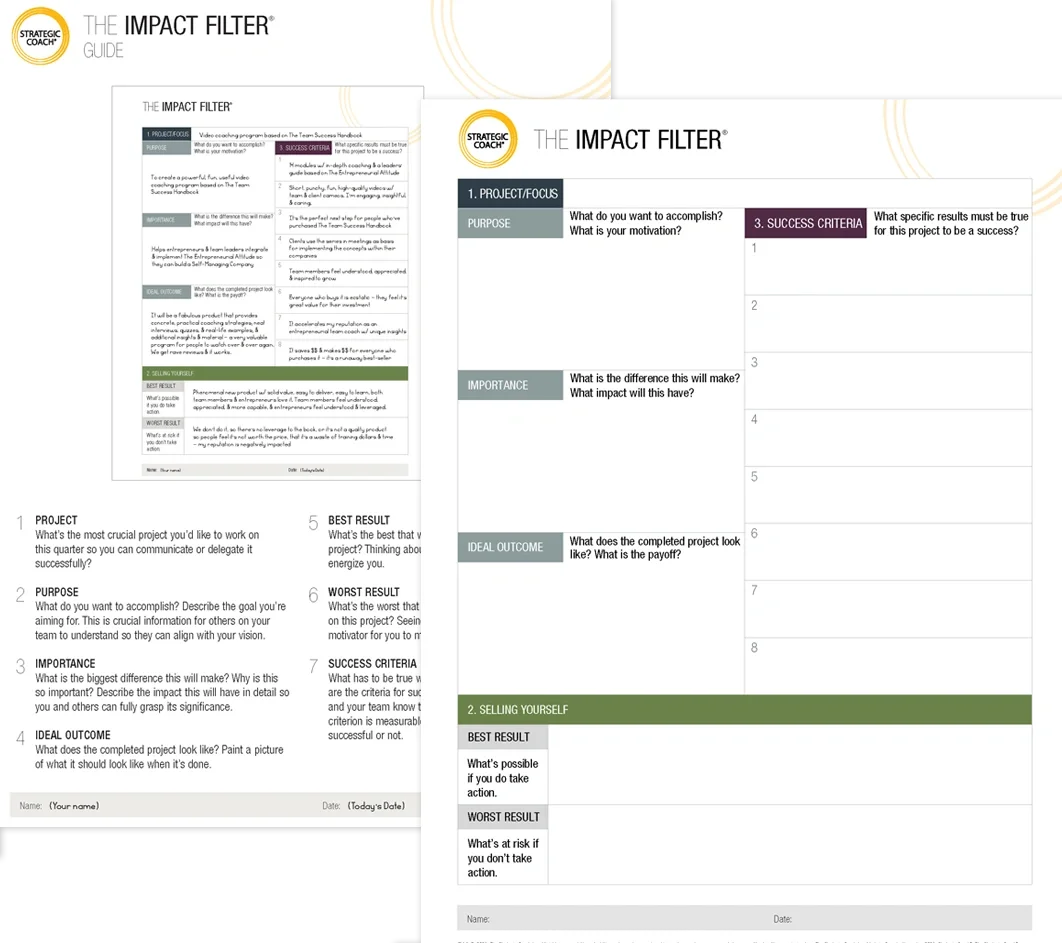
The Impact Filter®
Dan Sullivan’s #1 Thinking Tool
Are you tired of feeling overwhelmed by your goals? The Impact Filter is a powerful planning tool that can help you find clarity and focus. It’s a thinking process that filters out everything except the impact you want to have, and it’s the same tool that Dan Sullivan uses in every meeting.