Turn Your Business Into A Theater With AI In Your Cast
May 19, 2026
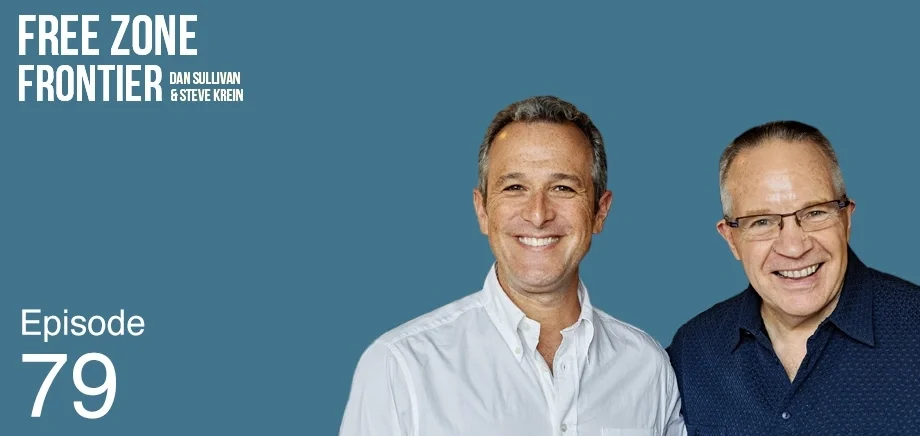
Hosted By
 Dan Sullivan
 Steve Krein
Entrepreneurs grow fastest when they combine their unique capabilities with the right collaborators—both human and AI—so everyone creates bigger results together instead of working alone. Dan Sullivan and Steve Krein explore how teamwork, technology, and ambition multiply one another in the new era of collaboration.
Show Notes:
Working with AI can feel highly personal because the tools remember your past thinking and mirror it back to you in powerful ways.
Division of labor is still the starting point for creating wealth, but now the labor includes both human team members and AI agents.
There’s a big difference between having a job made up of tasks and having a role defined by the results you create for the team.
When unique capabilities get combined, the result is something that probably didn’t exist yet.
If you automate activities that don’t work, it will just amplify what isn’t working.
For successful entrepreneurs, growth alternates between greater meaning and more money, and AI only matters if it increases both.
Evaluating how someone contributes to teamwork gives you a clearer read on their character than any assessment or profile.
The most valuable team members going forward will be AI-first and AI-native, using agents as collaborators rather than occasional helpers.
Resources:
The Wealth of Nations by Adam Smith
Who Not How by Dan Sullivan with Dr. Benjamin Hardy
Casting Not Hiring by Dan Sullivan and Jeffrey Madoff
Episode Transcript
Steve Krein: Hi, this is Steven Krein from StartUp Health. I'm here with my podcast partner, Dan Sullivan, for the Free Zone Frontier podcast. Hi, Dan.
Dan Sullivan: Steve.
Steve Krein: You know, we're living in this AI world. We're talking about how it's impacting entrepreneurs and our teams and our families. And I'm really intrigued by the impact it's having on teamwork and in particular, how AI seems to be such an individual sport. You know, you're sitting down having a very personal one-on-one conversation with yourself, yourself and the tools. And oftentimes it knows you better than you know yourself, as it kind of spits back from memory what you talked about last time or what it thinks you talked about. But I'm wondering how the human agency is being amplified, whether you have it or you don't. But in particular, how it's no longer okay for everyone just to be using it however they want and how an entrepreneurial team uses it does matter and the impact that the collective team and what they can put out.
Dan Sullivan: I was noticing a couple weeks ago. It was the 250th anniversary of Adam Smith, a Scottish economist, philosopher, when he came out with a book called Wealth of Nations. And the great breakthrough in The Wealth of Nations was identifying that the starting point for creating wealth is the division of labor. You used to have a craftsman who would create a complete product. Now you've broken the product down into 23 parts and you have 23 people and one of them does this part of the project. But, you know, they had no electricity in those days. They were lacking every technological advance that we have today. What they had was steam power. And it was interesting, that book came out within months of the introduction of James Watt, also Scottish, created the first steam engine that produced 25 percent more energy than it took to run the steam engine.
That was the multiplier, and the great entrepreneurial rush came in is that it didn't matter how you were born in British society. If you had a knack for this new technology called steam power, you could go right to the top. Wealthy families would want their children marrying you who were a nobody simply because you were producing wealth and they weren't producing wealth. Take it 250 years down the road from the steam engine to right now, now we have the ability to create the collaboration of Unique Abilities, which is really what teamwork is. It's the collaboration of Unique Ability. This person has a Unique Ability, that person has a Unique Ability, where the power is not in their individual Unique Abilities, but it's the teamwork of individual Unique Abilities.
Steve Krein: First of all, I love going back 250 years and during the analogy of the steam, what an individual can do today versus what a team could do oftentimes now are different things than they used to be. You used to need a team of 23, you said 23 people to do each piece of the assembly line or each piece of the product. And now an individual can do a lot more, almost a full stack of things. Teamwork changes as a result of that. And so is a team any different than two individuals or three individuals collaborating anymore, where each person has amplified Unique Abilities, they have more capabilities because of AI, and they contribute more as a collaborator versus just an employee and a team member?
Dan Sullivan: Yeah, I mean, I think that what we're seeing, it's a book that Jeff Madoff and I are having published through Hay House. We're talking about, there's a big difference between someone who has a job and someone who has a role, because a job is just an individual's relationship to tasks, you know, that you hire someone and inside their job description, it's a system of tasks that they're responsible for carrying out those tasks. A role is defined by the team that the person operates in. In other words, a person is either valuable or not valuable in relationship to their contribution to teamwork. And that's why we love theater. I mean, even one person shows are a teamwork of probably 15 or 20 people. You just don't see 19 of them. You just see the person on stage. But when it's a full cast, let's say a cast has 10 people. Every one of the roles is absolutely crucial for the impact of the entire presentation. There is a big risk to it, you know, because everybody has to be present with the other members of the team and do on a timely basis exactly, they say this, they do this action, and everything like that.
And I think the point that Jeff and I are making in Casting Not Hiring is that now that you have AI, there's just so many tasks that can just be done through automation. But if the person using is good at the AI, in other words, that they can take care of all these tasks, now they can take the total product of their mastery of something and they can combine it with the mastery of someone else to create something that probably doesn't even exist yet. You're actually creating brand new products right now. Theater's been around since the beginning. I mean, it's a form that has been around for not millennia, it's been like millions of years. Theater shows up right from the beginning of telling stories because it's all based on a story. I just saw Hamnet two weeks ago.
Steve Krein: Thinking about your description of theater, but let's apply that to building agents and what is now possible with an agentic team or a team of agents that are supplementing your team and the teamwork. And a lot of those jobs or asks that you talk about can now be automated.
Dan Sullivan: Yeah.
Steve Krein: And freeing up the individual collaboration, I'm finding it to be even more helpful to be able to think about your team of agents the way you think about your team of humans. Because they need more certainty and clarity in your instructions. And, you know, if you automate stuff that doesn't work, it just amplifies it. But the idea that you can get clarity of what success looks like in a team of eight agents versus a team of eight humans is radically different.
Dan Sullivan: We have no idea what this is going to look like five years from now. I think that all the normal ways, and I'll just start with economic activity, you know, where you're producing money. I don't think there's any economist that has the slightest idea of what AI in the hands of a million people will produce in five years.
Steve Krein: It's the democratization of entrepreneurship. I mean, if you think about what, they used to call them freelancers, or I should say maybe they still call freelancers, but individuals can do so much.
Dan Sullivan: Gig workers.
Steve Krein: Yeah, gig workers. But the idea of individuals becoming more capable of collaborating with other people. What does the world look like when there are 10 times the number of entrepreneurial operators—by the way, aren't building big companies necessarily. They're building, you know, very tiny team.
Dan Sullivan: Actually, right size companies. I mean, yeah. The big thing is that there are companies that get too big. I'm kind of opposed to the word scaling now because it simply means a quantitative difference. It doesn't mean a qualitative difference. You know, I mean, we're not a small company. We have 120 team members.
Steve Krein: But you can do a lot more with those 120 team members today than you could have a year or two ago.
Dan Sullivan: Oh, yeah. I mean, that's the book that we're doing with John Bowen. We're making the claim that 10x was a radical thing 25 years ago. You talk about 10x growth. We're talking about 100x growth in this book, strictly because AI has come into the picture.
Steve Krein: Yeah, what's the framing of a 10x versus a 100x in the book?
Dan Sullivan: Yeah, well, the big thing is that we have 10 things that are multipliers for the individual entrepreneur. Ambition is one of them, but teamwork is another one. How good are you as an entrepreneur in creating teamwork? That's a multiplier, okay? And then we have technology as another one. So it's teamwork times technology times ambition. We're talking about a different game here. But the big thing is that you will only do this if everything you're doing as an entrepreneur is giving you greater meaning. So one of the things we say that there's an alternating cycle between meaning and money. So there is a certain point where you've created a lot of meaning, but you've reached a boundary now that any money beyond this boundary has no meaning to it. So you've got to go back and give meaning to the next stage of growth. And then the money will flow into the new structure of meaning.
I was reading some articles about Warren Buffett. They were saying, well, who's the next Warren Buffett? And I said, well, there was only one, and there's only going to be one, because all of his success that we know him for happened after 65 years old. He had 35, 45 years before that when he was just creating structures that kind of agreed with each other, and then it started showing up. I remember Warren Buffett said, the exponential growth of compound interest is a lot more impressive between 85 and 95 years old. So my sense is that we're at a crossover point with this particular technology that hasn't been true with any previous technology of today. But the whole point is AI wouldn't exist without all the previous jumps in technology. But my sense is that you will only take advantage of AI if it doesn't give you the promise of more meaning in your life from doing it. You won't do it just for the money. The money has to be something that produces greater meaning.
Steve Krein: How do you think the type of person who could be an entrepreneur today, because being an entrepreneur and maybe even in the Coach world, because income is the determiner of which program you're in, what happens when becoming an entrepreneur—being an entrepreneur in theory is more accessible because you have technology, you have AI and capabilities, but you don't have any of the thinking structure to understand what you're describing?
Dan Sullivan: Yeah, I think a lot more people will be creating their jobs. And this is true now. I mean, everybody talks about entrepreneurism, but I would say 90% of entrepreneurs have simply created a job for themselves. They used to work for a jerk for 40 hours a week, and now they're working for a jerk for 70 hours a week. But the whole value of entrepreneurism is in the company, because the company can be evaluated. And the way they evaluate it is how much is the company worth minus the owner. I mean, if you're selling your company, it means that you're not going to be there when someone else is using your company. So what is the level of teamwork that you've created in this company that's predictable in terms of output, in terms of, you know, profitability?
Steve Krein: The number of people a company has, though, is changing. The need is changing. How do you frame, even in the Who Not How context, how do you think about when who is a human versus who is AI?
Dan Sullivan: Well, it's all capability. Dean Jackson and Chad Jenkins, these are two. You know Dean, but I don't know if you know Chad.
Steve Krein: Yeah, I know Chad as well. I know Dean better, but yeah.
Dan Sullivan: They're coming out with a book, and it's based on vision, capability, and reach. Yeah, VCR. And I don't know. I mean, we'll never be smaller. We have 120, but we'll never be smaller. And the reason is that the structure of the workshops and everything else, there's an enormous amount of personal teamwork.
Steve Krein: Yeah, the front stage is very key to the whole.
Dan Sullivan: Yeah, and we see ourselves as a combination that we're in the theater business and we're also in the hospitality business. And I said, you know, that the way people get treated when they come to the workshops is the thing that they value most. I mean, they do their thinking and they do their cross fertilization, but they're treated so well when they come. The food is good, you know, like it's not cold cuts on Wonder Bread, you know, when you come to Coach. But the big reason is that they're comparing what they get, you know, first level is 15,000, second level is 25,000, third level is 50,000, and probably it'll increase over the next couple of years. And my sense is they're not comparing us to other coaching programs; they're comparing us to other things that they write $15,000, $25,000, and $50,000 checks. You know, and it's what is the quality of the experience that you're getting with that?
And my sense is, you know, I follow the message of the Four Seasons Hotel. The Four Seasons Hotel is run on a system that's called systematize the predictable. And I would say systematize means automate. Automate the predictable so you can humanize the exceptional. So you make every part of your company, front stage and back stage, geared to the front stage. In other words, that everything is thought through. What is this person's experience going to be when they stay in a Four Seasons hotel? And that's what we preach. But then you have some numbers. So right now we've exceeded a thousand new registrations in a year, and now our goal is 1,200 registration. And we're going through the entire company and we're analyzing how everybody's activities contribute going from 1,000 registrations to 1,200 registrations. Some of it is human teamwork and some of it is AI.
Steve Krein: When you look across the team, if you were to think about how many are really operating AI first and how they think and how they show up versus AI second, the difference being AI first, where they're really starting the problem solving or the opportunity capturing or whatever they're trying to work on with AI helping shape their thinking versus just putting their thinking through AI. So AI first versus AI second versus analog, like, is anybody not using AI anymore? I mean not using AI at all to do their job or is it mostly AI second AI first people?
Dan Sullivan: I think we have some jobs that people aren't using AI. Things like receptionists. Now, receptionists are not receptionists for too long. They usually, within six months of being a receptionist, they're into another team. And therefore, the qualities they have as receptionists are their strongest suit. They're happy to see people. They make people feel welcome in that. Well, that's a great starting point if you're moving somebody into another team because there's two things that you can't test for with normal profiles like Kolve or a StrengthsFinder that I found after 36 years. You can't test for character and you can't test for ambition.
Steve Krein: Yeah, you can measure ambition. Using the ambition scorecard, you don't think you can get a sense?
Dan Sullivan: Well, you don't know where they are in relationship to their ambitions.
Steve Krein: Without spending time.
Dan Sullivan: Yeah, without spending time. But measuring about their contribution to teamwork, first of all, it gives you a real read on their character. I mean, how are they inside the team? Well, that's the character. Are they dependable? Are they cooperative? Are they encouraging? You know, those are character issues.
Steve Krein: Yeah, you know, it's interesting. I'm very intrigued by the supplement of agents and AI to a team's chemistry. And I feel like there is, in this conversation around AI first, AI second, or analog, or on the top end, AI native, I think teams are not just made up of people anymore—those questions around how you're testing for changes, you know, what you can test for, what you can't. But are humans in competition just with other humans for that? Or is there now a whole new level of responsibilities and roles within companies that are now delegated to AI that need to be hired and trained and upskilled in the same way, but they don't come with any of the different levels of ambition?
Dan Sullivan: Yeah, I mean, take it back in history and, you know, I think that this is a—I'm giving you a minor example to grasp a major example that's in front of us. And the minor example is you wouldn't hire anyone who can't type, but that only became true when computers came in—because of email. So what I'm saying is that there's going to be some general things, if we're having this podcast five years from now, somebody who can't create and use their own agents, you're just not going to hire them.
Steve Krein: Yeah, you need to have AI-first and AI-native team members. I'm seeing that very black and white today in teams across the board. The companies are not there yet. Start-ups are moving closer to that, but established companies that have 5, 10, 15, 20-year veterans of their organizations oftentimes don't have AI-first organizations.
Dan Sullivan: Yeah, we won't be in the cutting edge of companies. Part of the reason is that we have an enormous amount of intellectual capital that other companies don't have. Keegan Caldwell—you know Keegan.
Steve Krein: Yeah, of course.
Dan Sullivan: We had him as a guest on our podcast. He took us on, you know, it'll be three years in April that we started the process. And so far we've gotten 74 new patents through the work with Keegan and company. And the interesting thing is that he did an industry analysis of all the other coaching companies. You know, Tony Robbins would be one, and, you know, there's all sorts of coaching companies out there. And he says, I discovered something very interesting. He says, none of them have any patents. Tony has no patents, nobody else. Anybody who would be a competitor for the dollar, you know, they are going to choose a dollar for one program and they choose somebody else's besides yours to a certain cent competitor. But none of the other coaching, I found about 20 of them, and none of them had any patents. They don't have any patents. And I said, he said, why do you think that is? And I said, well, you can't patent stolen property. Yeah, so the big thing is that we distinguish ourselves, you know, and we got them all framed. They're getting framed, and they're on the walls when you come in.
Steve Krein: How many do you have now?
Dan Sullivan: 78.
Dan Sullivan: 74 new. We had four before Keegan, so we have 78. They've been appraised. We got appraisal, third-party appraisal for them all. It's like having your own bank, because you can borrow half the appraised value. There's big lenders.
Steve Krein: Who's doing the appraisals, or how are you getting that appraised?
Dan Sullivan: Yeah, it's a third party. I mean, it's a really well-developed industry now. You can borrow against your patents. It gives you your own bank. I'll send you a copy of the tool. I just introduced a new tool. It's called Competition-Free Growth. So where in your company, and yours is what, 13, 14, how long is yours?
Steve Krein: This is our 15th year.
Dan Sullivan: 15th year. Where have you already established aspects of your company that are competition-free? And it's really, really interesting that everybody's got lots of areas of their companies that are competition-free. And I said, to the degree that you're profitable, it's because you're competition-free. Otherwise, you'd be competing on price for everything.
Steve Krein: Yeah. And hence why the IP becomes such a critical piece of it.
Dan Sullivan: Yeah. But I think the agents that you have, first of all, I think they're going to be custom designed agents.
Steve Krein: Yeah.
Dan Sullivan: I think the customized agents become intellectual property.
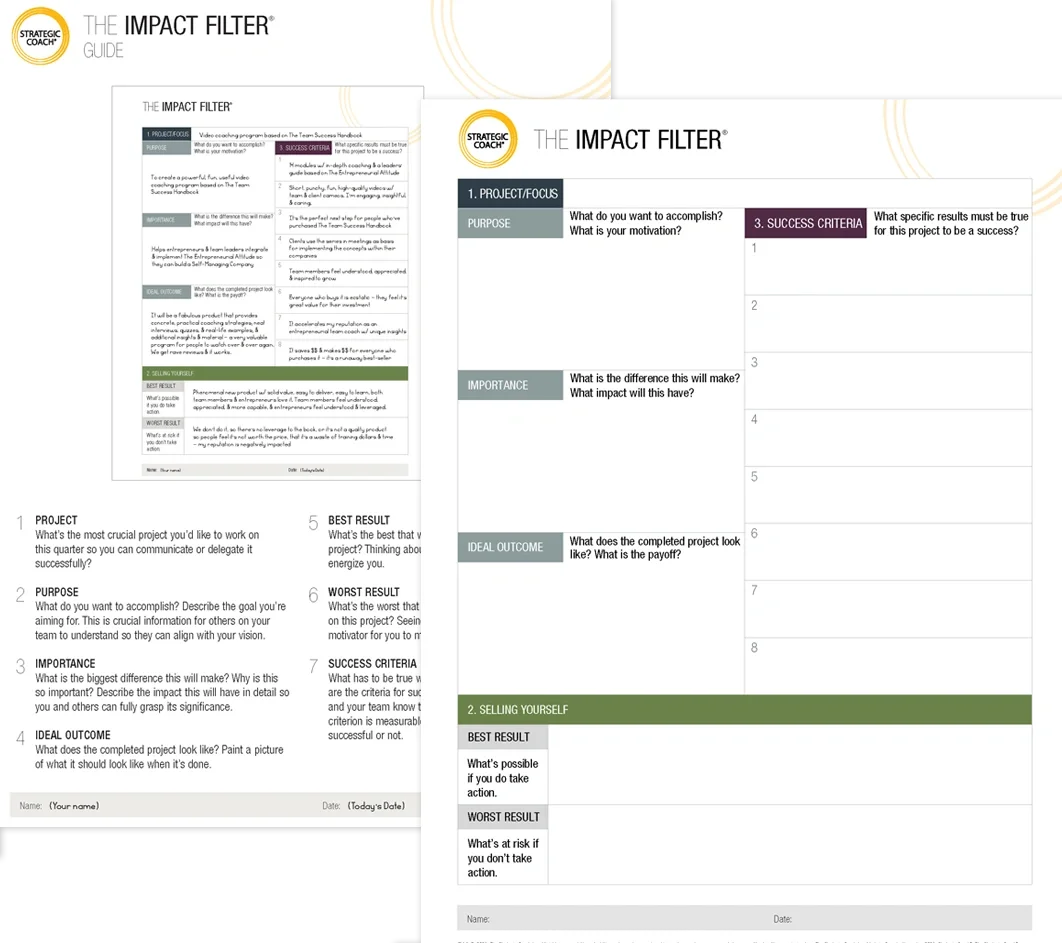
Steve Krein: The one thing I'll touch on, and it's early in this for a lot of folks, but the tools that we now have available, you know, I'm not a developer, but I now can create things a developer used to be needed for. So you can say what you want. You can say what you want. And I got to tell you, the capability stack that you now have as a CEO is so profoundly game-changing in terms of taking an idea all the way through. So you're not just concepting it, you're building it, and you can ship it, and you can sell it, and you can do all of the things that used to require a team. And what's interesting is the game of operator is gone. The idea that you share your vision, even in an Impact Filter, to a team who interprets it, and then the next team interprets it, and then the next thing, and by the time you get four or five steps past the original vision, it doesn't look like it used to look in your head.
Now, in some ways it's better because you had other inputs, but in other ways it's been either watered down or changed. And I'm really fascinated by the idea of the development of an individual who's capable of doing a lot more, removing some of the lost in translation steps in a method. And I started reading about Elon Musk and his factories. And one of the reasons why many of his companies are so successful, among many of the reasons, one of them is he got rid of everybody being in separate places involved in design and engineering and the factory floor where everybody can be a part of the process. And in some ways, AI has done that for the individual entrepreneur in the same way. I just don't need to have five different or even six different people involved in the development of something. And a prototype is no longer a piece of paper with some drawing on it or some words on it. You can actually build the prototype and build the working product.
Dan Sullivan: Yeah, it was very interesting. I had a podcast with Mike Koenigs, and that was last week. He had been to A360. We didn't go this year. We were in Buenos Aires. But Peter put out a new XPrize, and it's for showing a science fiction film. We did a podcast last week, and he showed me five movie ideas that he got, where he gave a three-minute tester of the movie. And he did all five of them strictly through AI. And they were all good. All five of them were really good, you know. They were complete animations. They were Pixar-quality animations. Three minutes for this one, three minutes for this one, three minutes for this one. He did it in 13 hours. You know what the total cost was?
Steve Krein: Probably a couple hundred dollars in tokens.
Dan Sullivan: Forty-eight.
Steve Krein: Forty-eight dollars?
Dan Sullivan: Yeah.
Steve Krein: Unbelievable. Well, I could talk for hours with you about this. What's your biggest insight from this session, Dan?
Dan Sullivan: The big thing is that our whole central tool for determining AI use for each individual is their Unique Ability.
Steve Krein: Yeah.
Dan Sullivan: I mean, what you want to do is to free everybody up from any activity except the full use of their Unique Ability. So I think we've got that as a really good cornerstone of now moving into this world.
Steve Krein: Well, mine is that teamwork is not just about human teamwork anymore. And so the AI team, the agents or the agentic team members to a team, make a big difference in the dynamic of what a team can put out. And the individual agency of each person using it is so amplified that I don't think a year or two from now, any of these organizations are going to look anything like the way they used to in terms of how they're built and how they're structured and the type of team members you need to be in concert with that is going to change.
Dan Sullivan: Yeah. Yeah. Great time. Yeah.
Steve Krein: Yeah. Great times.
Dan Sullivan: Great time to live.
Steve Krein: Yes.
Dan Sullivan: Yeah. All right. Excellent. I mean, it's the only time I've had to live. So as far as I know. Okay. Thanks a lot.
Related Content
The Impact Filter®
Dan Sullivan’s #1 Thinking Tool
Are you tired of feeling overwhelmed by your goals? The Impact Filter is a powerful planning tool that can help you find clarity and focus. It’s a thinking process that filters out everything except the impact you want to have, and it’s the same tool that Dan Sullivan uses in every meeting.