A Theatrical Approach To Building A Winning Team
November 16, 2026

Hosted By
 Dan Sullivan
 Jeffrey Madoff
Most companies hire to fill jobs. The best leaders cast to build greatness. Casting Not Hiring offers a new way to build a team that thrives together rather than a collection of people who simply function on their own. Order Casting Not Hiring now.
Show Notes:
The person you bring on board needs both the skills to do the work and the ability to be a good teammate.
You may already be casting rather than hiring without having a name for it.
A unique team needs people who bring their own strengths and make the team better.
There’s no business that the “casting, not hiring” approach doesn’t apply to.
The casting approach works well beyond theater, from medical practices to restaurants and financial services.
Every business has a front stage that customers experience and a backstage that helps make that experience possible.
Part one of Casting Not Hiring explores the thinking behind casting through examples from successful organizations in different fields, while part two turns those ideas into practical steps using and expanding on Dan’s thinking tools.
The 4 x 4 Casting Tool™ makes expectations clear from the start, including what success looks like and what could put the working relationship at risk.
Give candidates a clear picture of the role so they can spend less energy guessing what you want and more energy making a great contribution.
Resources:
Casting Not Hiring by Dan Sullivan and Jeffrey Madoff
Who Not How by Dan Sullivan with Dr. Benjamin Hardy
The Gap And The Gain by Dan Sullivan with Dr. Benjamin Hardy
The Greater Game by Dan Sullivan and John Bowen
Learn more about Jeffrey Madoff
Dan Sullivan and Strategic Coach®
Episode Transcript
Jeffrey Madoff: This is Jeffrey Madoff and welcome to our podcast called Anything And Everything with my partner, Dan Sullivan.
Dan Sullivan: One Sunday, we were just talking about the whole process of bringing new people into companies. And I'm phrasing it that way because there's a contrast that Jeff made, which I think was a very significant thing in the conversation. He said that most people hire, but he says, actually, what I do is that I cast. My way of going about bringing new people into a production, into a video production, into a theatrical production, is to cast people. In other words, you have an existing team that you're putting together and you're casting that the person that you're bringing on board not only has the technical skills and everything that's needed for them to make a particular contribution, but they would be a good teammate. I heard that and immediately I said, “That's a book.” Now, a little background—I'm very familiar with books and the title is 50 percent of the sale. And my sense is that a book that says Casting Not Hiring, at that point, I said, I think everybody will be interested in this. But what Jeff and I have found out since the very early days that not only are people interested, but they actually get it. They actually get what that's all about.
Jeffrey Madoff: Yeah, I think that you're right. You know, I thought that it was interesting because the book itself was a casting decision, you know, the two of us, the two different worlds, one production, one entrepreneurship and the coaching with that. And what did making this book teach you about casting that you now use with your own teams?
Dan Sullivan: Well, in the case of my company, which is Strategic Coach, I wasn't so clear about it just when we were having our conversation about Casting Not Hiring. But as we got into it and Jeff started interviewing really impactful people in the marketplace who had different kinds of organizations, and they all agreed that casting is the way that they have put their teams together inside their companies. It became very clear to me that at Strategic Coach, we've done that from the very beginning, because we have a central concept in Strategic Coach, which is called Unique Ability, and then Unique Ability Teamwork. So the whole thing is that we're looking for not standard skills, we're looking for a person who has an unusual feel on the first day that they come aboard of making a particular type of contribution.
Well, that's exactly what casting is. It's not a standard vending machine type of thing where you're getting a particular type of standardized part and you're putting it into a standardized process or standardized machine. It's a unique team and therefore it requires new people who have a unique contribution to make. And this can be tested for beforehand, but it can also be determined in auditions. And we have a five-step audition. You have to go through five steps, starting from the very first, that you're responding to some sort of communication from us and then now you're starting to be auditioned. You'll be brought in and there's a feel for this and there's first stage, you're checked off, you're passed on, and long before they ever get in touch with the person that they're actually going to be working with. So we're auditioning for the company, the company culture, we're auditioning for the team, we're auditioning for a particular role that they're going to play in direct relationship with an individual or with several individuals.
Jeffrey Madoff: Yeah, the notion of the Casting Not Hiring came from my background in doing so many shoots, working with actors and models, and how there is a collaborative team set up from the get-go. And it always made more sense to me to cast instead of hire because it encompassed a much wider range of ability and brought more to the team so that it's truly an example of the whole is greater than the sum of the parts. I think that's what good casting is. And so I think that that was quite interesting, because I think the main surprise I had, Dan, was like the conversation I had with my doctor when I was getting my physical.
And he said “Oh, Casting Not Hiring, that's the book you're writing?” And I said, “Yeah.” And he said, “Oh, I love that.” “You love it. All you heard is the title.” And he goes, “No, it's great because that's what I do.” And I said, “What do you mean that's what you do?” And he said, “I'm the bottom of the funnel for internal medicine in this region for Mount Sinai Hospital. It's a world-class health organization. And everybody's resume that lands on my desk, everyone who's being considered, they all went to the best medical schools. They all did residencies at the best hospitals. Many of them have published. So on paper, everybody looks good, but you have to go beyond the resume to see what kind of person it is and do they enhance the practice or are they somebody that, they may have all of the requisite skills and even be a star, but that star can really disrupt a good practice.” And that made me think, wow, this could apply to financial advisors, lawyers, accountants, there's no business that this doesn't really apply to. And I think that to me was beyond what I initially thought.
Dan Sullivan: Yeah. Yeah. And I think the other aspect, Jeff, is not just the back stage. So the theater aspect of what we're talking about here goes to the front stage. That your company is front stage to a public audience. And that the same principles that would make something great theater, a great performance, a great presentation, apply in every other business, not just theater business.
Jeffrey Madoff: Well, you know, one of the things that came up for both of us—I won't speak for you. I'll just say it for myself. I think we're bringing a book to market that is unique because part one are the case studies and philosophy behind it. Part two, which I wrote, is the implementation and the expanding on your tools that have helped make Strategic Coach more unique, if there's such a term as more unique, if you're unique or you're not.
Dan Sullivan: Uniquely unique.
Jeffrey Madoff: Uniquely unique, yes.
Dan Sullivan: Whiter than white.
Jeffrey Madoff: Yes. White's whiter and bright's brighter. I think that was tied, if I'm not mistaken.
Dan Sullivan: Yeah, P&J knew theater.
Jeffrey Madoff: And that gives us the opening to then do new and improved casting not hiring. But the book's got two names on the cover, your name and mine. And in the introduction, it's that we could not have done this book without the other. Actually, let's flip it. What do you think my unique contribution was? And I'll tell you what I think your unique contribution was.
Dan Sullivan: Well, I think, first of all, you're a connector with many different kinds of people, where I wouldn't say that that's my strong suit whatsoever. First of all, over the years, a lot of your theatrical productions have actually been interviews, documentary interviews. So you've done a lot of that. But I think you're just an all-around schmoozer. You just really, really love getting to know new people, finding out what they're doing. And one of the things that was required to deepen this book right off the bat was to show many, many examples of existing very, very successful organizations in very, very different fields that were actually casting, not hiring. They were actually doing auditions, not interviews, to bring new people on board, and their whole aim was to have theater-like impact in what they're doing, whether they're in the fashion business, in the restaurant business, in the design business, in the medical business. scientific field.
And so my sense is that you've got a half a century of firsthand interviews and conversations with a great number of people, and once we both became convinced that there was an instant read on this idea, it was possible to supply right up front many, many very, very powerful examples of entrepreneurs already doing this. Great social proof, as they would say. And you're a phenomenal interviewer. And that shows in what came out in the interviews when the people are quoted in the book. It is a result of really great questions. You are connecting the idea to their actual experience. And I think that that was terrific. Plus, you're a great writer.
Jeffrey Madoff: Well, thank you for the kind words. But I think what you brought to the party, which is so interesting, first of all, from just talking social proof, you know, your clients for the last, what, 47 years now or so?
Dan Sullivan: 52, close.
Jeffrey Madoff: You know entrepreneurs. You created a new type of business, coaching entrepreneurs. And by this time, you have built a very substantial, very respected business. What that enabled us to do from the germ of the idea was test it. You know, you and I did those interviews. I think those interviews ended up in one of your quarterly books. And all of that was testing the concept. Is there enough here for a book, is there enough here that's going to resonate with a wider audience? So you set up a laboratory, essentially, where you're able to get feedback on the kind of ideas that, if the ideas are any good, they're going to be good to your clients and good for your clients. So that gave us the ability to get a contract quickly with Hay House, because you've written for them before, you have an audience, but we were able to test these things.
So we've got the philosophical, we've got the case study business examples, then with your tool, The 4 x 4 in particular for this, but you reference others also that you do, that you brought a whole package a whole bundle of different talents that allowed us to look from many different perspectives between the two of us. And I think the decision to have a part one and a part two, and it all comes together, I think is unique. So I think that you brought things to this that were good. You yourself are also a very good writer and you've had books as bestsellers. But I think that more than anything to me, it was a unique, mutual contribution of ideas, and then those ideas because of your setup, we could test them out right away. We're not just throwing it out there. This has been in front of a number of entrepreneurs who are quite successful that, for both of us, have reinforced the value we think that we're putting out there, because it seems to resonate with these people. So I think it's an interesting 360 view we're bringing to this and to the readers.
Dan Sullivan: The Hay House thing was interesting, because I've gone through the process of submitting a new book idea to Hay House four times before this one. And, you know, it's back and forth for maybe a month. Where do you see this fitting? Where do you see the market is? The response on this one was three days. They came back with a complete conviction that this was of great interest to entrepreneurs, but the times that we're living in right now, technological times, where there's a great depersonalization going on in the marketplace, where things are becoming technological rather than personal, they felt that there's gonna be a thirst and a hunger for a book along these lines. So that was really great. You know, it's kind of frustrating, Jeff, we never got to explain really what the book was about, because everybody that we told the title to say, oh, oh yeah, I get it, I get it. And I don't know if we actually ever explained, you know, people say, well, that's interesting, what's it about? I don't think we ever got to answering that question. And it was fortunate because at that point, we didn't even know what it was about yet.
Jeffrey Madoff: It is interesting, I think, that the title at least made people think they knew what it was. That's all I care about. But the interesting thing is they weren't wrong.
Dan Sullivan: No.
Jeffrey Madoff: They kind of got it, which was quite interesting. You know, at one point you gave me your tool, the methodology, and, you know, I've been casting in one way, which is, you know, sitting with people, getting them to know off the resume and so on, but you had plotted out with The 4 x 4 a methodology to not only be able to envision this, but actually one of the four quadrants that I think is the most impactful if people really get into it is, I love the idea of you can have all the other qualifications, but if you're not on time, if you don't show up ready, you're not prepared, you don't do what you're gonna say, you're done.
Dan Sullivan: We're going to hire you. That is completely missing from, you know, I've been in the business world since the early seventies. You too. I think we're sort of equal in our time in the business world. I said, you know, the interesting thing is that when someone is hired, it's almost like there's information that's kept from them. And I think it is kept from them. I don't personally do a lot of hiring. I have a whole team. You know, I'm kind of a specialist in my own company that I come up with new entrepreneurial thinking tools. I come up with new workshops. I test the workshops. I'm the first person in. I come up with new books. I come up with a lot of new stuff. So I'm sort of specialized.
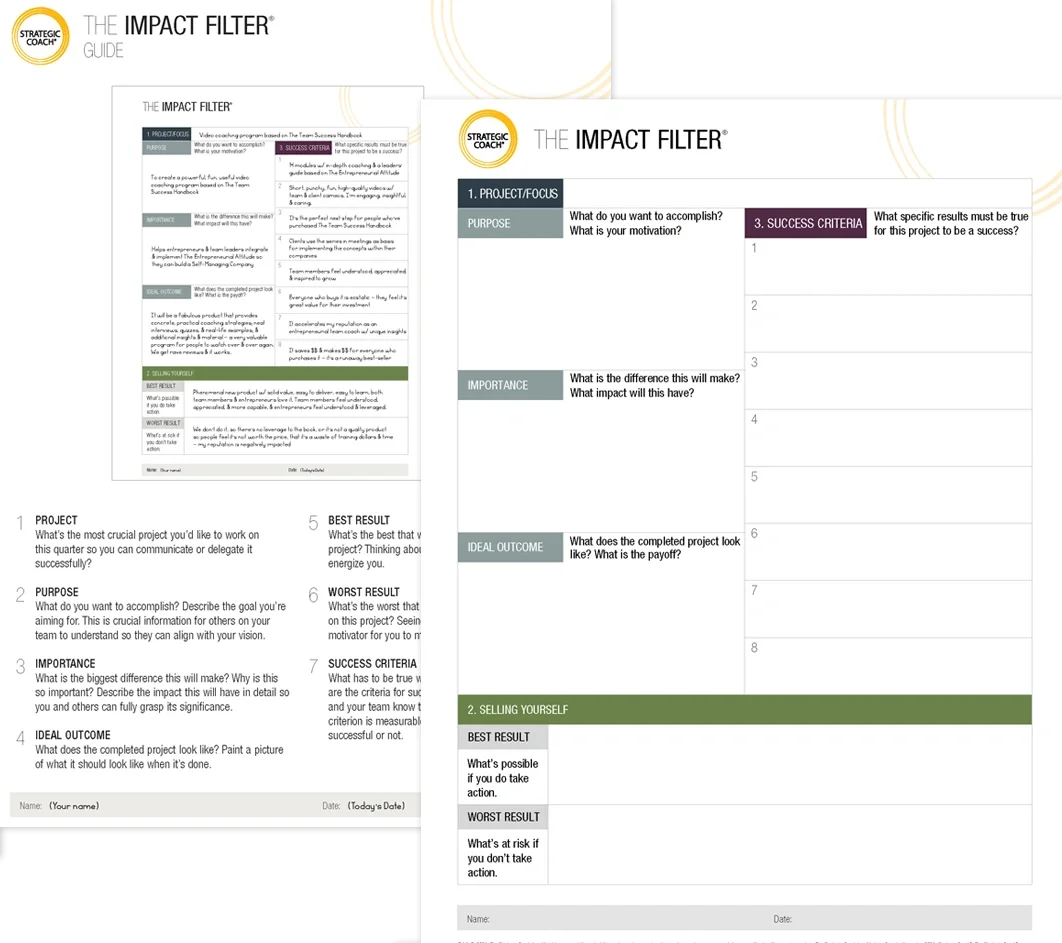
So a lot of the having new roles in my team actually comes from the inside. They're already inside the company and we hire from the inside before we hire from the outside. But in one case where I started something brand new, which was podcasting, I was rolling along for two or three years, creating dozens and dozens of podcasts, but it was creating a tremendous back stage mess. These weren't being logged in. They weren't being described. The marketing around them was very, very sloppy. Because I said, okay, I'll create a lot of podcasts. And I had a whole bunch of series. And it got to the point where it was getting very cluttered and very confusing. So I put together one of our other tools called an Impact Filter, which is, you know, a new podcast manager, describes, you know, why it was so important to have this podcast and what it looked like if the person came on board. This would be true. This would be true. This would be true. This would be true.
And we send it out as our job offer using the word job rather than role. Because, you know, when we go through the agencies, we have to go through a standardized process that the employment agencies use. And we immediately got three in particular who had experience that were familiar with podcasting, they were familiar with sound technician and everything that goes into producing a podcast. Now, I had created The 4 x 4 Tool about three months before this happened for an inside audition and creating a role inside. And it worked like a charm. It was dynamite. I mean, we saw a 60 percent increase in performance in one area that translated right into dollars. It was a big hit. So I said, we're going to do this for the podcast manager.
So at the last stage, after he had responded and he showed that he had actually listened to the podcast. He had tremendous radio experience. And the biggest casualty of the podcasting world has been standard radio. So he had 20 years in radio and he was smart enough to say, I've got to jump into another boat here. So I gave it to him and he came in and he said, “Wow, I just totally get what this is all about,” because I had shown him how he had to show up, what kind of attitude he had to have, and then specifically what kind of measurable progress he had to make. And then if he really wanted to be a hero to me, there were some projects he could take on. And if he drove me crazy for these four reasons, I would fire him. And I told him, you know, right up front. Before he met me, he already knew this information.
So my sense is there was nothing that was off the table that he didn't know. Everything that he could possibly know about coming on board was on that sheet of paper. I told him, I says, “Aside from what's written on the sheet of paper, there's nothing else. There's no secret expectations. There's nothing. Everything is stated on the sheet of paper, The 4 x 4.” So that's why, but it has now become standard procedure in our entire company to use The 4 x 4. And I would say at a minimum guess, there's about 200 of our Strategic Coach entrepreneurial companies that are using this as their onboarding structure and technique.
Jeffrey Madoff: Yeah, that missing information in most job situations is, and I will fire you if you do X, I think that that's really important because a lot of people don't know, they don't know what they did wrong, so to speak, or they don't know why they aren't the right fit. And you're kind of laying that out from the get-go for you. And I think that that's an important aspect for leadership is to know, what are your thresholds and what are those boundaries that when crossed are going to jeopardize the relationship?
Dan Sullivan: The interesting thing, and this got very, very clear as we were going through the book process, that I'm describing a relationship between one person and another person. I'm not describing a standardized job relation with a standardized company. I'm talking about a specific Unique Ability role to someone else who has a Unique Ability role. And these two roles have to be in agreement with each other, not just technically, but they have to be psychologically, emotionally, intellectually. We have to be in sync with each other right from the start.
Jeffrey Madoff: I was up to do this documentary about Weill Cornell Medical College. They were opening up a campus in what was called Education City in Qatar. And it was a very big deal. And I got a last-minute phone call asking me if I could meet with the people they had heard about me. They said, we want to be clear. We think we have our candidate. But we met someone who insisted that we meet with you. I just want to let you know that we're pretty far down the road in this process. Are you willing to meet knowing that?" And I said, “Yeah, I am.” So I went, met them, and it was about a two-hour meeting, and I got the job to do it. And when we were in Qatar, the woman who was in charge of all of this said, “Would you like to know why you were hired for this job?” I said, “Yeah, I'd love to know why.” “You were the only one that asked questions. Everyone was trying to sell us on their production capability, on what they've done in the past and all of that. You were trying to find out what we wanted. So that ended up having discussion after you left and thinking, he's the one that we want.”
It was a fascinating gig to get and I'm very happy I did. But I think that what I take away from that, and this is how I approach so many things, is so, what are the given circumstances in this world we're dealing in? It takes us back to acting and Stanislavski's method. So I wanna find out, what are the given circumstances? What are you looking for? I know that you went after Harvard first. Why didn't they do this? Because you were paying a lot of money, you know, to do it. So they liked the fact that I had background knowledge and a number of questions for them, which they felt through the nature of the questions that showed to them a certain insight that they thought was valuable. And then I ended up doing a sequel to that piece also a few years later when this first graduating class graduated. So I think that I was cast in that role based on my knowledge of the given circumstances and the questions I asked that tried to dive in all of that so that I could speak to the right issues and know what they were looking for. And I think one of the things that you do with your tools is focus the thinking. This will help you focus. This will help you think about your thinking.
Dan Sullivan: I think the big thing, my intention is to blueprint the new role and the new person in the role so good that it's successful. I want them to be successful. And my feeling is that the greater clarity they have, of exactly who I am and exactly what I'm trying to achieve gives them a lot of confidence that there aren't other issues that they don't know that they have to worry about. And that interferes with their attention on the actual work, the actual teamwork. But I was just thinking as you were talking about this, that that lack of clarity goes both ways, that oftentimes job applicants hold their cards close to the vest, too. They don't say anything about themselves, so that neither side is really asking questions. So they're working to rule.
There's a certain standard format, an employment format, that you have to check all the boxes. But as a bureaucratic and it's mostly government dictator, it doesn't really have anything to do with the business. And my sense is that the theater analogy is not only useful, but it's crucial, because no theater producer or theater director would ever hire someone just because they qualify as an actor or they qualify as a singer or they qualify as a musician or a dancer. It has to be just exactly the right person. It can't be just anybody. It's got to be someone who not only technically checks all the boxes, but is the kind of person that you want because you know that there's going to be better teamwork. So my sense is, it's not just a neat little trick that we're pulling off with this book and giving it a theater packaging. It's that theater itself is the structure that tells you that it has to be right in ten times more categories than a normal job interview.
Jeffrey Madoff: Something else happens too, which doesn't happen on a job in the same way, a regular job, so to speak. I was doing a holiday commercial. This was for a retailer. It was this family getting up Christmas morning and holding up the new sweater and, you know, that you can get and all that. Anyhow, initially, there were, I don't know, 150 people. We had to have a father, mother, and a boy and girl kids. By the time we had our third round of callbacks, it had gone from like 150 people down to 20. And I called everybody into the room before we started and said, “I want to tell you right up front, you all have the talent to do this job. Okay, so I don't want you to think, if you don't get it, what did I do wrong? You haven't done anything wrong, okay? Or he wouldn't be here now. But now the challenge for me is, I have to put to what the client will think is …” This could be a family. You know, they had to be around the right age, they had to somewhat look like they would be from the same family, and those were the given circumstances. “So I just want you to know that now that becomes a deciding factor. Who among you are the one father, one mother, one son, and one daughter that work together and it's a credible family for Christmas morning?” And what was fascinating to me was almost every actor came up to me afterwards saying, “I don't know if I'm going to get this or not, but nobody's ever laid that kind of thing out before. I appreciate you saying that.”
Dan Sullivan: Yeah. I mean, they're getting 10 percent of what would be incredibly useful information. You supply the other 90.
Jeffrey Madoff: Well, and I think that's another part of it. As you said earlier, it's a two-way street, and I don't think either side should hold back. But one of the things I would probably add into the quadrant that you did, things that drive me crazy, is if literally within the first five minutes of the interview, you want to know what the salary and benefits are. You know, wait a minute. You're getting way ahead of yourself right now, you know, because you haven't been made an offer. And that kind of thing, because I want people to be, even if they're faking it, interested in the job first, you know, and convince me that you have some interest in this. And I think that that's really important because, you know, we're all performing, if you will, from the moment we meet in that kind of a situation. And I feel for those people because you're walking to a cold room and you got to win them over quickly.
Dan Sullivan: The other thing, you told me that great story of a really terrific audition and putting the person in the role who explained to you that she had to start earning money really, really fast. And therefore, if this wasn't going to be fast, she had another offer that she was going to take. She was telling you the truth about her situation, which gave you a chance to change the rules for your situation. And only because she filled you in on what her situation was. It wouldn't have happened if she hadn't told you the truth about where she was.
Jeffrey Madoff: Well, that's right. Could she have been lying about that? I didn't have any sense that she was. And I knew that she was special. So I think that's another thing that speaks to leadership is, you need at times to be elastic about your rules and qualifications, because there are terrific people that you may miss if you don't take the time to explore.
Dan Sullivan: Yeah. Yeah. It's the difference between us and computers. We can change the rules. They can't.
Jeffrey Madoff: Yes. Yes. And nuance and judgment.
Dan Sullivan: Yeah.
Jeffrey Madoff: Intuition.
Dan Sullivan: Yeah.
Jeffrey Madoff: Intuition Yeah. So I'm looking here at Gord's questions. Hay House is a major publisher with a process, a supplemental PDF, an audio book, a whole production around the book. What did the larger production teach you about bringing an idea to an audience? Now, you've had experience with them. I really haven't, other than the meetings I've had, which were fortunately, according to you, kind of unusual in how frictionless those went.
Dan Sullivan: My first contact with Hay House was through a mutual friend, Joe Polish. Reed Tracy, who's the president of Hay House, was at one of the meetings of Genius Network, where I'm a member, and he was a guest speaker. We happened to arrive early, the two of us. We were the only ones in the room. And I went up and I introduced myself, and I said, “Hi, I'm Dan Sullivan.” He said, “I know who you are.” He says, “I understand you write books, but you don't use big publishers for them.” And I said, “Well, it isn't about the big publishers so much, it's how fast can I turn the book around, and I have about a 90-day attention span, so if I can't write and put the book out in 90 days, it's probably not going to get done.” And he said, “You know, we've been in business now about 30 years, and we started off—I wasn't the owner—it started off as a new age publisher, ‘80s, ‘90s sort of alternative culture kind of books.” But he said, “More and more, we believe that the growth of our market is going to be in the entrepreneurial world, that the number of entrepreneurial companies has grown exponentially, the number of people interested in entrepreneurship. And you have a big reputation in the entrepreneurial world.”
So that was it. And we just chatted back and forth. But there were two other individuals at this conference who knew me and knew what I was looking for the next jump for Strategic Coach. And long story short, within about 24 hours, a first deal was put together for our first book with someone who is essentially a book writing coach and someone who is a very accomplished writer. So it was a partnership writing, just as we have, Jeff, on this book. So that deal was put together, and then first book, very successful. Second book, very successful. Third book, very successful. Fourth book was just within 2026, so it's out there. It doesn't have the long run of the other three books.
But one thing that I've really discovered in this whole process is that we here at Coach create new books every quarter. So when I was 70 years old, I decided to write a new book every quarter. Very short book, about 44 pages of copy, cartoons, audio version, video version. So when we had our discussion about Casting Not Hiring, it was part of our system that I could just go back with my team and I said, “We have a new book. It's going to be called Casting Not Hiring.” And we have nine people on the writing team and we put it all together. And I think we had the outline back to you within about three or four days, and we had the small version of the book back in 90 days.
Then we were able to talk about our partnership together, and then we sent the book off, and if you want to sell a publisher on a big book, give them a completed little book. That's what I've taken from this experience, you know, because it shows them that you've got a handle on the idea, that you've got interesting structure and everything. It tells them a lot. Even though I have successful experience with them, I always approach it, this is a new project and let's approach it in the most theatrical way. Let's really show them what the impact of this book could be.
Jeffrey Madoff: I think that anybody putting money into anything, in this case a publisher, they're going to want to de-risk their investment as much as possible. So the more that you can show them of the strengths that you bring to the table, the more comfortable they feel about it. It's not just the idea, and it's not just how you present the idea. It's also, I think, incumbent when you're trying to sell anything is to be very clear how this answers needs that they have. And don't be so hypnotized by the sound of your own voice that you don't let them talk, because you're just selling, selling, selling, selling. I think that that was a gem to have the small book because we also use that to send out to the potential interview subject. So they had an idea of what it was. That's just, I think, preparing to close the deal.
Dan Sullivan: The big thing is, what seals the deal is that you've lowered the risk. That's in all situations, that's not just in publishing, is that you're showing such grasp of the subject and you're showing the organization of the subject and the packaging of the subject in such a way that the risk is very low.
Jeffrey Madoff: Did you, when we were going through this process and learning about, you know, when I was talking a lot about theater and Stanislavski method, et cetera, et cetera, even though you've looked at Strategic Coach as front stage and back stage, are there any things that you learned about a theatrical approach that either you recognized we're already doing that, that works for us, or something that you wanted to expand the offering because you felt that made a lot of sense as you came to understand that world more?
Dan Sullivan: Well, I think the big difference between part one and my experience in Strategic Coach, I would say, you know, we've coached 25,000 entrepreneurs, somewhere in the neighborhood. I think we're beyond 25,000 who have spent at least an average of three years with us in our program since 1989. But I would say they're probably 97 percent services businesses. They're not stuff businesses. And what I found valuable about your interviews is that they were with food. Food is a real thing. You know, food has incredibly tighter deadlines than probably any other situation besides ER. In other words, you've already had to invest in the food and it's got probably a 24-hour deadline. You've got to use this food within 24 hours or you're in a lost situation, wastage. And the other thing is that you can't sell last night's empty seats.
Jeffrey Madoff: Right. Be it at a play or an airplane. That's right.
Dan Sullivan: Yeah. And the margins aren't that high. I mean, everybody said they must be making a pile. You'd be surprised. Anything can affect it. So that was incredibly valuable to me. And then the designer, you know, the designer who did all of Ralph Lauren's, it was a service business, but he's producing real buildings, you know, inside decor. So it was very, very interesting to me to see that regardless of what the business is, there is a front stage and a back stage. There is an audience, and the audience has to be impressed. You know, the money doesn't flow until the audience is impressed. And the audience is your best ongoing marketing structure. It's who they tell after they've had a great experience that really determines whether you're going to be a success or not.
Jeffrey Madoff: Yeah, it's so interesting. I mean, I worked with Ralph Lauren for 36 years. He was a client. And what were his instincts? Like he was the first person to do advertorials. One of those slammed together words, there was advertisement with editorial. The main thing it was that for X amount of dollars, and it wasn't cheap; you could go to Vogue, buy eight pages of advertising, and it's like you inserted the Ralph Lauren lifestyle magazine into Vogue. And he was the first designer to do those kind of multi-page ads, and he's the only designer I can think of who so clearly, I'm talking about now in the fashion world, who created a world. And we go into how Alfredo Paredes, who was a creative director, we go into how that world is created. And it's really interesting. And with Ralph, his approach was unique. The movies was his muse, not for how the business was structured, but the whole front stage. And it did spill into how the business was structured because with Ralph, you had to look like you belong there. If you were into punk fashion and wanted to have 300 safety pins on your torn leather jacket, that's cool, but you wouldn't probably get hired there if you show up like that. You know, because he's casting. He was casting all the time.
Dan Sullivan: You know, it's 2026, and I'm in my eighties. And the moment you say Ralph Lauren, I think Gary Cooper and Cary Grant.
Jeffrey Madoff: Right, right.
Dan Sullivan: That's immediately what I think about. Yeah. Two of the most stylish actors since the movie business began.
Jeffrey Madoff: And that's right. And that brings so much borrowed credibility to a campaign. I mean, many of the ad campaigns was like the Kennedy's at Hyannis Port. Bruce Weber, who shot a number of those for Ralph, basically borrowed and stole from the best. And so you see these shots and it's like almost frame for frame when Ralph's walking along the beach with his wife. And then if you've ever seen the picture of John and Jackie Kennedy walking on the beach. And so he realized the power of iconic images. So he would cast the models who looked the part. So there wasn't anybody, and I don't think there is to this day, who so thoroughly created a world that a lot of the people initially just didn't get. They didn't understand. And when Ralph opened up his own flagship store in New York on 72nd and Madison, the big fear with Bloomingdale's and some of the major retailers, Bergdorf, Saks, at that time, was that's gonna cannibalize our business. And in fact, it helped the business, because it just that much more created that world. It was very good.
Dan Sullivan: I think 46th Street, the diamond dealers kind of know this principle.
Jeffrey Madoff: How so? How do you mean?
Dan Sullivan: You might not go to a diamond store if it was the only diamond store, but you would go to a diamond store if there were 20 other diamond stores right next to it. Yeah. I'm in a diamond buying mood.
Jeffrey Madoff: It all reminds me of that scene in Marathon Man with Laurence Olivier walking through. That was like an amazing scene in the movie. But yeah, I think that influences, you know, whether it's the influence of the movies, whether it's the influence if you're a chef of world cuisine, all of these things that you take inspiration and influences from that create not only a brand, but create an experience. And I think that now more than ever, people are hungry for experiences, because it seems more rare. And as we get more and more technologically isolated, I think that those special live experiences, and going back to risk, that whether it's a play or a concert or a sporting event, when something is live, there is risk infused in that enterprise, because something can go wrong, like when one of the dancers fell and couldn't continue. And I think that's just what makes things interesting when you just quite don't know.
Dan Sullivan: Well, I think the other thing is that live is using all the senses. I have long discussions with people in the medical field, and they talk about the brain being six pounds of matter that's in our skull. But I said, you know, the brain is the whole body, you know, and the more people can be in a situation where they have a spatial awareness, where something's going on, they have a social awareness, there's many other people with them, they have sound, they have sight, and everything. The more senses you can bring into an experience, the more fully engaged both the performers and the audience are going to be. And that's why I think live is going. We're being told that the entire world is basically just going to be a visual experience, that it's digital and all reality is going to be distilled down to digital information. It's not very satisfying. But my sense is not that this is a daily preoccupation on my part, but I do watch the figures for live entertainment that's going up. Movies are having a trouble spot, because movies can very easily be put on Netflix, and so movie theaters are not having such a great time, but theaters that are live performance are having a great time.
Jeffrey Madoff: Putting this book into the world, what are you most excited to hear back from people who use it?
Dan Sullivan: That it's a multi-level solution to multi-level problems they didn't know they had. In other words, it explains something why hiring has been a very, very chancy business for them; that first of all, we ask the entrepreneur, because I write for entrepreneurs, we're asking the person who owns the company and the team that are the leadership company that you apply The 4 x 4 Casting Tool to yourself before you use it to actually bring new people on board. But the other thing is read the interviews, and you have some really great ones with an actual theater director and say that, for the sake of your thinking, pretend that you're putting on a play. Pretend that you have an audience, because all businesses have audiences, and that you think about how much of your entire operation is for the front stage impact. And then how does the back stage has to be so that all the energies, the creativity, the best use of your money can be on the front stage impact? I think that's what they're going to say, and I think they're going to know how to start doing that right away.
Jeffrey Madoff: After putting this book into the world, one of my most excited to hear back is, oh yes, I bought this for everyone I've ever met in my life. And I think it's required life reading.
Dan Sullivan: And they should buy extra copies to give to all their friends too.
Jeffrey Madoff: That's correct. Yes, we can just start, it's sort of like a chain letter. And I think that it's been a treat because in the interviews I've conducted, the people that that has resonated with, you know, who own very successful businesses and recognize some of the things that they already do and it feels validating, but never have they seen it in this kind of a framework and structure that really kind of sparks enthusiasm, but they get it. And I think for me, to hear back from people who have read the book and said, yeah, we started using those techniques and I realized this wasn't just a philosophical, this is a practical work. Those principles have really worked for us. This book has been invaluable to us. That would be a great thing to hear.
Dan Sullivan: Yeah, the other thing, and it's more of a side issue than a main issue, but I think a lot of people in the theater world are actually gonna get a lot of insights out of this book. I mean, there are a lot of people who are good at what they do, but don't know why they're good at it.
Jeffrey Madoff: Just like I think that even businesses beyond entrepreneurs, or along with entrepreneurs, I think anyone who is involved in leadership, I think this could be something that could be very useful and helpful, because I think the positive impact on the business, which is less turnover, which is a big expense, both in money and time, I think this gives them a much more vibrant framework to work with. I mean, you don't have high turnover. I never had high turnover in my company. I think that says something.
Dan Sullivan: The interesting thing, I was reading The Wall Street Journal yesterday, and on their main review section, Saturday—Wall Street Journal is a very interesting paper—there was a graduate, electrical engineering, and he had failed with 2,300 job applications, 2,300 in a row. He hasn't been hired. And I said, I think he's approaching it the wrong way.
Jeffrey Madoff: What was your first hint, the first 500?
Dan Sullivan: I think by the third, you should be getting some messages. And I read this story, and he's demanding from the world that he get exactly hired what he studied for in college.
Jeffrey Madoff: Good luck with that.
Dan Sullivan: One of the recommendations that came to me when I was in the job market, and I had good job markets, you know, when I was growing up, that if there's someplace you'd really like, ask to do it for free for a couple months just to show what you can do and get to know what the business is. And people said, well, you know, why would you do that? And I said, it shows an interesting attitude that probably none of your competitors are going to show. But what it means is that you have to save enough money. You've got to get your finances in order before you do it, because you're not going to get paid for the two months. But go and be as useful as you can in any way that they appreciate over a two-month period, and I bet you have the job with no problem whatsoever.
Jeffrey Madoff: Well, I would tell my students who would be seeking internships, I said, don't look at this as an internship. Look at this as an opportunity and stepping stone because you can make yourself valuable enough that they're gonna wanna hire you. I mean, if they feel that in the 10 weeks, 12 weeks you work during the summer that, no, this person is smart, they're ambitious, they come prepared, you know, I think that you always have got to be ready for that audition, you know, that can help you move forward.
Dan Sullivan: But if you walked in the door and said, you know, I find this a really interesting company and I'd like to work here and I would like to take a risk, but I would like to do it for free for a couple months just to show that I can be really useful, but also that I'll find out a great deal about what you actually do. Seems to me like a different kind of approach, a more theatrical approach.
Jeffrey Madoff: Yeah, I think that that's a good idea, to have enough money that you don't have to take the first offer you get, regardless. Prepare yourself for a waiting time.
Dan Sullivan: Do some savings. It's a valuable lifetime skill. Yeah, I was in Boston at the marketplace where Faneuil Hall, it's a Revolutionary War landmark, and there was a mime, sort of like Marcel Marceau. And he had a huge crowd. There was about 200 or 300 people. He had just a terrific routine. And it went on for maybe a half hour. But in the last five minutes, he got everybody in the audience to do what he was doing. And so he put his arm like that, and everybody put their arm like that. And then he'd go like this, and they'd go like this. And then finally, he took his hand, and he reached out, and he picked out his billfold. And everybody reached out and picked up their billfold out of their purse or out of their pocket. And then he went in, and he pulled out a bill. And then he had two assistants, and they went around. And he got this huge applause. He turned there, giving him money as part of the act. And I thought that was really terrific theater. I said, that's really great theater.
Jeffrey Madoff: So, Gord's final question here, which I think is quite an interesting one, is if the two of us were to make another book, what would you most love to explore next?
Dan Sullivan: The book for me has to be success stories that came out of the first book. You know, 24 success stories from Casting Not Hiring. That's what I would do. I think it's a terrific topic. I think we have proof that there's an instant read from the public about what the book is and why it's a fascinating idea for them to do. But you had the hard part because you had to go out and show people who are already successful that there's a fundamental set of theater structures and processes that they're doing, but we're giving them a theatrical structure. So to see how they're actually using that and innovating with it—there'll be a lot of innovation. They won't do it exactly the way that we tell them, but they'll use it as a beginning structure to enter into that world. I think that would be a very fascinating book. And I think 24 is the right number. I think 25 is too many and 23 is a little bit too short.
Jeffrey Madoff: And what are those numbers referring to?
Dan Sullivan: Chapters.
Jeffrey Madoff: Oh, okay.
Dan Sullivan: 24 examples of people using casting and hiring.
Jeffrey Madoff: I think there's interesting opportunities that this can become a thing, like a brand where there could be interesting kinds of workshops, and this is what I used to do in my class, putting together people that you might not expect to have much in common, or they come from such different worlds. One of the classes that I did, I had an astronaut, actually a guy who I think had more hours in space than anybody, and he took these amazing pictures from outer space. And then I had this woman who, her book had come out, she is a renowned astronomer. So I said, look, I don't know what's gonna come of this conversation, but the fact that you're out there in outer space looking back at Earth, and you're at Earth looking out into the cosmos, I'm wondering how you view the world we live in, and what perspective do you have, your unique point of view and your unique point of view.
Actually, the most interesting thing to me was that it was, I don't remember the exact numbers, but the time that an astronomer spends looking through a telescope, which I thought would be all the time, is maybe two hours a month. I mean, it's not that much. But with having your laptop, you can be getting images that weren't possible to get years before. It was so interesting. But I think that the Casting Not Hiring, there's a lot of potential pinballing of ideas that can be beneficial for businesses to learn from and exercises that businesses could do that would really make this an ongoing way of looking at the world. And I think that could be very cool.
Dan Sullivan: Well, it's a book where I think the world is on our side, the way it's developing, because I think that there's enormous amount of pushback. Using technology to remove human beings or using technology to depersonalize human situations has gone as far as it's going to go. And I think there's a tremendous pushback, but a pushback without a solution. And I think we're providing the solution—a solution, not the solution, but a solution as it relates to the business world, especially the entrepreneurial world. And the other thing is corporations are always talking how they want to become more entrepreneurial. They can't do that unless they start bringing people on board in a different way.
Jeffrey Madoff: Yeah, it's interesting to me because I think that, you know, there are people that work at companies that they say, “Well, I'm an intrapreneur.” “So what's that?” They said, “Well, it's basically bring an entrepreneurial point of view to the business.” And I said, “So do you have full agency over what you do and are you taking the full impact of the risk?”
Dan Sullivan: Are you getting a cut of the action?
Jeffrey Madoff: Yeah. A dear friend of mine who's been extremely successful, he was the CEO of AMC Networks—I've mentioned him before, Josh Sapent. And he said, “Look, I showed up, I didn't have to worry about anything. There were already desks. There was a staff of people. We had a copier machine. I mean, when I walked into these companies, everything was already there.” And he said, “I don't do what you do.” And I said, “Well, I would happily trade bank accounts with you.” He said, “Yeah, you did this from nothing.” You know, that was very kind of him to say. And I think that the big thing that I think we're enabling people to do, and if a company is smart, they would empower people to do, is have more agency over their work.
Dan Sullivan: Yep, yep.
Jeffrey Madoff: And I think you get the best results from people. Of course, assuming that you are confident in your ability to do that, but the more agency you give people, and this worked with models that I worked with, with actors, but also with other companies, even in that Weill Cornell job, because of that interview and me getting the job, I had gained their trust to approach things in a way of more agency than somebody who they would just hire to bring in. And I think agency is also something that's becoming more and more important to people.
Dan Sullivan: Oh, yeah. Ownership of your experience. Yeah.
Jeffrey Madoff: Yeah. I have a sense that the wind is blowing in the right direction on this one.
Dan Sullivan: Well, see, it's a guess and a bet.
Jeffrey Madoff: That's true. By the way, that could be an interesting next book, too—Guesses And Bets. What are the guesses that seemed huge and paid off? What are the ones that seem huge and tanked? You know, and why? I was toying with this idea of The Museum of Bad Ideas. You know, things that didn't work for whatever reason that got tremendous hype. Yeah, and there were some that, NFTs, that was the name, correct?
Dan Sullivan: Yeah, NFTs, yeah, unfungible tokens, non-fungible tokens, NFTs. I didn't understand any of the three words. I couldn't understand them. Gone, that means it's not something fungible. Fungible, you know, is that kind of dealing with mold or something like that? And tokens, that's kind of a bus. You're doing mold removal work on a bus.
Jeffrey Madoff: Yeah, I think that's what it is.
Dan Sullivan: Yeah, I had a client and she got called by the Vatican. They wanted to turn things that the Vatican had into NFTs. A few at a time, you know, and they've had good decorators. Michelangelo is one of their decorators. He is not, you know, they've got warehouses and basements and everything all filled with stuff. She knew I was Catholic, and I said, “First of all, I think it's a bad idea on the part of the Vatican. And if I were you, I wouldn't have anything to do with them. But besides that, I think it's probably a good opportunity for you.” And I said, “They've been around a long time. They've got all sorts of tricks.” And I said, “I don't think it's appropriate for religion to be taking their artwork and things and turn them into fungibles. And one of them is that the biggest buyers of fungibles would get to meet the Pope.” And I said, “I don't think this is a good approach. I don't think this really works really well.” And then they died within six months after that, but it was bizarre.
It was like Charlie Munger, who was Warren Buffett's partner for so many years. He was talking about Bitcoin, cryptocurrency. And it was at the same time as Sam Bankman-Fried got exposed. And Charlie Munger said, what are cryptocurrencies? He says, well, here's the way you think about it. You live right next door to your neighbors for 40 years, and your lifestyles are really similar. Somebody buys a new washer, you buy a new washer. But it's not every month. It's sort of gradual over 40 years. Not too much change, too fast. And then one month, you just notice brand new car, the house is being painted, there's additions being put on. It's just total change. And so you just wander next door and you say, what are you doing? And he says, we've got this great new thing. We're selling gold-plated turds. He says, go play the turds. And he says, yeah, yeah. What are they worth? He says, well, it's not what they're worth is that they're so hot that no matter how much you pay for them, somebody else wants to pay more. That's how it works. And well, how does that work? Well, it just works. So you come home to your wife and you say, you know what they're doing? We gotta start selling these gold-painted turds. We gotta do that. And he says, that's the basic understanding of what cryptocurrency is. That's gold-painted turds.
Jeffrey Madoff: Yeah. I know who you were talking about in terms of doing this stuff with the Vatican. And I'm thinking, first of all, like you, bad idea. The second of all, why would the Vatican choose to basically do a very high-priced souvenir shop of things that are held dear or the iconography of the Vatican in history? I mean, nothing about it made any sense to me.
Dan Sullivan: But you had the honor of an interview with her.
Jeffrey Madoff: Yeah, I don't know that I was interviewing. I guess she wanted to meet me and she was certainly nice enough. But, you know, it's one of those things, you hear the idea and I'm thinking, okay, I don't get this at all. I mean, not even a little bit. I won't go into the humor that I could come up with based on that, but …
Dan Sullivan: Yeah, I told her, “Do all the people you're talking to seem to be Italian?” And she said, “Yes.” And I said, “Do you know an organization called the Mafia in Italy?” And she said, “Yeah, they're the same people.”
Jeffrey Madoff: Thanks for joining us today on our show, Anything And Everything. If you enjoyed it, please share it with a friend. For more about me and my work, visit acreativecareer.com and madoffproductions.com. To learn more about Dan and Strategic Coach, visit strategiccoach.com.
Related Content


The Impact Filter®
Dan Sullivan’s #1 Thinking Tool
Are you tired of feeling overwhelmed by your goals? The Impact Filter is a powerful planning tool that can help you find clarity and focus. It’s a thinking process that filters out everything except the impact you want to have, and it’s the same tool that Dan Sullivan uses in every meeting.