The High Price You’ll Pay For Creative Isolation
November 25, 2025

Hosted By
 Dan Sullivan
 Shannon Waller
Isolation is more than just uncomfortable—it distorts your thinking and drains your creativity. In this episode, Dan Sullivan and Shannon Waller open up about the risks of going it alone as an entrepreneur and why strong relationships make all the difference. Listen now to learn smart, actionable ways to reconnect, recharge, and keep yourself moving forward with clarity and confidence.
Here’s some of what you’ll learn in this episode:
- Why isolation causes the mind to invent stories and distort reality.
- The reasons entrepreneurs are particularly vulnerable to feeling isolated.
- Why isolated entrepreneurs develop outrageous aspirations.
- What makes Strategic Coach® the perfect place for entrepreneurs to make long-lasting connections.
Show Notes:
Being an entrepreneur can be a lonely path, especially without external feedback.
When there’s no outside input, your mind starts making things up.
Isolation causes your brain to respond just like it would to sensory deprivation.
Entrepreneurs thrive on constant change, while most people resist change.
An entrepreneur’s creative imagination needs to be rewarded with real opportunities.
Many entrepreneurs feel truly stimulated only when they’re working productively.
Isolated entrepreneurs use their imaginations to give themselves the sense that they're actually connected to the world.
Feeling misunderstood quickly morphs into paranoia and makes isolation worse.
Entrepreneurs are better than most at finding their own clarity, even in tough situations.
The entrepreneurial journey means creating brand-new ideas and selling them, time after time.
Seeing life from other people’s perspectives keeps you connected and tuned in to reality.
The more you understand and appreciate other people’s experiences, the richer and more meaningful your own life becomes.
Resources:
Always Be The Buyer by Dan Sullivan
Episode Transcript
Shannon Waller: Hi, Shannon Waller here and welcome to Inside Strategic Coach with Dan Sullivan. Dan, you say things that really capture my attention and my imagination. And one of those things that you said recently was that people who are isolated hallucinate. Oh, that will be an interesting conversation. So I'd love to know what you mean by that and how people get isolated. And then we'll talk obviously about how they can solve that. But I find that really interesting that people who are isolated start to hallucinate. So tell me more.
Dan Sullivan: I've actually thought about this a great deal. One is because I grew up on a farm in Ohio in the 1940s and 1950s. I'm a fifth child in a family of seven, but I have four older. There's a big gap between me and the next generation, next oldest brother, and then I have an even bigger gap between two other brothers. So they weren't my playmates. I didn't really play with my older siblings and my younger brothers. And in the area where the farm was, there were no other children my age, so I didn't really have any playmates until first grade. And then we had to drive six miles to get to the school. So it was a trip in a car at the beginning of the day and a trip back. So you didn't hang out after school with other kids, you know, you had to be there.
So what happened, I'm a social, you know, I'm a schmoozer. I like talking and, you know, I like hanging out. I like talking. And I learned at a very young age to talk to adults. And for some reason or another, I found that if you were a child who asked interesting questions, adults would really respond in a great way. And one of the questions I came up with was when you were my age, I would say to an older person, when you were my age, what was going on in the world? And they would tell me, you know, I found that very, very interesting.
So I had not been isolated in my childhood to a certain extent. And I talked to my mom and dad about their, you know, growing up, not as my parents, but as, you know, they were both born in 1910, so they were 34 when I was born. And so I would ask them what was going on in the 1910s, the 1920s, 1930s. So I was always filled up, you know, with a lot of social interaction, a lot of stimulation and everything like that. And as a result of that, other people describe that I feel very isolated. I don't have any anybody to talk to. I've never actually experienced that. But I've been very, very keenly interested in why it happens.
What is it that puts a person in a situation where they feel isolated and they're not interacting and getting stimulated by conversation? But what I've noticed is that when people do get isolated, they start making up stuff to explain their situation. And it's lacking in proof, and it's lacking in being able to check it out. And that's what I would call hallucinating. Now, I've actually had the physical experience of that because there used to be things called, they're probably still around, but it's been a long time since I've had the experience, they're called flotation tanks.
Shannon Waller: They're still around?
Dan Sullivan: Yeah, flotation tanks. It's a tank that you go in. It's got water, but it's saline water. It's got a lot of salt in it, there's no sound, there's no light, you're in the float tank, and your body just isn't getting a lot of external stimulation, nothing's coming in, and your mind goes really, really crazy. Your mind kind of goes weird. You start thinking all sorts of things. Not a great deal of it, but I have a certain amount of being claustrophobic, so I don't find it a really comfortable experience. I've been a great reader of novels that involve spies versus spies, that type of thing, espionage and corruption. I'm very attracted to those stories. And one way of torturing people is to drug them in such a way that they go to sleep and then they wake up and they're in a completely rubberized suit that covers their entire body. They're cut off from all feeling and they're in a flotation tank like the one that I experienced. Their eyes are covered and there's absolutely no sound and they go completely crazy. They just go crazy. They're taken out and they're asked questions and they don't … they say, okay, you're going to go back into the tank. And it's such a negative feeling that they'll break.
So it's very, very interesting. It's not like torture where you're doing harm to people, you're just taking away all their sensory information. And my sense is there's a relationship between when people feel socially isolated and when they are sensory deprived, that people who are socially or feel socially isolated, that they're responding in the same way that someone who's being tortured in that way actually does. The mind has to think about something, and since there's no external input, the mind makes up stuff to respond to. What it makes up has no relationship to what's actually going on in the world around them.
Shannon Waller: I completely agree. And it is actually a psychological tactic used by sociopaths and narcissists to isolate people from their communities, from their people, so that they can then put their ideas in your mind. I've read those stories. I've not read one with a deprivation tank. That's a new one. That's an innovative torture right there. But it's interesting, Dan, and fortunately we're not in the espionage world, but we do see people who get isolated, which are entrepreneurs, we've seen some team members. So let's talk about that and how it applies to entrepreneurs, because in another recent podcast, you talked about, you know, being an entrepreneur can be lonesome, because you're off on your own, your ambition is separate from other people, sometimes you can't talk about it. So how do you see this with entrepreneurs? I'm really curious.
Dan Sullivan: Well, one is where they live. They're an ambitious person and they're living among people who aren't ambitious, okay? They thrive on continual change, but the people around them resist any kind of change. I mean, it's boring to them, first of all. So consequently, the only stimulation they have is when they're actually working. But they're restricted in what they can work on because they're not dealing with adventuresome consumers. And the family, their family that they come out of, no one's got really any ambition beyond to continue on in the conditions that they were born. The other thing is that because they can't work smart, in other words, constantly coming up with new ideas that have customers and they have new ways of incoming, they're very, very restricted in the kinds of activity they can do to get paid.
But they have a busy mind. They have a busy imagination. And since they're creative, imagination is not being rewarded with opportunities and it's not being continually rewarded with income. They start making up stuff to feel that they're okay, but they're making it up. And what I notice is they start becoming outrageous in their aspirations. And what I mean by that is that instead of just creating a new project that in a very short period of time has good cash flow to it, they start wanting to change the industry or save the world or everything like that because their imagination has become bigger and bigger to give them the sense that they're actually connected to the world that they are. And then they have a belief that nobody understands them, so they then proceed to come up with ideas where nobody understands them.
Shannon Waller: A self-fulfilling prophecy, yes.
Dan Sullivan: Yeah, the brain just wants to work on something, you know, but they get isolated. Then they become a bit paranoid because that sense of not being understood can be very quickly enlarged to people are out to get me. People are out to stop me. And then it turns really negative and they become paranoid. Okay. There's always competition of some sort in the marketplace, but that's just other people trying to be successful at their business. But for the isolated entrepreneur is that people are out to get them. People are out to frustrate them. And that's pure hallucination.
Shannon Waller: Because it's really not that personal.
Dan Sullivan: People are just doing what they're doing, you know. I said, it's kind of like it's a rainy day and you're standing too close to the curb and there's a big puddle and a car coming by splashes you and you're angry that they did this purposely. And I said, no, they were just late. They didn't even know you were there. Next time, when it's raining, back up to the storefront so that you don't get splashed. It's that interpretation of what's happened to you as if it's personal. It's not personal. It's just, you know, you got to watch yourself. You got to size up the situation that you're in. But I think a lot of hallucination just comes from is that you're not grasping what you're uniquely good at. And the other thing is that you're comparing yourself to other people. The other thing is you're doing everything yourself.
Shannon Waller: Right.
Dan Sullivan: The other thing is you're working harder and longer to achieve the same result. You don't have any break from the way that you're going about your business. You're not really taking rejuvenating time. You're not eating properly. You're not sleeping properly. All those will get you to a point where you become delusional.
Shannon Waller: If I can add one to that, Dan, you don't have anyone else like you to talk to.
Shannon Waller: Right?
Shannon Waller: So there's no one else. And you are actually, because you are so, you know, paranoid, you don't invite that in either, because you might think they're up to take something or steal something or what have you. So you're completely lacking in community or a relationship with someone who can reflect back some reality to you. So you're socially isolated. I would add that to the list. That's very true. So what's the path through? What's the way out of this? What's the solution, the remedy to entrepreneurs being isolated?
Dan Sullivan: Well, I don't know the answer to that because I've gone in just the opposite direction in my life, in the sense that I'm deeply connected, not only from a business standpoint, but I'm deeply connected with really powerful friends. I grew up in a big family and I kind of got the handle on the value of being in a big family. Even if they didn't pay attention to me, I paid attention to them. You know, I'm a number five child. Babs is a number four child. Babs and I are together. We're deeply connected. Babs and I, you know, we have friends, you know, you and Bruce are lifetime friends and everything like that. So I always make sure I'm deeply connected. And then I create layers and layers and layers of teamwork around me inside the company and then collaborations with other entrepreneurs. I have this sense that I'm really dealing with reality of relationship, reality of measurable results and everything like that. So the chances of me actually meeting that isolated person are reduced. For the most part, I just don't meet isolated people, but I'm very, very conscious of what happens to someone when they feel isolated.
Shannon Waller: Dan, this actually ties back to our value creation model, which starts with leadership, which is providing direction where people are confused, and then relationship, which is providing confidence where people are feeling isolated. This is something that's been in our framework for a very long time. And then finally, creativity, which is providing capabilities where people are feeling powerless. They don't know what to do. So it's interesting to me what you have created. It's really fun thinking about this as a big family type structure, which is what Coach very much is, but it's an entrepreneurial community where people are very connected. You know, just walked out of where I am right now and people are sitting down for their small group discussions and I got a hug from a fellow team member. There's this sense of community where people can be unabashedly ambitious and there's no isolation. You are connected, and you've always been so tuned in. And you've told me this, because I'm the eldest child of two, so I have a very different framework. And it's like, no, it's not good when people are isolated. You'll pick it out. You'll identify it. You'll bring them in. So it's always something you've been very aware of. So to me, it's really fun to be able to do a deeper dive into this today. But Coach is very much about creating a community where people never have to feel isolated.
Dan Sullivan: Yeah.
Shannon Waller: Relationship is there.
Dan Sullivan: Yeah. And the interesting thing is that I'm not going that I'm feeling what the isolated person is feeling. I'm just observing what their behavior is. I don't know what's going on in their minds, but just observing their behavior, something's off. The way they're behaving is, over the years, I've really watched out for this, that if you have an isolated person, nothing good is going to happen. You have to get them connected. So my attitude isn't so much on a feeling level, it's just a clear recognition that nothing good can happen. If this person gets isolated, nothing good is going to come out of that situation. You have to arrange things differently so that the person feels connected or the person leaves, you know, the person leaves because an isolated person will cause trouble, you know, and you can't have that kind of trouble happening. You know, I'm not trying to transform them. I'm just trying to protect the environment.
Shannon Waller: It's interesting, Dan, because well, you're right, we actually don't run into a ton of isolated entrepreneurs, but I'm sure they're hopefully listening to our messaging and getting the word out so they realize they're not alone. But it can happen within companies, it can happen within families even, where people do get isolated. And so I think really that focus on, doesn't have to be from a feeling standpoint, which I think is, it's a strategic approach is what you're talking, is that nothing good can happen when someone is isolated. They will start making up things in not a good way. It's not healthy for anyone, including the environment. So make that connection, pay attention. And it's interesting, because we have so many incredibly capable people in our company, and the teamwork, in some cases, I'm not going to say it's automatic, but it feels really easy. Sometimes I'm a little conscious or wondering, could I take that for granted? And I need to make sure that I connect with people, that they don't get isolated, again, because it's not healthy for anyone if that happens.
Dan Sullivan: Yeah, and you brought up before about things that are happening in the world. I'm very deeply interested in politics. My mother was very interested in it, and I caught the bug, if you will, from her. I've always been very, very interested in history and everything else. So what I strive to do is to see how the situation, world affairs today compares to other situations. So I have a sense of not being too influenced by what's happening today, because it's 80% like it's happened sometime else where I've read about it. And that gives me sort of a sense, you know, the world isn't ending. Civilization is not collapsing. It's just that, it's like calm days at sea, it's stormy days at sea, you know. Each of them is going to end and become the other fairly quickly.
But there are people who don't know history, and they listen to the wrong messages, and they start feeling terribly scared about you know, what's going to happen to the world, what's going to happen to, you know, the economy, what's going to happen to my job and everything like that. And that'll isolate them. They get isolated. People can get isolated about almost anything. What the isolated person hasn't learned how to do is to supply their own clarity, supply their own confidence. But entrepreneurs are better at this than people who are not entrepreneurs.
Shannon Waller: Yeah. Why is that, Dan?
Dan Sullivan: Because they've always had to make up something new and sell it.
Shannon Waller: Yeah, that's a great point.
Dan Sullivan: Yeah.
Shannon Waller: It's interesting, Dan, there's a degree of non-isolation or connectedness because in order to create value in the marketplace, you have to be paying attention to your marketplace.
Dan Sullivan: Well, you have to see things from other people's point of view. And that keeps you connected. Seeing things from other people's point of view keeps you connected. So it's an interesting thing, but we're in a period of time right now—and again, that's partially because of the technology that people are using to connect with each other. For example, from my own standpoint, I was born and conscious before there was television. So television has never had that big an impact on me. I grew up with radio and, you know, there were programs on radio that were like fictional programs and you had to use your imagination to fill in the video. Very early I read and I read all sorts of books and in reading you have to create the visuals, you know, you have to take the words and create them into visuals. So I've always been really, really good at that for me, so that movies never had a big impact on me.
Now, once you get into computers, I'm really very, very picky about what I'm interested in there. I'm not influenced by it. I stopped watching television altogether in 2018. I haven't seen any television whatsoever. I like YouTube. You can be very selective about what you're watching. A lot of historical things or podcasts with really interesting people talking, never been on social media. I have to swear if it was to save my life, I wouldn't know how to get on social media or receive it. You know what I mean?
Shannon Waller: You have social media, you're just not on social media.
Dan Sullivan: Yes. people have taken things that I've said and put them out on social media. Yes, this is true. This is true. And I hope they're doing a good job. So you've got to be discerning about what you're allowing to come into your brain. So I have a lot of filters. I have a lot of sensors. It's not easy to get ahold of me. If you want to get ahold of me, there's a series of other relationships and levels of scrutiny before you can get in touch with me. But this is all designed consciously because I don't have any responsibility to make myself available to the world except for my own purposes.
Shannon Waller: It's interesting, Dan, you put some sample copy on the board just to echo this. It's like you are always the buyer.
Dan Sullivan: Yeah.
Shannon Waller: Right. You choose who comes into your life, personally, professionally, what have you, you are always the one deciding, not trying to sell yourself to somebody else, which is a very powerful standpoint. If someone wants to take action on what we've been talking about today in terms of people who are isolated hallucinate and how to, if people are looking at themselves, they're looking at the people around them. What are some action steps that people can take to prevent isolation, prevent hallucination, could be team, family, world? What are your thoughts on how to take action on this?
Dan Sullivan: Well, learn how to ask really great questions, for one thing. What I mean is get interested in how other people are experiencing life, okay. When you ask them a question and they say something, resist the urge to say something back, and then you ask them another question. If you can ask five questions in a row, you'll begin to see that the solution is to get out of your own world and start exploring other people's world, okay? That takes practice. I mean, it's like doing exercise. It's hard the first day. It's a lot easier on the fifth day. And the more that you can appreciate the reality of other people's life, the more your own life becomes meaningful.
Shannon Waller: That's beautiful, Dan. Thank you. I appreciate that. Start exploring other people's worlds.
Dan Sullivan: Yeah.
Shannon Waller: Yeah.
Dan Sullivan: What a great automatically connects you because you're approaching them in such a way that they're benefiting from your interest.
Shannon Waller: And very clearly how to make a connection.
Dan Sullivan: Yeah, I'm really interested in how other people live their lives. I'm fascinated with especially entrepreneurs. I'm just fascinated with how this new entrepreneur that I'm meeting actually became an entrepreneur, what they experience, where the big breakthroughs are. You know, I can talk for hours with other entrepreneurs about their experience. I find it stimulating. I find it very instructive and everything like that. So I don't think there's any better way to un-isolate yourself than doing that.
Shannon Waller: Yeah, simply be interested, ask five questions, and start exploring other people's worlds. Fantastic. Dan, thank you so much. Wise as always.
Dan Sullivan: Thank you.
Related Content



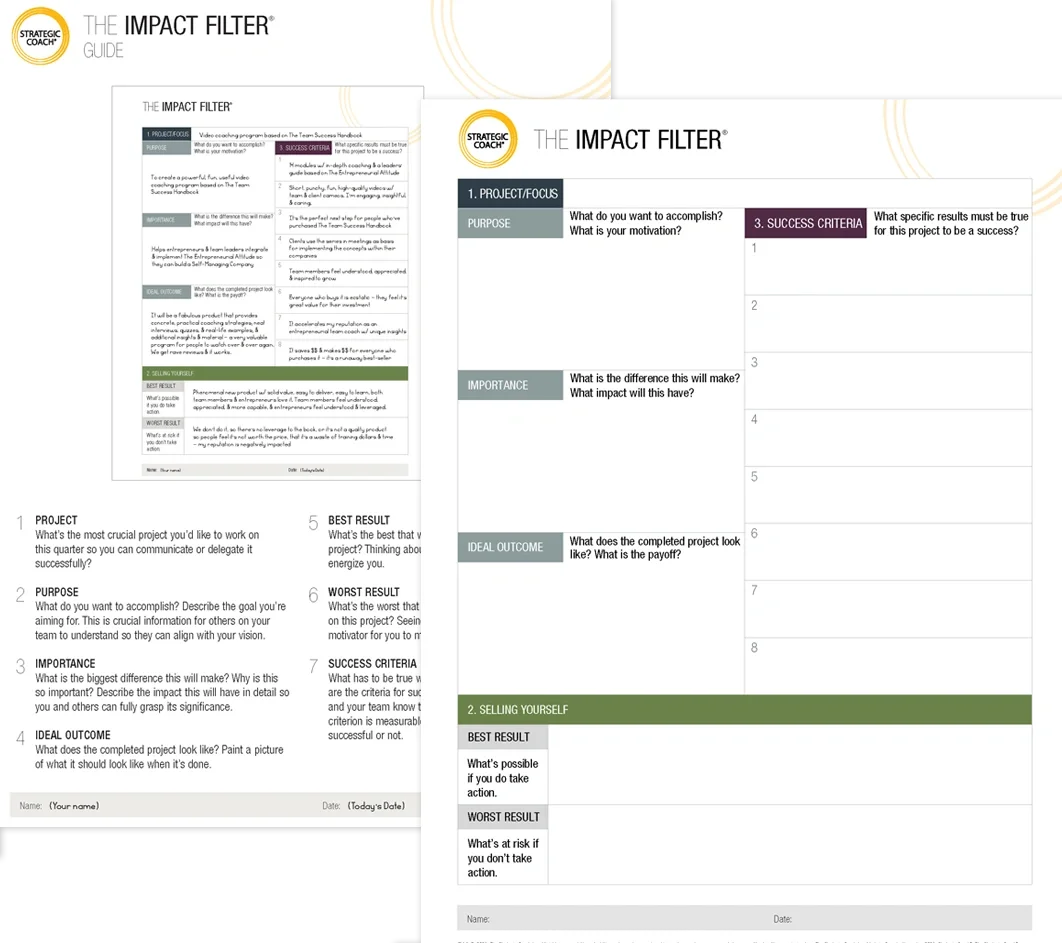
The Impact Filter®
Dan Sullivan’s #1 Thinking Tool
Are you tired of feeling overwhelmed by your goals? The Impact Filter is a powerful planning tool that can help you find clarity and focus. It’s a thinking process that filters out everything except the impact you want to have, and it’s the same tool that Dan Sullivan uses in every meeting.